

On this page
Oxidizing an alcohol increases the number of bonds between carbon and oxygen while reducing carbon-hydrogen bonds. The carbon atom carrying the hydroxyl (-OH) group is known as the carbinol carbon. Transforming this single bond into a carbonyl group (C=O) requires removing two atoms: the acidic hydrogen on oxygen and an alpha-hydrogen bonded directly to the carbinol carbon. Because this process removes molecular hydrogen overall, the NCERT Class 12 Chemistry textbook describes it as oxidative dehydrogenation.
Primary alcohols have two alpha-hydrogens, oxidizing first to aldehydes and then to carboxylic acids. Secondary alcohols carry one alpha-hydrogen, oxidizing cleanly to ketones. Both transformations depend on having a hydrogen atom bonded to the carbinol carbon, as discussed in oxidation and reduction in organic chemistry.
What happens during the oxidation of an alcohol?
In standard laboratory oxidation using hexavalent chromium reagents—such as potassium dichromate in dilute sulphuric acid or pyridinium chlorochromate (PCC)—the reaction begins with esterification. The lone pair on alcohol oxygen attacks the chromium centre, shedding water to form an alkyl chromate ester.
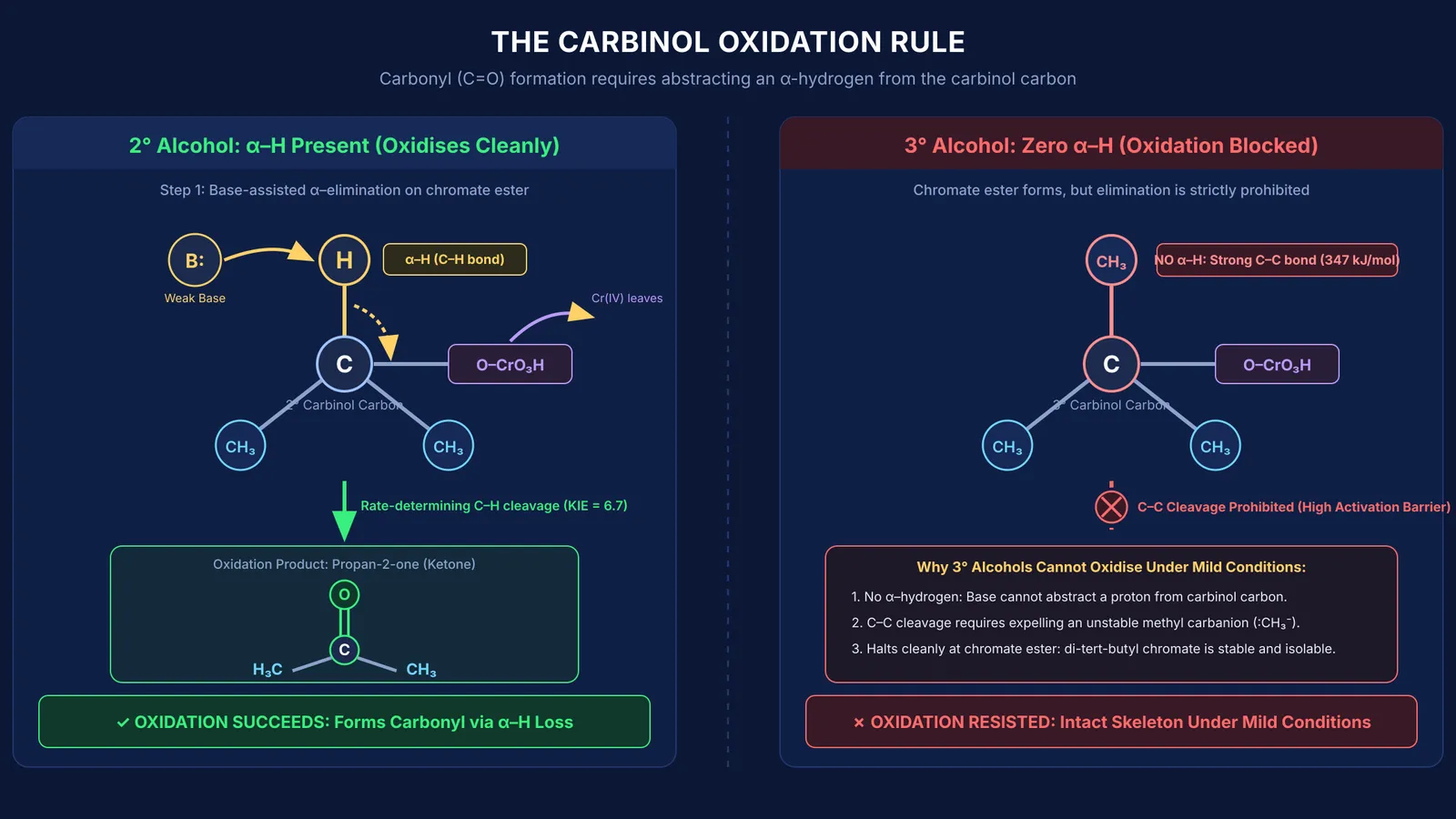
Once this ester forms, a weak base in solution attacks the hydrogen on the carbinol carbon. In a concerted elimination step, the base abstracts the alpha-proton, electrons from the C–H bond swing inward to generate the C=O pi bond, and the reduced chromium species departs. Because this step removes the alpha-hydrogen to establish the double bond, any alcohol that lacks this specific hydrogen cannot complete the sequence.
Why do tertiary alcohols fail to oxidise with mild reagents?
In a tertiary alcohol such as 2-methylpropan-2-ol (tert-butyl alcohol), the central carbinol carbon is bonded to three alkyl groups and carries zero alpha-hydrogens. When exposed to mild oxidants—including acidified potassium dichromate, PCC, or Jones reagent at room temperature—the molecule remains untouched.
To form a carbon-oxygen double bond without an alpha-hydrogen, the molecule would have to cleave a carbon-carbon sigma bond instead. In an elimination-type oxidation mechanism, breaking a C–C bond requires expelling an alkyl group as an unstable carbanion, such as a methyl carbanion (CH₃⁻). Because carbanions are exceptionally high-energy, poor leaving groups, this heterolytic pathway has an insurmountable activation energy barrier under mild reaction conditions.
The stability of tertiary alcohol intermediates was demonstrated by Fillmore Freeman in the Encyclopedia of Reagents for Organic Synthesis. Mixing chromium trioxide with tert-butyl alcohol produces an ester intermediate, di-tert-butyl chromate, [(CH₃)₃CO]₂CrO₂. In primary and secondary alcohols, chromate esters decompose rapidly by losing an alpha-hydrogen. In tert-butyl chromate, the absence of an alpha-hydrogen halts reaction at the ester stage. The compound is so stable that chemists isolate and store it as a selective oxidising reagent for other molecules.
How does Westheimer's mechanism prove the role of alpha hydrogen?
Experimental proof that alpha-hydrogen removal governs oxidation came in 1949 through physical organic chemistry. In the Journal of the American Chemical Society, Frank H. Westheimer and Nicholas Nicolaides measured the chromic acid oxidation rate of ordinary 2-propanol compared to its deuterated analogue, 2-deutero-2-propanol. Replacing the alpha-hydrogen with deuterium slowed the oxidation rate by a factor of 6.7 at 25 °C.
As Westheimer reviewed in Chemical Reviews, this large primary kinetic isotope effect proved that breaking the carbinol C–H bond is the rate-determining step. First, the alcohol and chromic acid rapidly establish an equilibrium to form the chromate ester. Next, a base abstracts the alpha-proton in the slow, rate-determining elimination step, creating the carbonyl double bond. In a tertiary alcohol, the initial ester forms, but the rate-determining elimination cannot occur without an alpha-hydrogen.
The Fermi Concept Library covers every concept in chemistry with its own lesson and its place in the map, showing how bond polarities and activation barriers dictate which reaction pathways remain accessible.
What happens when tertiary alcohols are forced to react under harsh conditions?
While mild reagents leave tertiary alcohols untouched, forcing conditions cause reaction by dehydration rather than direct oxidation. Under hot, concentrated acidic conditions, tertiary alcohols lose water via an alkyloxonium ion to form a stable tertiary carbocation, following the mechanism explained in dehydration of alcohols and carbocation shifts.
The resulting alkene then undergoes oxidative cleavage by vigorous reagents like hot acidified potassium permanganate (KMnO₄), cleaving the carbon skeleton into smaller carboxylic acids and ketones. Similarly, when alcohol vapours pass over heated copper at 573 K (300 °C), NCERT Class 12 Chemistry records that primary alcohols dehydrogenate to aldehydes and secondary alcohols to ketones, while tertiary alcohols undergo catalytic dehydration to alkenes, converting 2-methylpropan-2-ol into 2-methylpropene.
How can you predict alcohol oxidation outcomes on exam day?
In competitive exams like JEE Main and NEET-UG, examiners test this distinction with multi-step conversion problems. Remembering carbinol structure prevents mistaking one isomer for another among the structural isomers of C4H10O.
Use this four-step diagnostic routine when examining an unknown alcohol:
Identify the carbinol carbon: Locate the carbon bonded to the -OH group and count adjacent alkyl groups to classify it as primary, secondary, or tertiary.
Count alpha-hydrogens: Check whether any hydrogen is bonded directly to the carbinol carbon. If the count is zero, the substrate is a tertiary alcohol.
Check the reagent: With mild oxidants like PCC or room-temperature Jones reagent, mark no reaction because the carbinol C–C bonds remain intact.
Check for harsh conditions: If heated with concentrated acid or heated copper, predict elimination to an alkene rather than direct carbonyl oxidation.
The Fermi Problem Library has worked problems with a step-by-step solver that explains the reasoning rather than printing an answer, helping students work through multi-step conversions systematically.


