

On this page
In a spinning rod or ring, inner material pulls outer material round its circle; that pull is the tension. JEE Main asked exactly this in its 12 April 2019 (Shift 1) paper: a uniform rod rotating in a horizontal plane about one end, and which graph shows the tension T(x) at distance x from the axis (question and solution on Cracku).
How do you find the tension in a rotating rod at a distance x from the axis?
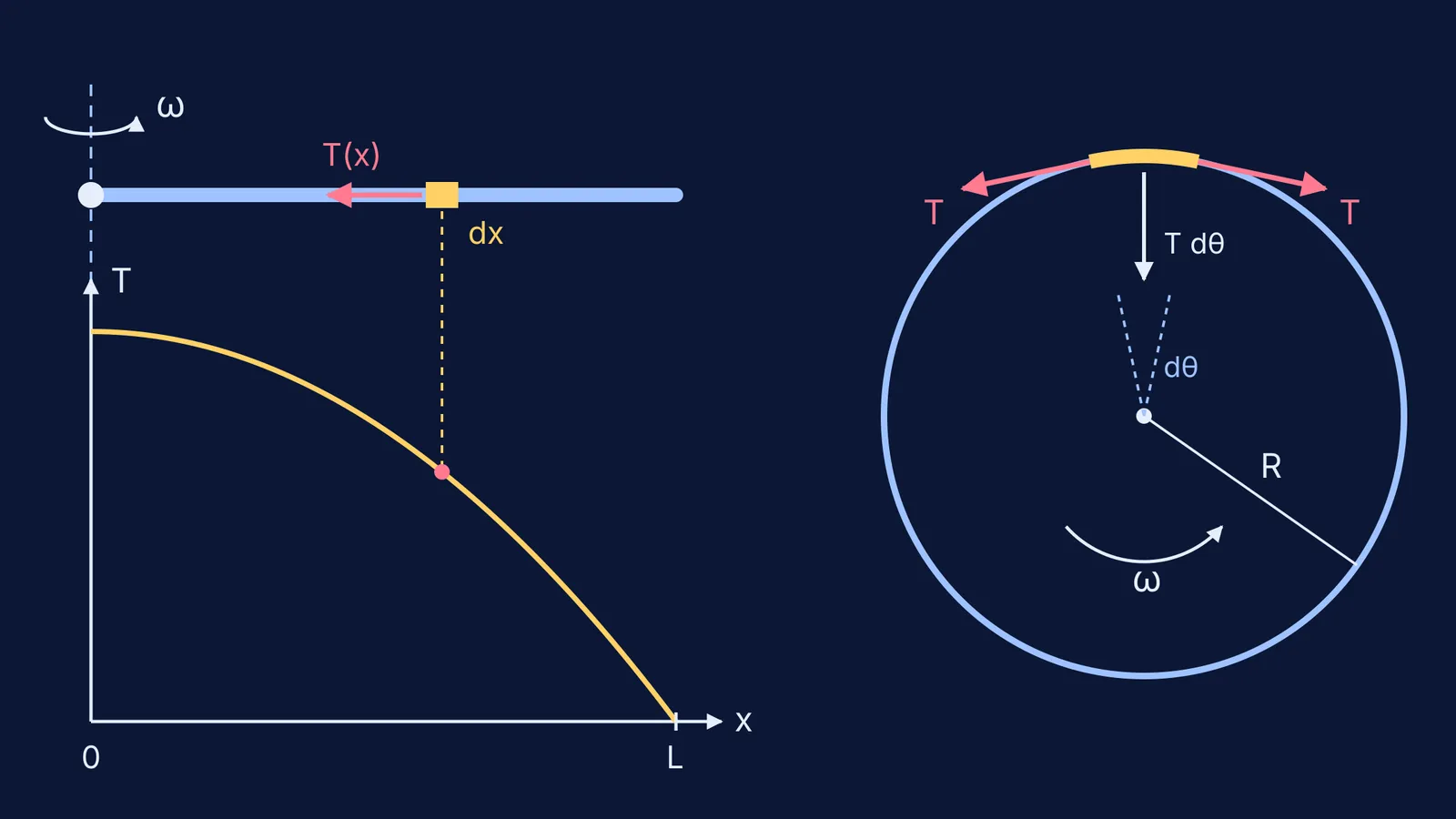
Take a uniform rod of mass m and length L spinning at ω in a horizontal plane about a vertical axis through one end.
Pick an element of length dx at distance x from the axis. Its mass is dm = (m/L) dx.
Its inner face is pulled towards the axis with T(x). Its outer face is pulled outwards with T(x + dx). The difference must be the centripetal force: T(x) − T(x + dx) = dm ω² x.
So dT/dx = −(m/L) ω² x. Tension falls as you move outwards.
Nothing lies beyond the free end, so T(L) = 0.
Integrate from x to L: T(x) = mω²(L² − x²)/(2L).
This is the downward-opening parabola of the 2019 JEE Main solution: mω²L/2 at the axis, zero at the free end.
Quick check: T(x) is the centripetal force on everything outside x, which has mass m(L − x)/L and its centre at (L + x)/2, so T(x) = [m(L − x)/L] ω² (L + x)/2, the same answer in one line.
Worked example: the rod
Take m = 2 kg, L = 1 m and ω = 10 rad/s.
At the axis: T(0) = ½ × 2 × 100 × 1 = 100 N.
At the midpoint: T(0.5) = (2 × 100 / 2) × (1 − 0.25) = 75 N.
If the rod snaps at 400 N, it snaps at the axis first: ½mω²L = 400 gives ω = 20 rad/s.
What is the tension in a ring rotating about its centre?
Now take a thin ring of mass m and radius R spinning at ω about its central axis. By symmetry T is the same all the way round.
Cut an element subtending a small angle dθ at the centre. Its mass is dm = (m/2π) dθ.
Tension T acts at each end, along the tangent. The two pulls are not quite opposite; their components towards the centre add to 2T sin(dθ/2), which is T dθ for small dθ.
That inward pull supplies the centripetal force: T dθ = (m/2π) dθ × ω²R.
So T = mω²R/(2π).
Example: a 0.5 kg ring of radius 0.2 m at 20 rad/s has T = 0.5 × 400 × 0.2 / (2π) ≈ 6.4 N.
For why circular motion needs a net inward force, see circular motion and banking problems; the same cut-a-piece idea for a hanging rope is in tension in a heavy rope.
At what speed does a spinning ring break?
Divide the ring's tension by its cross-sectional area A. Writing m = ρ(2πR)A gives a stress σ = ρω²R² = ρv², where v = ωR is the rim speed. The Engineering ToolBox gives the same thin-ring result, σ = ω²ρr² (Engineering ToolBox, stress in rotating rings).
A spinning rotor shatters when the hoop stress inside it exceeds the ultimate tensile strength of its material (Wikipedia, Flywheel). Setting σ equal to the material's tensile strength gives the breaking rim speed, v = √(σ/ρ).
The radius drops out: a small ring and a large one of the same material break at the same rim speed.
Try it with figures from the Engineering ToolBox flywheel table: maraging steel has density 8000 kg/m³ and a typical design stress of 900 MPa (Engineering ToolBox). Then v = √(900 × 10⁶ / 8000) ≈ 335 m/s. For a ring of radius 0.5 m, that is ω ≈ 671 rad/s, about 6,400 revolutions per minute. As 900 MPa is a design figure, not a breaking strength, this is a design-limit speed, not a bursting speed.
Which mistakes cost marks in these questions?
Using the mass of the whole rod instead of the part beyond x.
Putting the centripetal force at the end of the outer piece instead of at its centre of mass, (L + x)/2.
Forgetting that both ends of a ring element pull.
Squaring the rpm figure before converting it to rad/s (multiply by 2π/60 first, then square).
The same setup returns in the EMF induced in a rotating rod.
If a step in your working does not match, the Fermi Problem Library has worked problems with a step-by-step solver that explains the reasoning rather than printing an answer. To see why the ring element's two tensions add up to an inward pull, the Fermi Concept Library gives each mechanics concept its own lesson.


