

On this page
Textbook ropes are usually massless, so they carry the same tension everywhere. Give the rod mass and make it accelerate, and that stops being true: every part has to drag the part behind it, so the internal force depends on where you look. One idea answers three questions: the tension at a point, how it varies, and how much the rod stretches.
What is the tension at a point in a rod pulled by a force?
OpenStax defines tension as "a pulling force that acts along a stretched flexible connector, such as a rope or cable" (OpenStax University Physics, 5.6). In a pulled rod, it is the force one part exerts on the next across an imaginary cut.
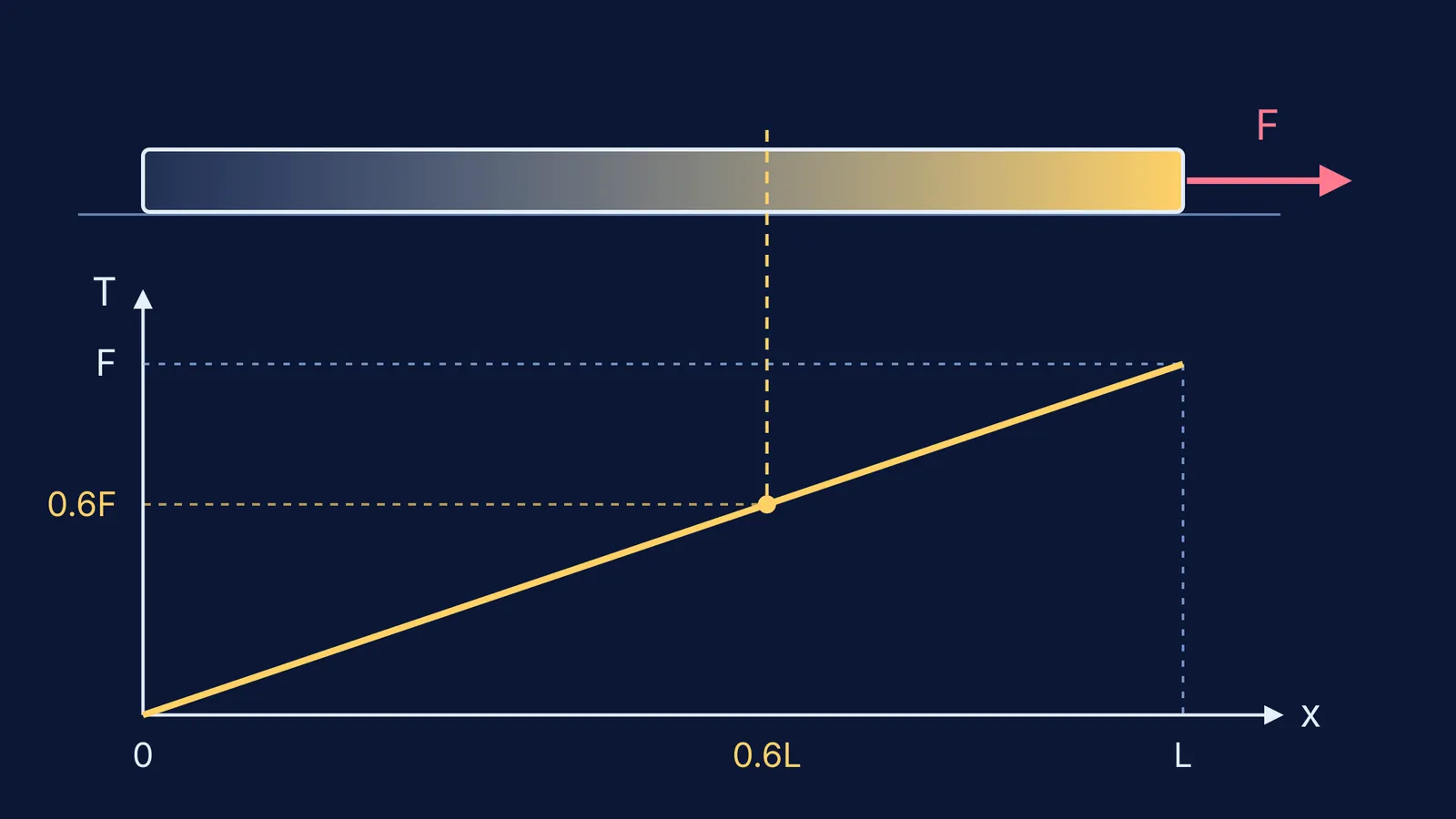
Take a uniform rod of mass M and length L on a frictionless floor, pulled at its front end by F. The whole rod accelerates at a = F/M. Measure x from the rear (free) end.
In a uniform rod pulled by a single force F on a smooth surface, the tension at distance x from the free end is T = Fx/L.
It is zero at the free end, F/2 at the middle and F at the pulled end: a straight line through the origin.
How do you find tension with the cut-and-look-behind method?
Newton's second law uses only external forces, and internal forces never appear on a free-body diagram (OpenStax University Physics, 6.1). To make tension show up, cut the rod and treat one piece as your system.
Find the acceleration of the whole rod: a = (net external force)/M.
Cut the rod at the point you care about.
Pick the piece with fewer forces on it, usually the piece behind the cut.
The only horizontal force on that piece is T at the cut, so T = (mass of that piece) × a.
For a uniform rod, a piece of length x has mass Mx/L, so T = (Mx/L)(F/M) = Fx/L.
Worked example: a steel rod pulled at one end
A steel rod of length 2 m, mass 4 kg and cross-section 1 cm² lies on a smooth floor. You pull one end with 1000 N. Apply Newton's second law (OpenStax University Physics, 6.1).
Acceleration: a = 1000/4 = 250 m/s².
Tension 0.5 m from the free end: 1 kg is behind the cut, so T = 1 × 250 = 250 N.
Tension at the middle: 2 kg is behind the cut, so T = 500 N.
The common mistake is writing T = 1000 N everywhere, as if the rod were a massless string; that holds only at the pulled end.
How much does an accelerating rod stretch?
Young's modulus is tensile stress divided by tensile strain, Y = (F/A)/(ΔL/L₀) (OpenStax University Physics, 12.3). Here the tension varies along the rod, so add up the stretch of small pieces: a piece dx at position x carries Fx/L and stretches by (Fx/L)dx/(AY).
The elongation of a uniform rod accelerated by a force F at one end is ΔL = FL/(2AY), half the stretch under a uniform tension F.
OpenStax lists Young's modulus for steel as 2.0 × 10¹¹ Pa (OpenStax University Physics, 12.3). For our rod, ΔL = (1000 × 2)/(2 × 10⁻⁴ × 2.0 × 10¹¹) = 5 × 10⁻⁵ m, or 0.05 mm.
The same integration appears in why a hanging rod stretches under its own weight. For stress, strain and Y from scratch, see our guide to elasticity and Young's modulus.
What if forces act at both ends, or it is a chain of blocks?
If F₁ pulls the front and a smaller F₂ pulls the back the other way, the cut method still works. The piece behind the cut feels T forward and F₂ backward, so T − F₂ = (Mx/L)a with a = (F₁ − F₂)/M. That gives T = F₂ + (F₁ − F₂)x/L, and the stretch becomes (F₁ + F₂)L/(2AY).
A chain of blocks joined by light strings is the same problem with the mass in lumps (OpenStax University Physics, 6.1). Take blocks of 2 kg, 3 kg and 5 kg in a line on a smooth floor, pulled by 50 N at the 5 kg block, so a = 50/10 = 5 m/s². The string between the 5 kg and 3 kg blocks drags 5 kg behind it, so T = 25 N. The string between the 3 kg and 2 kg blocks drags only 2 kg, so T = 10 N. For the pushing version, see how to find the contact force between blocks pushed together.
If you keep landing on the wrong number, try similar problems in the Fermi Problem Library, where the step-by-step solver explains the reasoning rather than printing an answer. If Young's modulus still feels shaky, the Fermi Concept Library gives it its own lesson.
Next time a rod, rope or train of blocks is being pulled: cut it, look behind the cut, multiply mass by acceleration.


