

On this page
In mathematics, a combination is a selection of items from a set such that the order of selection does not matter, as defined by Wikipedia. Combinatorics gives us the tools to count groups without listing them out. For example, a poker hand of five cards drawn from a 52-card deck yields 2,598,960 possible combinations. But in exams like JEE Main, you are rarely asked for straight combinations. Instead, you are given constraints: a certain player must be in the team, another is injured and must be out, or two players refuse to play together.
If you are struggling to set up these equations for permutations and combinations, the Fermi Problem Library has worked problems with a step-by-step solver that explains the reasoning rather than printing an answer.
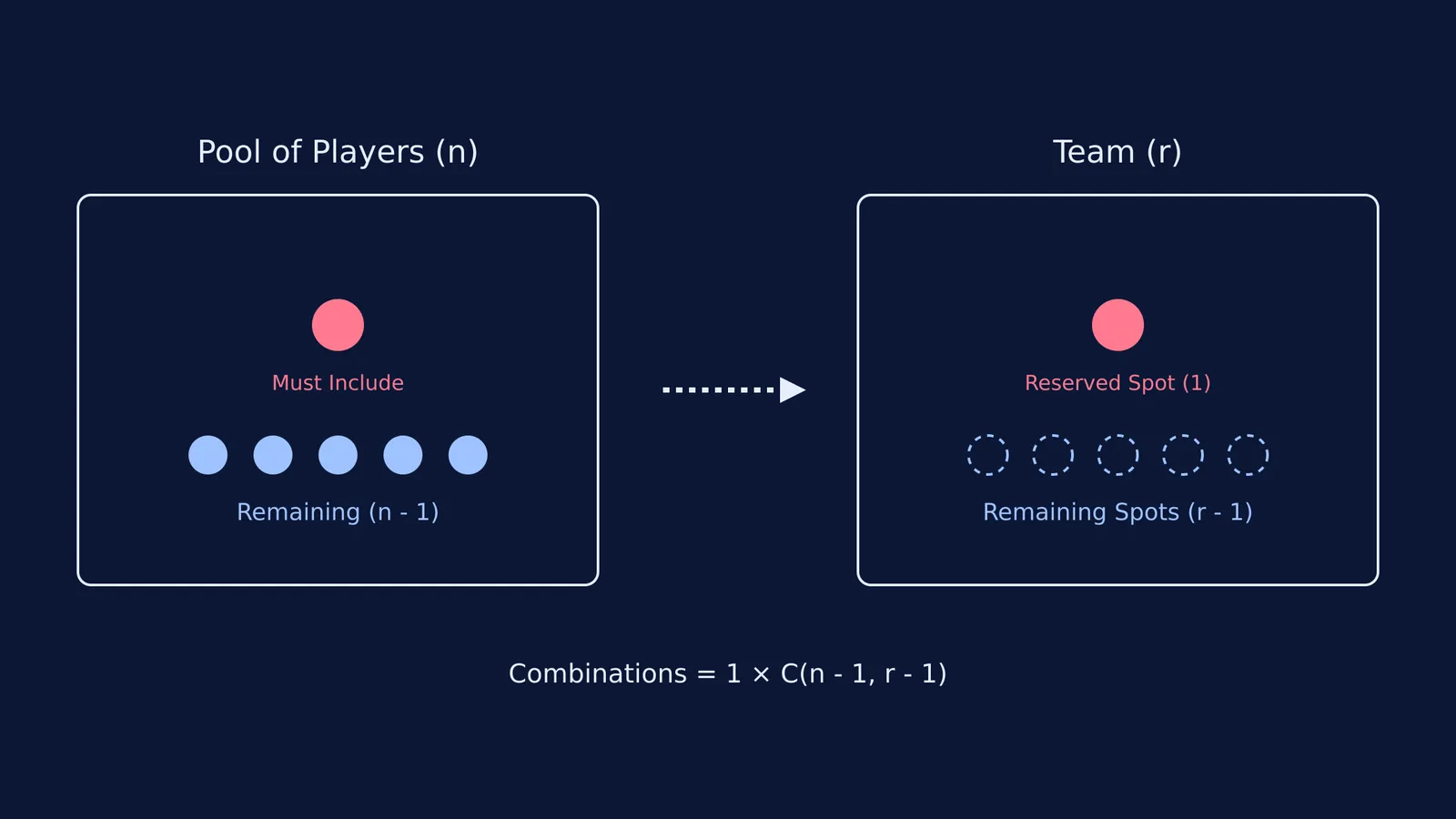
How many ways to select a team that includes a particular player?
Suppose you need to select a team of r players from a squad of n players. The captain (a particular player) must always be in the team.
Since the captain takes up one of the spots, you now only need to fill the remaining r − 1 spots. You cannot pick the captain again, so you choose from the remaining n − 1 players in the squad. The number of combinations is exactly C(n − 1, r − 1).
Example: Selecting a cricket team of 11 from a squad of 15, where Virat must be included.
The remaining spots = 11 − 1 = 10.
The remaining players = 15 − 1 = 14.
Total ways = C(14, 10).
How do you calculate combinations when a player is excluded?
Now consider the opposite case. One player is injured and cannot play.
You still need a full team of r players, but the available pool has shrunk by one. You must select all r players from the remaining n − 1 healthy players. The number of combinations is C(n − 1, r).
Example: Selecting a team of 11 from 15, but one fast bowler is ruled out.
The spots to fill = 11.
The available players = 15 − 1 = 14.
Total ways = C(14, 11).
Notice what happens if you add the two scenarios together: C(n − 1, r − 1) + C(n − 1, r). This gives you the total ways to select a team of r from n, which is C(n, r). This is a well-known mathematical identity called Pascal's rule, noted on Wikipedia, which states C(n, r) = C(n − 1, r − 1) + C(n − 1, r).
What if two players refuse to play together?
This is a classic trap question. Two players, A and B, refuse to be on the same team. You must find the number of ways to form a team of r players from n players such that A and B are never together.
You can solve this by counting the total possible teams and subtracting the teams that break the rule.
Total teams without restrictions: C(n, r).
Teams where both A and B play: If both A and B are forced into the team, they take up 2 spots. You fill the remaining r − 2 spots from the remaining n − 2 players. That is C(n − 2, r − 2) ways.
Valid teams: Subtract the unwanted teams from the total. Total ways = C(n, r) − C(n − 2, r − 2).
Alternatively, you can build the valid teams by adding the three acceptable, non-overlapping cases:
Neither A nor B plays: C(n − 2, r)
A plays, but B does not: C(n − 2, r − 1)
B plays, but A does not: C(n − 2, r − 1)
Adding these gives C(n − 2, r) + 2 × C(n − 2, r − 1).
If you want to practice more constraints, read about at least one, at most two: selection problems with combinations. It is also helpful to review how drawing items changes when you compare with and without replacement. And if identical items are involved, arranging letters with repeats uses a different approach entirely.


