

On this page
How does Bernoulli's principle apply to a syringe?
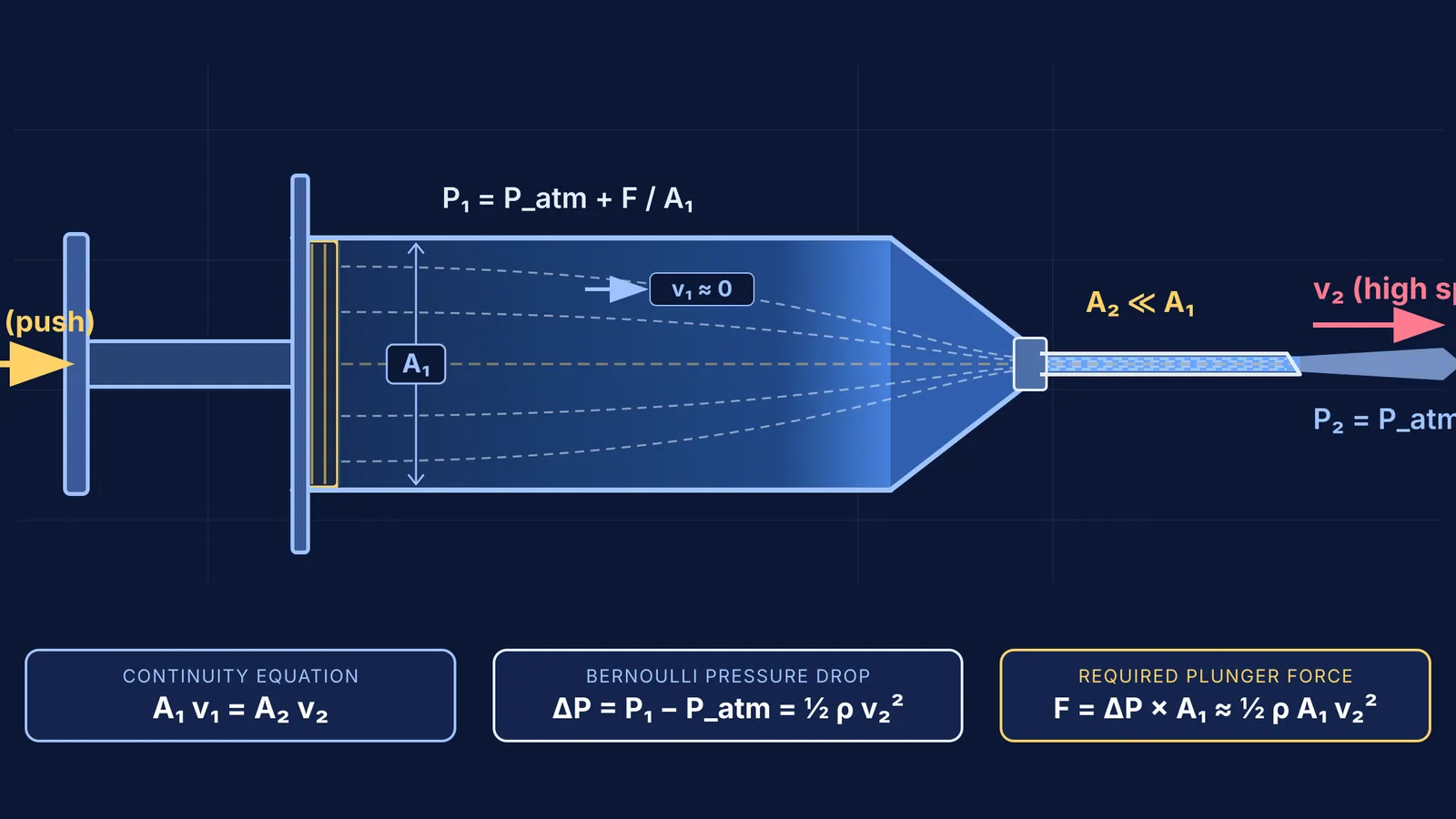
When pressing the plunger of a horizontal syringe, fluid accelerates from a wide barrel into a narrow needle. This system provides a direct illustration of fluid dynamics in the NCERT Class 11 Physics syllabus. Because the syringe is horizontal, gravitational potential energy is constant along streamlines, leaving mechanical energy conservation dependent entirely on fluid pressure and kinetic energy.
Two core principles govern the motion:
Equation of continuity (conservation of mass): A₁v₁ = A₂v₂, where A₁ is barrel area, v₁ is plunger speed, A₂ is needle bore area, and v₂ is exit speed.
Bernoulli's equation (conservation of energy): P₁ + (1/2)ρv₁² = P₂ + (1/2)ρv₂², where ρ is fluid density, P₁ is barrel pressure, and P₂ is exit pressure.
At the needle tip, fluid discharges into air, so P₂ equals atmospheric pressure P_atm. The historical basis comes from Daniel Bernoulli's work on flowing fluids, showing that higher fluid velocity corresponds to lower static pressure. Fluid moves slowly inside the barrel at elevated pressure, then accelerates through the needle tip as static pressure drops to atmospheric level.
How do you calculate the force needed on the plunger?
To find the required thrust, determine the pressure difference between the barrel and atmosphere. Subtracting P_atm from Bernoulli's equation yields the gauge pressure ΔP inside the barrel:
ΔP = P₁ − P_atm = (1/2)ρ(v₂² − v₁²)
Substituting v₁ = (A₂ / A₁)v₂ from continuity expresses ΔP through exit speed:
ΔP = (1/2)ρv₂² × [1 − (A₂ / A₁)²]
Because pressure is force divided by area, the applied plunger force F over area A₁ is:
F = ΔP × A₁ = (1/2)ρA₁v₂² × [1 − (A₂ / A₁)²]
Worked example: how much force ejects water at 4 m/s?
Consider a horizontal syringe problem aligned with NCERT Class 11 Physics. A water-filled syringe (density ρ = 1000 kg/m³) has barrel area A₁ = 2.0 cm² and needle orifice area A₂ = 1.0 mm². What plunger force ejects water at v₂ = 4.0 m/s?
Convert the parameters to SI units:
Barrel area: A₁ = 2.0 cm² = 2.0 × 10⁻⁴ m²
Needle area: A₂ = 1.0 mm² = 1.0 × 10⁻⁶ m²
Fluid density: ρ = 1000 kg/m³
Exit speed: v₂ = 4.0 m/s
From continuity, find the plunger speed:
v₁ = (A₂ / A₁) × v₂ = (1.0 × 10⁻⁶ m² / 2.0 × 10⁻⁴ m²) × 4.0 m/s = 0.02 m/s
Bernoulli's equation gives the required gauge pressure:
ΔP = (1/2) × 1000 kg/m³ × [(4.0 m/s)² − (0.02 m/s)²]
ΔP = 500 × [16.0 − 0.0004] Pa ≈ 8000 Pa (8.0 kPa)
Multiply gauge pressure by plunger area to find applied force:
F = ΔP × A₁ = 8000 N/m² × (2.0 × 10⁻⁴ m²) = 1.6 N
A force of 1.6 N—about the weight of a 160 g object—creates 8.0 kPa gauge pressure, ejecting water at 4.0 m/s. For multi-step fluid problems with constriction geometries, the Fermi Problem Library provides a step-by-step solver that explains the underlying reasoning rather than just printing an answer.
Why does a narrower needle require more force in the real world?
The Bernoulli calculation predicts the ideal kinetic force needed to accelerate fluid mass. In practical applications, fluids experience internal viscous friction governed by the Hagen-Poiseuille equation.
Research by Andrea Allmendinger and colleagues in the European Journal of Pharmaceutics and Biopharmaceutics shows that for narrow needles, viscous resistance dominates ideal kinetic pressure losses. Because viscous resistance scales inversely with the fourth power of needle radius (1/r⁴), halving needle bore diameter multiplies required viscous force sixteenfold.
A 2024 fluid mechanics study led by Seung Min Oh in Plastic and Reconstructive Surgery - Global Open showed that smaller syringe barrel diameters reduce the manual thrust needed to inject viscous fluids. This mirrors the mechanical advantage in Pascal's law in hydraulic machines, where reducing driving piston area reduces manual force needed to build a target pressure.
Where do students make mistakes in syringe exam problems?
Students working through NCERT Class 11 Physics fluid problems commonly encounter three stumbling blocks:
Unit conversions: Forgetting to square prefixes when converting cm² to m² (10⁻⁴) or mm² to m² (10⁻⁶), causing errors of 100 to 10,000 times.
Area mismatch: Multiplying gauge pressure ΔP by needle area A₂ instead of plunger area A₁. Force is applied to the plunger, so it must be calculated across the plunger face.
Atmospheric pressure: Adding P_atm unnecessarily. Atmospheric pressure acts on both the plunger exterior and the needle exit, cancelling out of net force calculations. You can explore related issues in our guide to common fluid mechanics mistakes.
To master fluid dynamics from first principles, the Fermi Concept Library covers every concept in physics, chemistry, biology, mathematics and computing, each with its own lesson and its place in the map.


