

On this page
Prophase I of meiosis is the longest and most complex phase of cell division. As a cell prepares to divide, it must ensure that genetic material is correctly sorted and shared. The second stage of this process, zygotene, is when homologous chromosomes—one inherited from the mother and one from the father—find each other and pair up.
This pairing is not a loose association. It is a precise, physical connection driven by a molecular machine called the synaptonemal complex. Understanding how this complex forms bivalents (or tetrads) is key to solving cell biology problems in board and university exams.
What is the synaptonemal complex?
The synaptonemal complex is a large, ladder-like protein structure that forms between homologous chromosomes during the zygotene stage of meiosis I. According to a review by Fraune et al. (2011), it acts as a structural scaffold to mediate chromosome pairing, synapsis and genetic recombination.
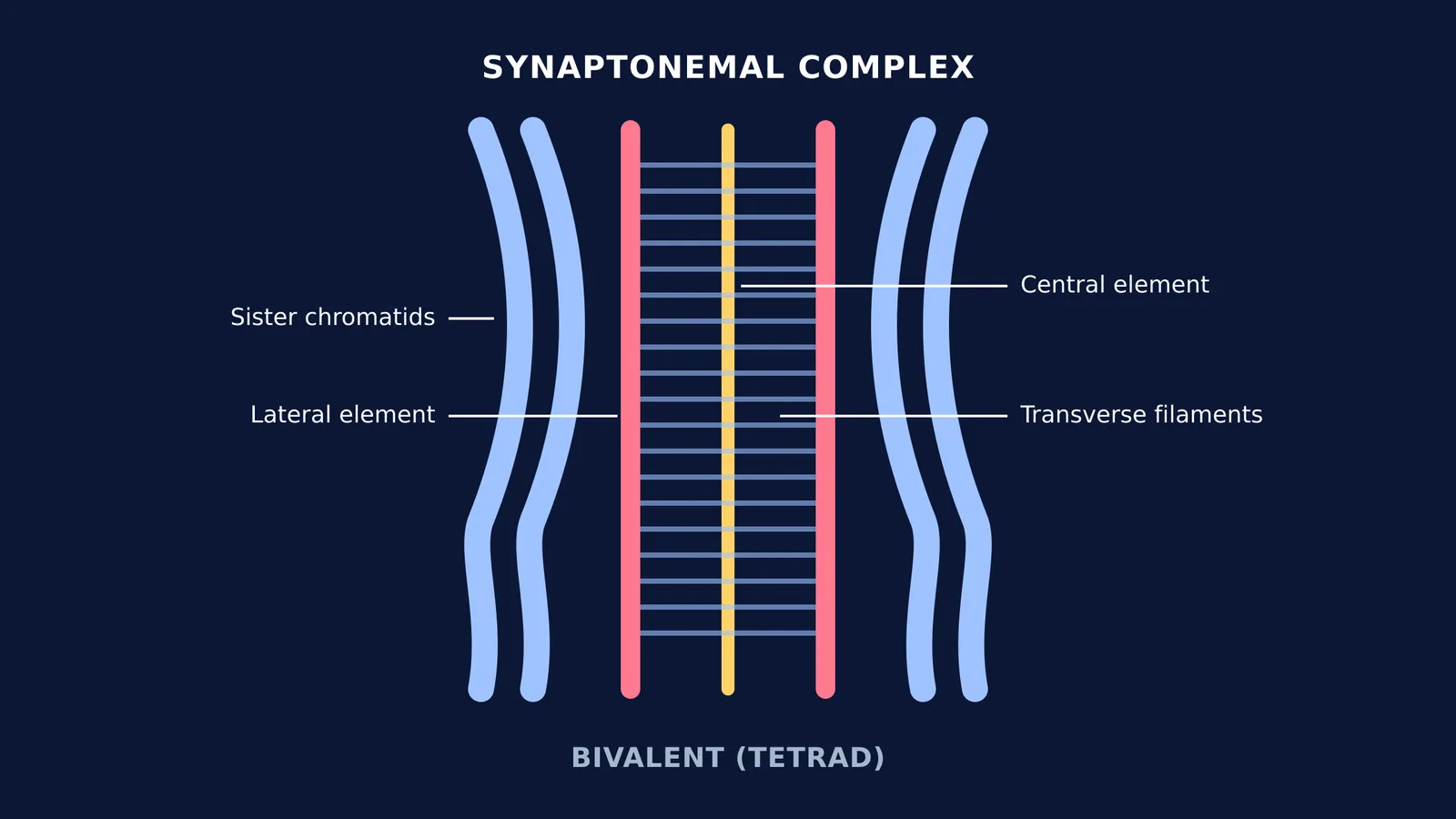
Under an electron microscope, the synaptonemal complex looks like a zipper with three main parts:
Lateral elements: Two protein axes that attach to the chromatin of each individual homologous chromosome.
Central element: A protein structure that runs down the middle between the two chromosomes.
Transverse filaments: Fine protein bridges that connect the two lateral elements to the central element, "zipping" the chromosomes together.
This structure begins to assemble in zygotene, is fully formed by the pachytene stage, and disassembles in diplotene. By holding the chromosomes in perfect alignment, the synaptonemal complex ensures that non-sister chromatids can accurately exchange genetic material during crossing over.
How are bivalents formed in the zygotene stage?
The process of homologous chromosomes pairing together lengthwise is called synapsis. As the synaptonemal complex zips the paternal and maternal chromosomes together, it forms a single paired unit called a bivalent.
Because this happens after the S phase of the cell cycle, mitosis and meiosis, each of the two chromosomes in the bivalent has already replicated. This means the bivalent contains four sister chromatids in total. For this reason, a bivalent is also referred to as a tetrad.
While the pairing and the synaptonemal complex formation happen during zygotene, the four distinct chromatids of the tetrad usually become much more clearly visible under a microscope during the next stage, pachytene.
Why does the number of bivalents equal the haploid number?
A common exam question asks you to calculate the number of bivalents for a given organism. The rule is simple: the number of bivalents is exactly equal to the organism's haploid number (n).
To see why, look at a human cell. The National Human Genome Research Institute notes that a normal human somatic cell is diploid (2n), meaning it contains 46 chromosomes in total. During zygotene, these 46 chromosomes pair up with their homologous partners.
When 46 individual chromosomes form pairs, they create exactly 23 pairs. Since one pair is one bivalent, there are 23 bivalents. Because the haploid number (n) for humans is also 23, the number of bivalents perfectly matches the haploid number. This mathematical relationship holds true for any diploid organism.
If you are asked about chromosome types by centromere position or how many bivalents form in a cell with 14 chromosomes, simply halve the diploid number: 2n = 14, so there are 7 bivalents.
How can an AI tutor help you visualise meiosis?
When cellular processes happen at a microscopic level, reading about them is rarely enough. You need to see how the structures move and assemble. Fermi Concept Library breaks down every concept in biology, each with its own lesson and its place in the map, so you can see how synapsis connects to inheritance.
If you are struggling to calculate chromatid numbers or apply these rules to exam problems, the Fermi Problem Library provides worked problems with a step-by-step solver that explains the reasoning rather than printing an answer. Fermi's AI tutor works out what you already know, builds a plan for the session, and teaches through it—drawing the figure and checking understanding as it goes, so you sit down to a clear next step.


