On this page
In short
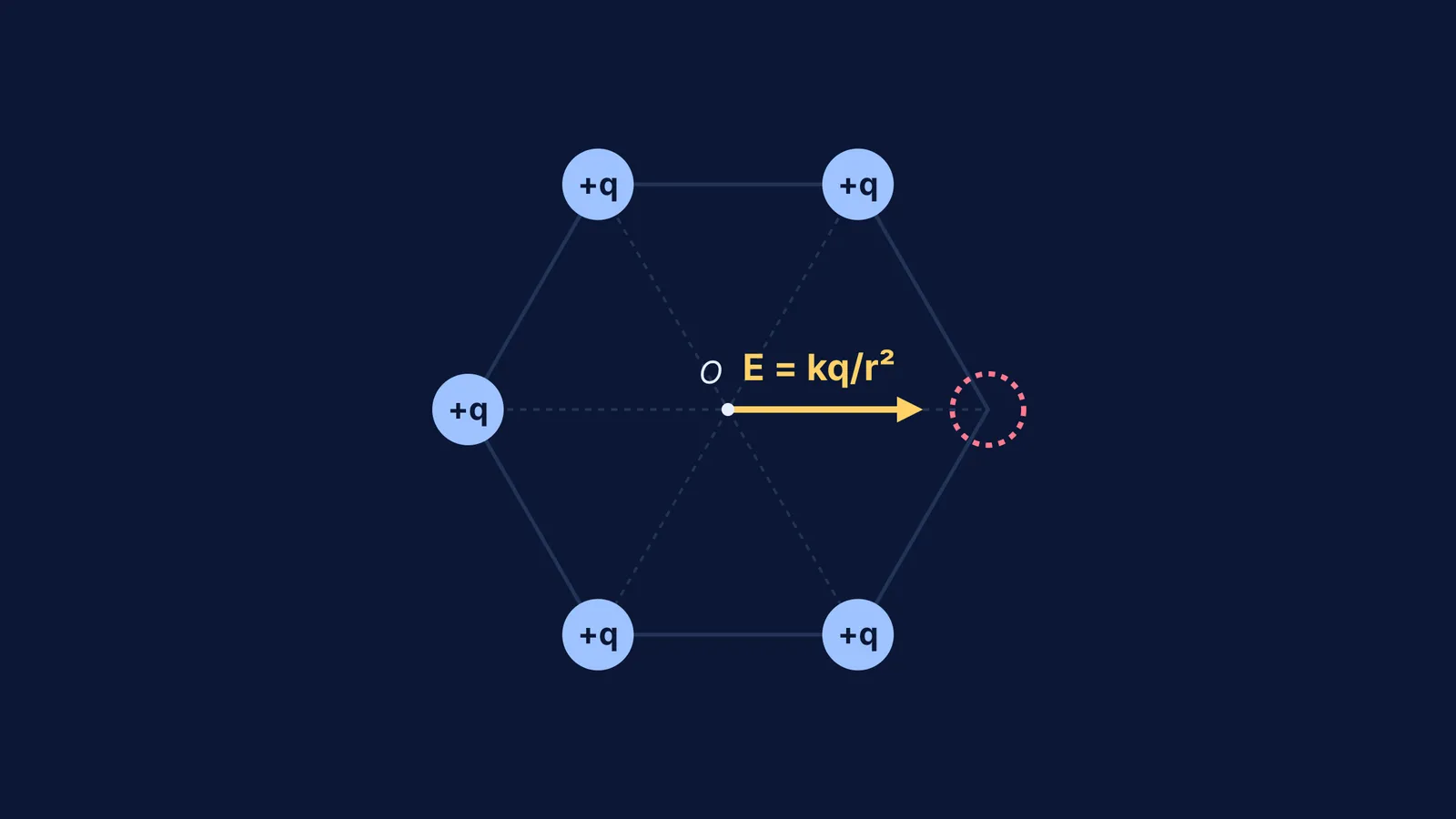
When you remove one charge from a regular polygon of equal charges, the electric field at the centre becomes exactly kq/r², pointing directly toward the empty corner. This shortcut relies on the principle of superposition, which states that the total field is the vector sum of independent individual fields. Because the n charges originally cancelled each other out, the remaining charges must produce a field equal and opposite to the one you removed.
A common trap in competitive exams involves n charges arranged on the vertices of a regular polygon. The question asks for the electric field at the centre when one charge is taken away. Calculating the components for n − 1 vectors is a slow, error-prone way to find the answer. A simple symmetry argument gives you the answer in seconds.
Why does a regular polygon have zero field at the centre?
If you place equal charges +q at the vertices of any regular polygon—whether an equilateral triangle, a square, or a hexagon—the system is perfectly symmetric.
The principle of superposition states that the total electric field at a point is the vector sum of the independent fields produced by each individual charge. According to this rule, the total field at the centre is the sum of these individual vectors. Because the charges are equal and spaced evenly around a circle, their electric field vectors pull or push equally from all directions. They balance out completely, leaving a net electric field of zero.
While calculating the work to assemble point charges requires you to sum scalar potential energies pairwise, calculating the net field requires adding vectors. When the vectors are symmetrical, the math disappears.
How do you find the field when one charge is removed?
Instead of adding up the remaining fields, look at what is missing. Think of the complete, closed polygon as two distinct parts: the single charge +q at vertex A, and the rest of the n − 1 charges.
Because the total field of the complete polygon is zero, we can write: E_removed + E_remaining = 0
This means the field from the remaining charges must exactly cancel the field of the single charge: E_remaining = −E_removed
Removing the charge at vertex A leaves you with only E_remaining. Its magnitude is exactly the field of that one missing charge: kq/r², where r is the distance from the centre to the vertex.
The minus sign tells you its direction is opposite to what the removed charge would have produced. Since a positive charge pushes away from itself, the remaining field must point straight toward the empty gap.
What if the removed charge is replaced by a negative charge?
Examiners sometimes take this problem a step further. Instead of leaving the corner empty, they replace the removed +q charge with a −q charge.
Using superposition, you can split this into two parts you already know:
The field of the empty-corner polygon, which is kq/r² pointing toward the gap.
The field of the new −q charge, which also pulls toward itself with a magnitude of kq/r².
Since both fields point in exactly the same direction, you simply add them together. The total electric field is 2kq/r², directed straight at the negative charge. Just as finding where potential is zero near two charges requires understanding how overlapping scalar fields behave, conquering polygon problems is about trusting vector symmetry.
The same rule applies to continuous shapes
This symmetry trick is not limited to discrete polygons. It works just as well for continuous shapes, such as a uniformly charged ring.
Imagine a thin, circular ring of radius r carrying a total positive charge Q. Because the charge is spread perfectly evenly, the electric field at the exact centre of the ring is zero. Every tiny piece of charge dq on the ring is cancelled out by an identical piece of charge directly opposite it on the circle.
What happens if you cut a small gap of length dl out of the ring?
Using the exact same logic from the polygon, the field of the complete ring equals the field of the broken ring plus the field of the piece you removed. The piece you removed carried a small charge dq. Thus, the remaining field must be equal and opposite to the field that the small piece produced.
The field from the missing piece would have been k · dq/r², pointing away from the gap. Therefore, the field at the centre of the broken ring has a magnitude of k · dq/r² and points straight into the gap. You solve a seemingly complex calculus problem using only subtraction.
A checklist for missing-charge problems
When you face a symmetry problem in an exam, use this mental framework before writing any equations:
Check for complete symmetry: Does the starting shape have zero electric field at the point of interest? This is true for the centre of regular polygons (triangles, squares, hexagons) and complete circles. It is also true in three dimensions, such as the centre of concentric spherical shells.
Identify the missing piece: What exactly was removed? Was it a single point charge +q, or a small segment?
Calculate the field of the missing piece: Find the magnitude of the field *as if* only that removed piece were present. For a point charge, this is simply kq/r².
Reverse the direction: Since the remaining shape must cancel the missing piece, assign the remaining field a direction opposite to what the missing piece would have produced.
Add any replacement charges: If the problem replaces the missing +q with a −q, add the field of the new charge to your result from step 4.
Next time you see a broken shape in a physics problem, do not immediately start resolving sines and cosines. Look for the missing piece. If you are stuck setting up the geometry for problems like this, the Fermi Problem Library has worked problems with a step-by-step solver that explains the reasoning rather than printing an answer.