

On this page
The distinct looks and flavours of Swiss and Roquefort cheeses come down to the different ways microbes breathe and feed. While bacteria inflate Swiss cheese from the inside with gas, fungi spread through Roquefort to break down its fats.
Why does Swiss cheese have holes?
The holes, or "eyes", in Swiss-style cheeses like Emmental are the work of the bacterium *Propionibacterium freudenreichii* subspecies *shermanii*.
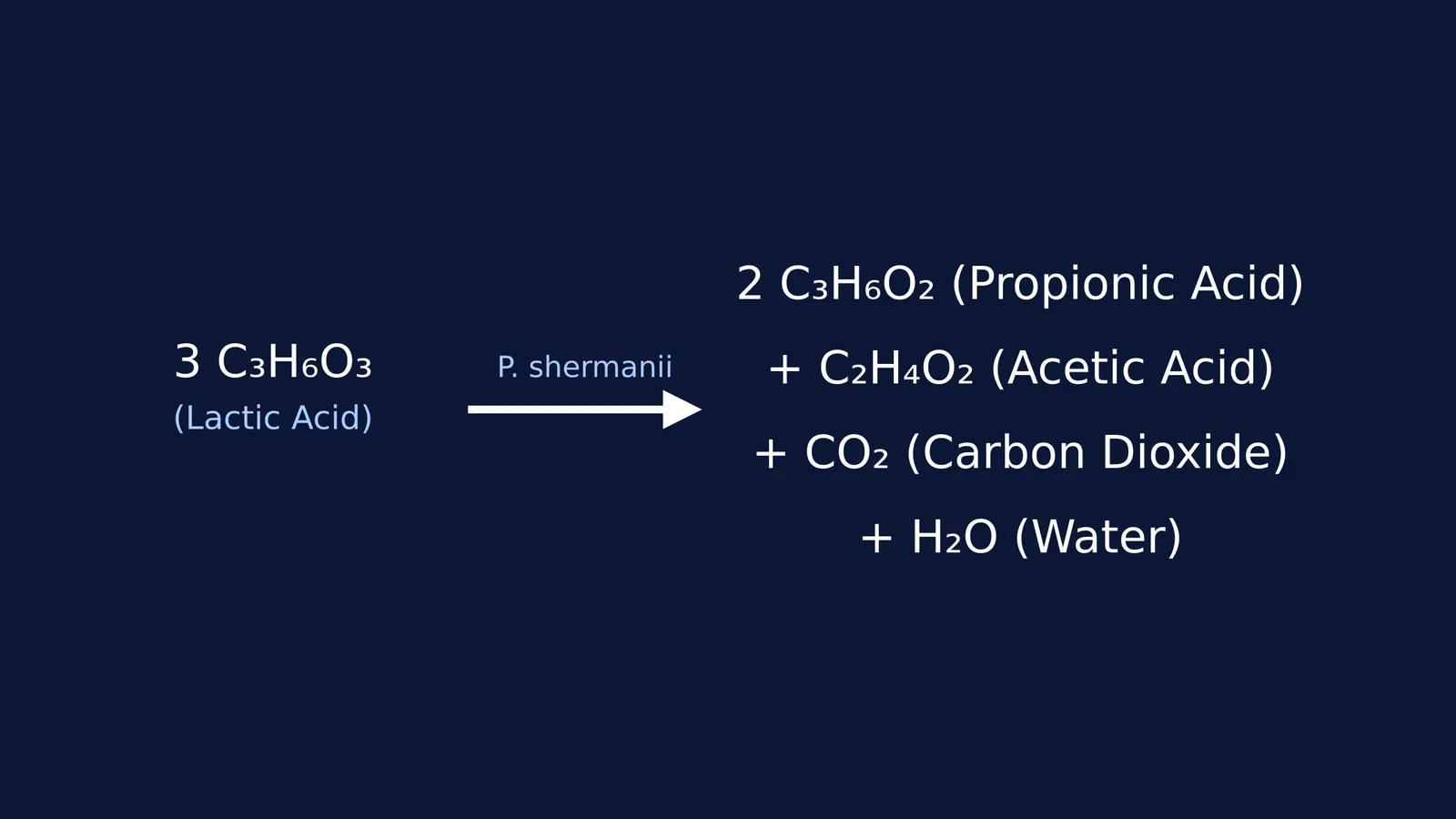
The cheese undergoes two stages of fermentation. First, starter cultures like *Streptococcus thermophilus* ferment the lactose in the milk into lactic acid. Once this primary fermentation is complete, the secondary fermentation begins. As the cheese ripens in a warm curing room, *Propionibacterium freudenreichii* consumes the lactic acid and ferments it into propionic acid, acetic acid, and carbon dioxide (CO₂). The fermentation of three lactic acid molecules yields two molecules of propionic acid, one of acetic acid, and one of carbon dioxide. This specific chemical ratio dictates both the volume of the gas pockets and the sweet, nutty flavour profile of the cheese.
Because the cheese has a dense structure and a firm rind, the CO₂ gas cannot escape. Instead, it accumulates and forms high-pressure bubbles that expand the soft curd into the characteristic holes.
For a long time, scientists thought the gas alone was enough to form these eyes. But cheesemakers had noticed that their cheeses were developing fewer and smaller holes. A 2015 study by researchers at the Swiss agricultural institute Agroscope found the missing ingredient: microscopic particles of hay dust.
In traditional barns, tiny specks of hay naturally fell into the milk buckets. These particles acted as nucleation sites—a physical starting point for the CO₂ to gather and form a bubble. Modern, enclosed milking machines filtered out this dust, leaving the gas with nowhere to congregate. Today, cheesemakers add controlled trace amounts of hay powder to the milk to ensure the holes form perfectly.
How is Roquefort cheese ripened?
While Swiss cheese relies on anaerobic bacteria, blue-veined cheeses like Roquefort are ripened by a fungus called *Penicillium roqueforti*.
Unlike the bacteria in Swiss cheese, this fungus is aerobic and needs oxygen to thrive. When the cheese wheels are formed and pressed, the interior lacks oxygen, keeping the mold spores dormant. Cheesemakers activate and encourage its growth by piercing the cheese wheels with dozens of long, thin stainless steel needles. This process creates narrow air channels deep into the core of the curd.
As oxygen enters the center of the wheel through these tunnels, the dormant *Penicillium roqueforti* spores germinate and grow outward along the channels, producing its signature blue-green spores.
During this maturation, *Penicillium roqueforti* secretes powerful enzymes—proteases and lipases—that break down the milk's proteins (proteolysis) and fats (lipolysis). The lipolysis breaks down the fats into free fatty acids, such as methyl ketones, which give the cheese its piquant, peppery kick. This chemical breakdown softens the texture of the cheese, making it rich and creamy. At the same time, the fungus produces various secondary metabolites that further create the sharp, pungent flavour compounds (many of which are secondary metabolites) that define blue cheese.
Mapping metabolic pathways
Both of these processes are real-world examples of microbial metabolism. Whether you are studying how anaerobic respiration produces gas, how respiration acts as an amphibolic pathway for fats and proteins, or how the six enzyme classes operate to break down lipids, mapping these pathways is a core part of biology.
If you are trying to learn how fermentation and respiration differ, the Fermi Concept Library holds interactive lessons on every biological pathway. Fermi's AI tutor can work out what you already know and build a plan for the session, checking your understanding of how different conditions change the products microbes make.


