

On this page
Why does swapping the limits of integration change the sign?
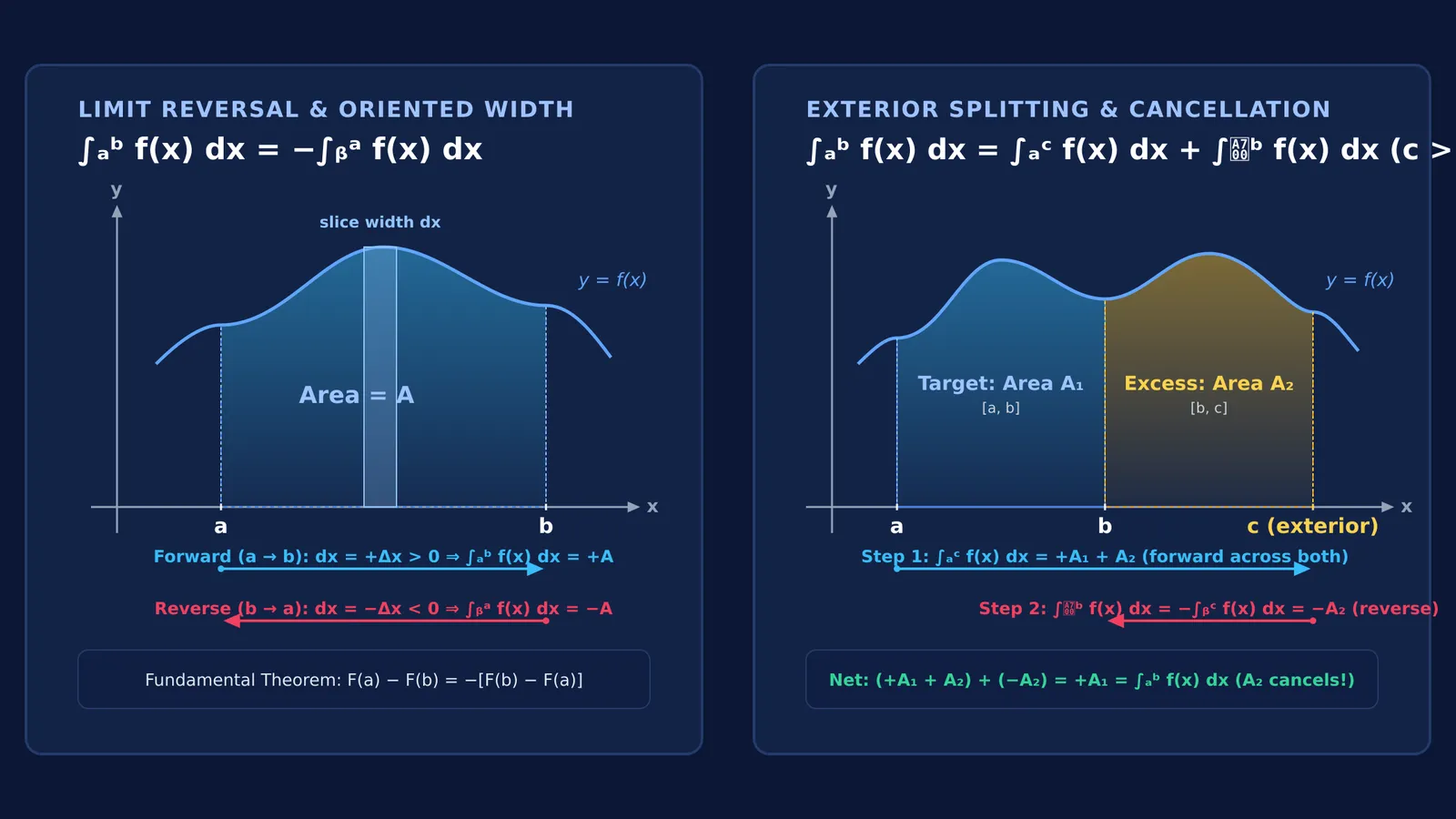
When you evaluate a definite integral, you are not merely measuring an unoriented geometric area; you are calculating an oriented accumulation along the x-axis. As defined in OpenStax Calculus Volume 1, Section 5.2 under Rule 5.10, interchanging the upper and lower limits produces the identity ∫ₐᵇ f(x) dx = −∫ᵦᵃ f(x) dx.
Two distinct mathematical viewpoints explain why this negative sign appears:
The Fundamental Theorem of Calculus: If F(x) is an antiderivative of a continuous function f(x), such that F′(x) = f(x), the second fundamental theorem gives ∫ₐᵇ f(x) dx = F(b) − F(a). When you reverse the limits of integration, the evaluation becomes ∫ᵦᵃ f(x) dx = F(a) − F(b). Factoring out −1 shows that F(a) − F(b) = −(F(b) − F(a)), as detailed on Paul's Online Math Notes. Reversing the endpoints simply reverses the subtraction of the antiderivative values.
The Riemann sum and oriented width: In the formal Riemann sum definition, the interval is partitioned into n subintervals of width Δx. When integrating from a to b, the displacement is Δx = (b − a)/n. If you integrate in the reverse direction from b to a, each step moves in the opposite direction along the number line, with displacement Δx′ = (a − b)/n = −Δx. Because each rectangular slice has height f(xᵢ) and width −Δx, every term in the approximating sum changes sign. In the limit as n approaches infinity, the differential dx carries this directionality.
Can you split a definite integral at a point outside the interval?
Most students first encounter the interval additivity property in the form ∫ₐᵇ f(x) dx = ∫ₐᶜ f(x) dx + ∫꜀ᵇ f(x) dx, with the intuitive assumption that c must lie between a and b. That restriction is helpful when graphing piecewise or absolute-value functions, but mathematically it is unnecessary.
As stated in Rule 5.14 of OpenStax Calculus Volume 1 and mirrored on Mathematics LibreTexts/05%3A_Integration/5.02%3A_The_Definite_Integral), the splitting identity holds for all real numbers a, b, and c, provided the integrand f(x) remains integrable on the largest interval containing all three points.
To see why an exterior point c works, consider the case where c > b > a:
The integral over the full interval is ∫ₐᶜ f(x) dx = ∫ₐᵇ f(x) dx + ∫ᵦᶜ f(x) dx.
Subtracting ∫ᵦᶜ f(x) dx from both sides leaves ∫ₐᵇ f(x) dx = ∫ₐᶜ f(x) dx − ∫ᵦᶜ f(x) dx.
Applying the limit-reversal property turns −∫ᵦᶜ f(x) dx into +∫꜀ᵇ f(x) dx.
Substituting this back yields ∫ₐᵇ f(x) dx = ∫ₐᶜ f(x) dx + ∫꜀ᵇ f(x) dx.
Algebraically, the antiderivative values at c cancel completely: [F(c) − F(a)] + [F(b) − F(c)] = F(b) − F(a). The only danger is continuity: if f(x) has a vertical asymptote or discontinuity between b and c, passing through c introduces an invalid improper integral.
When does reversing limits and splitting save steps in JEE problems?
In competitive exams like JEE Main and JEE Advanced, using limit reversal and exterior splitting eliminates tedious intermediate steps. Three common situations illustrate this advantage:
Inverting bounds during substitution: When substituting u = 1/x or u = cos x, the new limits often invert, placing the larger number at the bottom. The differential carries a negative sign, such as du = −dx/x² or du = −sin x dx. Instead of carrying double negatives through subsequent calculations, use the negative differential immediately to restore standard lower-to-upper order. This technique is essential when updating bounds during u-substitution.
Bypassing messy intermediate evaluations: Suppose a problem asks for ∫₁⁵ f(x) dx − ∫₂⁵ f(x) dx, where evaluating f(x) at 5 produces complicated expressions. Reversing the second integral gives ∫₁⁵ f(x) dx + ∫₅² f(x) dx = ∫₁² f(x) dx. You evaluate only at 1 and 2, skipping the bound 5 entirely.
Handling piecewise and modulus functions: When integrating across domains with multiple sign changes, splitting at partition points isolates positive and negative branches. Comparing methods against definite integrals with modulus and floor functions and reviewing core definite integral properties keeps your algebra compact.
How should students check their signs when manipulating limits?
To prevent sign errors during timed problem solving, follow a four-step routine:
Check orientation: Note whether your lower limit is smaller than the upper limit. If reversed, confirm that an external negative sign or differential factor accounts for it.
Check continuity: Before choosing an external point c, confirm that f(x) is continuous across the entire span from min(a, b, c) to max(a, b, c).
Track net parity: Each limit reversal changes the overall sign once. An inverted bound paired with a negative differential maintains net positive parity.
Verify with a constant: When unsure of a property, test it mentally on f(x) = 1. The integral ∫ₐᵇ 1 dx = b − a, while ∫ᵦᵃ 1 dx = a − b = −(b − a), which confirms orientation instantly.
When working through tricky calculus problems, the Fermi Problem Library provides worked problems with a step-by-step solver that explains the reasoning rather than printing an answer. To explore how calculus concepts connect across the syllabus, the Fermi Concept Library covers every concept in physics, chemistry, biology, mathematics and computing, each with its own lesson and its place in the map.


