

On this page
A geometric progression (GP) is a sequence where each term is found by multiplying the previous term by a fixed number, called the common ratio (r). For example, if you repeatedly fold a piece of paper in half, the area of each fold forms a GP with a common ratio of 1/2. The same mathematics applies to recurring payments, radioactive decay, and calculating the exact value of recurring decimals.
When the common ratio is between −1 and 1 (|r| < 1), the terms get smaller and smaller as the sequence goes on. This means you can add up all infinitely many terms and get a finite answer. The sum to infinity is given by the simple formula:
S = a / (1 − r)
where "a" is the first term and "r" is the common ratio. If you are practising for an exam, you will use this formula for many types of sequences, from basic algebra questions to evaluating sums like 9 + 99 + 999.
How do you solve a bouncing ball GP word problem?
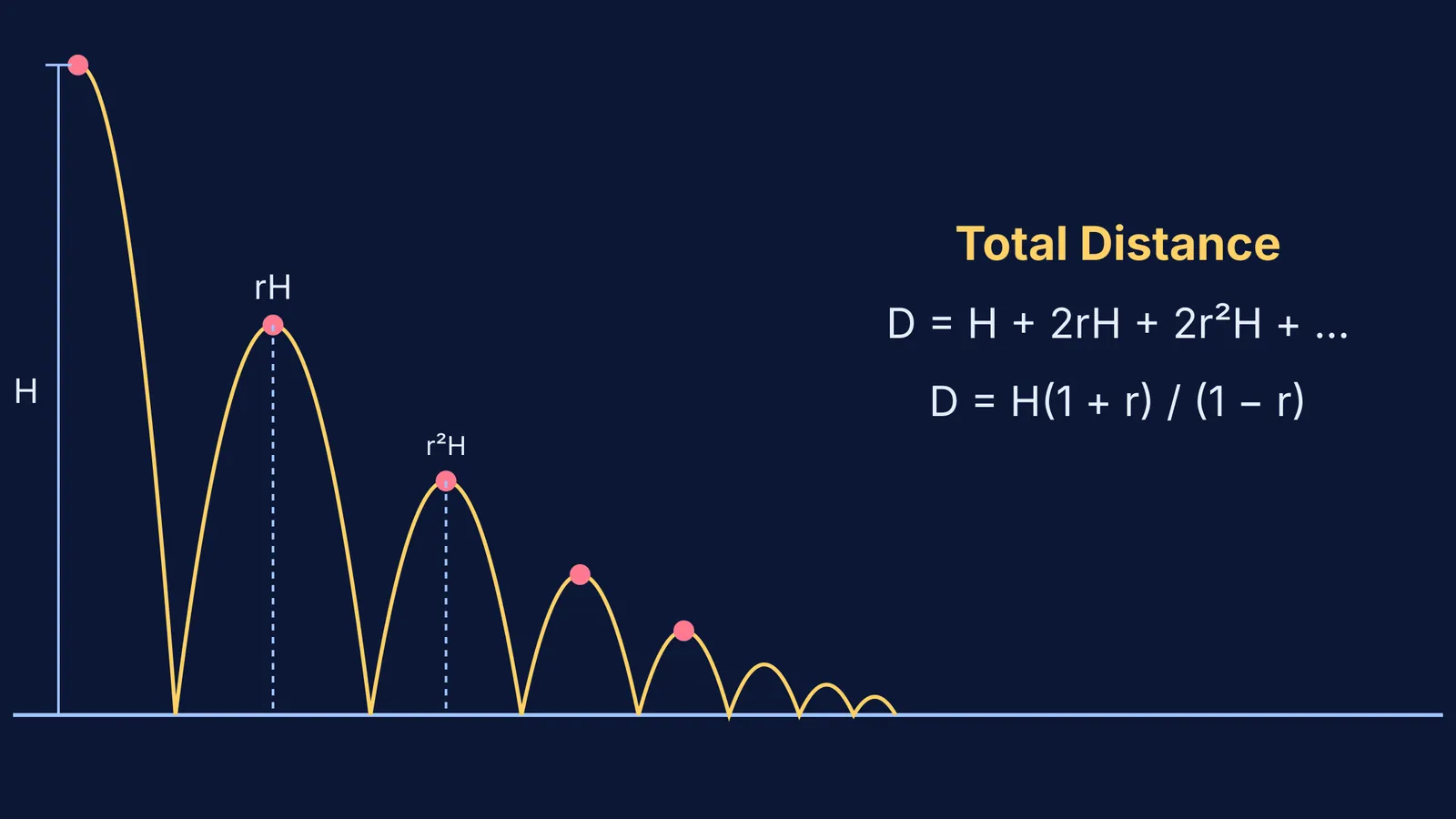
The bouncing ball is a favourite application of the sum to infinity formula. When a ball is dropped from an initial height H, it falls to the ground, bounces back up to a smaller height, and then falls again. If it loses the same fraction of energy on every bounce, the heights of its bounces form a geometric sequence.
Let the common ratio of the heights be r. Here is how you calculate the total distance the ball travels before it stops bouncing:
The first drop is a single downward trip of distance H.
The first bounce goes up to rH and back down to the ground. That is an up-and-down trip of distance 2rH.
The second bounce goes up to r²H and back down. That adds a distance of 2r²H.
The total distance is H + 2rH + 2r²H + 2r³H + …
The terms after the first H form an infinite geometric series with a first term of a = 2rH and a common ratio of r. Using the formula a / (1 − r), the sum of all the bounces is 2rH / (1 − r).
Adding the initial drop H gives the total distance formula:
Total Distance = H + 2rH / (1 − r) Total Distance = H(1 − r + 2r) / (1 − r) Total Distance = H(1 + r) / (1 − r)
What is the coefficient of restitution?
In physics, this common ratio of heights is linked to a property called the coefficient of restitution (e). The coefficient of restitution measures how much speed a ball retains after colliding with the floor. Because a falling object's kinetic energy is proportional to its height, the ratio of the bounce height to the drop height (r) is exactly the square of the coefficient of restitution (e² = r).
Real-world sports rely heavily on these bounds. The International Basketball Federation (FIBA) requires that a basketball dropped from 1800 mm onto a hardwood floor must rebound to a height between 1035 and 1085 mm. This means the height ratio r for a tournament basketball is between 1035/1800 (about 0.575) and 1085/1800 (about 0.603).
If you take a basketball with a common ratio of r = 0.6 and drop it from 1.8 metres, the total distance it will travel up and down before coming to rest is:
1.8 × (1 + 0.6) / (1 − 0.6) = 1.8 × (1.6 / 0.4) = 1.8 × 4 = 7.2 metres.
The ball effectively travels four times its drop height.
Mastering sequence problems with Fermi
Geometric progression word problems are about mapping a real-world pattern to the variables a and r. It is easy to make a mistake when identifying the first term — for instance, forgetting that the first drop of a bouncing ball is a one-way trip, while all subsequent bounces are round trips. Setting up equations when given three numbers in an AP or GP can also be tricky if you pick the wrong starting variables.
If you are struggling to spot the pattern in a sequence problem, the Fermi Problem Library has worked problems with a step-by-step solver that explains the reasoning rather than printing an answer. When you get stuck on an infinite sum, Fermi's AI tutor works out what you already know and builds a plan for the session, teaching you how to set up the sequence correctly so you are ready for the exam.


