

On this page
When you add sugar to your morning tea, you are performing a fundamental chemistry experiment: preparing a homogeneous solution. If you stir two teaspoons of sugar into a standard teacup, the resulting concentration is approximately 0.16 M. Understanding how to calculate this bridges the gap between abstract textbook molarity formulas and the real world, giving you an intuitive sense of what a 0.16 M solution actually looks and tastes like in everyday life. Whether you are studying for a board exam or simply curious about the science in your kitchen, working through this calculation step-by-step is an excellent active-learning exercise.
How much sugar is in two teaspoons?
To find the molarity of any solution, we first need the precise mass of the solute being dissolved. A standard level teaspoon of granulated sugar weighs roughly 4.2 grams (The Calculator Site). So two level teaspoons contain exactly 8.4 grams of sugar. This is the mass value we will use for our calculation.
The sugar we use at home is sucrose, a disaccharide with the chemical formula C₁₂H₂₂O₁₁. By adding up the atomic weights of its constituent atoms—12 carbon atoms, 22 hydrogen atoms, and 11 oxygen atoms—we find that the molar mass of sucrose is 342.3 g/mol (PubChem). This crucial number is the key to converting our everyday mass measurement into the moles required for a chemistry concentration formula.
How do you calculate the molarity of sucrose in tea?
Molarity (M) measures concentration in moles of solute per litre of solution. It is the foundation for almost every quantitative reaction in a laboratory setting. Here is a step-by-step framework to calculate the concentration in your teacup:
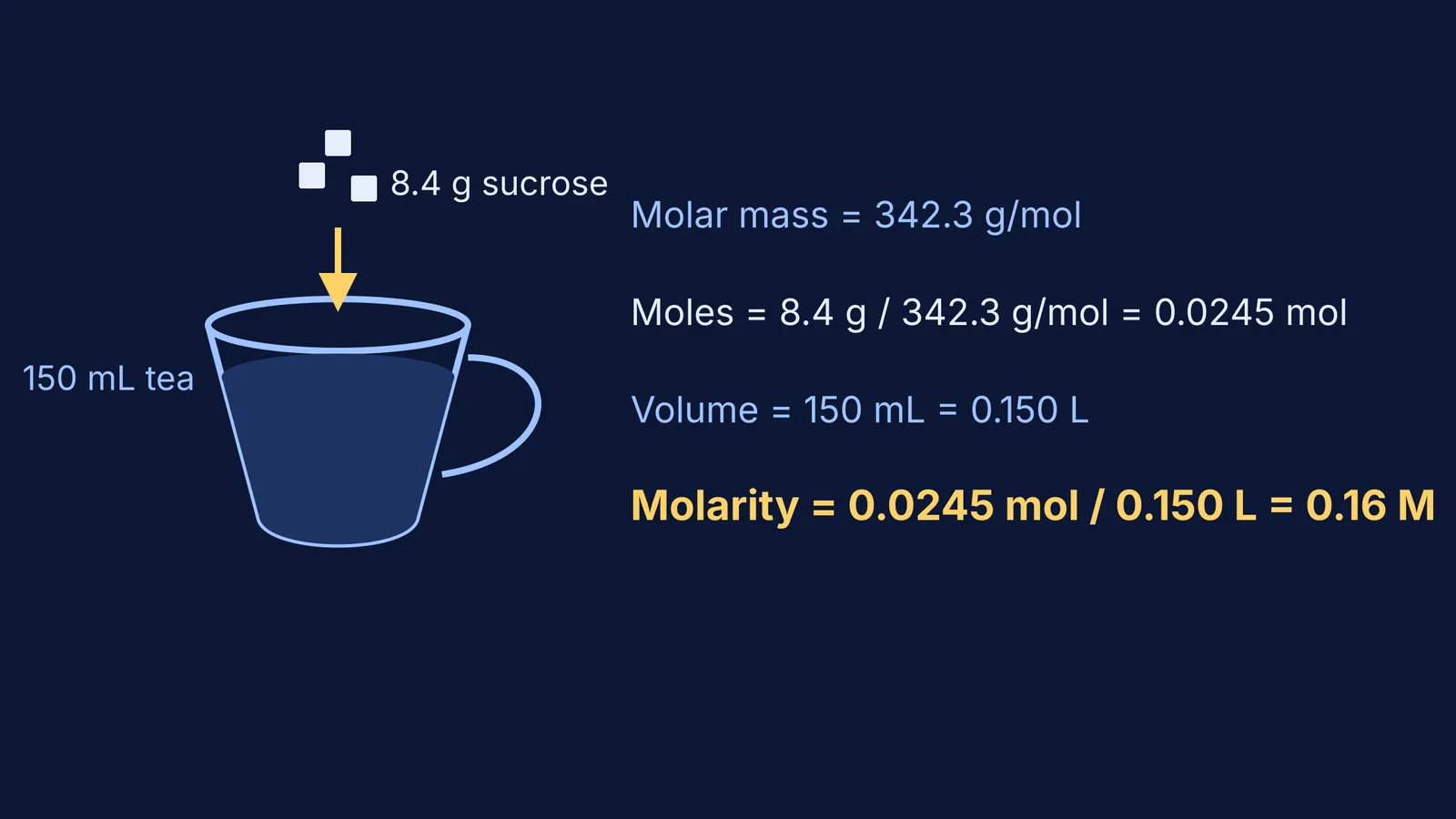
Find the moles of solute: We established we have 8.4 grams of sucrose. Divide this mass by the molar mass: 8.4 g / 342.3 g/mol = 0.0245 moles of sucrose.
Determine the volume of solution: Let us assume our teacup holds 150 millilitres of liquid. Because molarity is based on litres, we must convert this: 150 mL = 0.150 L.
Calculate the final concentration: Divide the moles by the volume: 0.0245 mol / 0.150 L = 0.16 M.
Your morning tea is roughly a 0.16 M sucrose solution. If you want to see how this changes when you add more milk or combine two different cups, you can explore the rules for finding the final molarity when mixing and diluting solutions.
When learning to set up concentration calculations, you can use the Fermi Concept Library, which has every concept in physics, chemistry, biology, mathematics and computing, each with its own lesson and its place in the map.
Is a 0.16 M sucrose solution a lot of sugar?
In a laboratory context, a 0.16 M solution is relatively dilute. However, in a dietary context, those two teaspoons represent a significant portion of your daily recommended intake.
The World Health Organization strongly recommends that adults and children reduce their daily intake of free sugars to less than 10% of their total energy intake, which equates to roughly 50 grams for a standard adult diet (WHO). They note that a further reduction to below 5%, or about 25 grams per day, provides additional health benefits. Drinking just three cups of tea, prepared with 8.4 grams of sugar each, brings you dangerously close to that 5% ideal limit before you have even eaten a single meal.
Furthermore, molarity helps predict physical changes in the liquid, known as colligative properties. These are macroscopic properties that depend strictly on the ratio of solute particles to solvent molecules, rather than the chemical identity of the solute itself. For example, finding molar mass from osmotic pressure relies entirely on knowing the exact molar concentration of the solution. Adding sugar to water slightly elevates its boiling point and lowers its freezing point, phenomena known as boiling point elevation and freezing point depression. This is why a heavily sweetened drink takes slightly longer to freeze than pure water, and why chefs sometimes use concentrated solutions to manipulate cooking temperatures. By mastering the calculation of molarity in simple, everyday examples like a cup of tea, you lay the necessary groundwork for understanding these more complex physical chemistry applications.
If you find converting between mass, volume, and moles tricky, the Fermi Problem Library has worked problems with a step-by-step solver that explains the reasoning rather than printing an answer.