

On this page
When an integral or equation mixes sums like sin x + cos x and products like sin x cos x, it often looks impossible to untangle. The standard identities don't seem to help, and expanding terms only makes the expression longer.
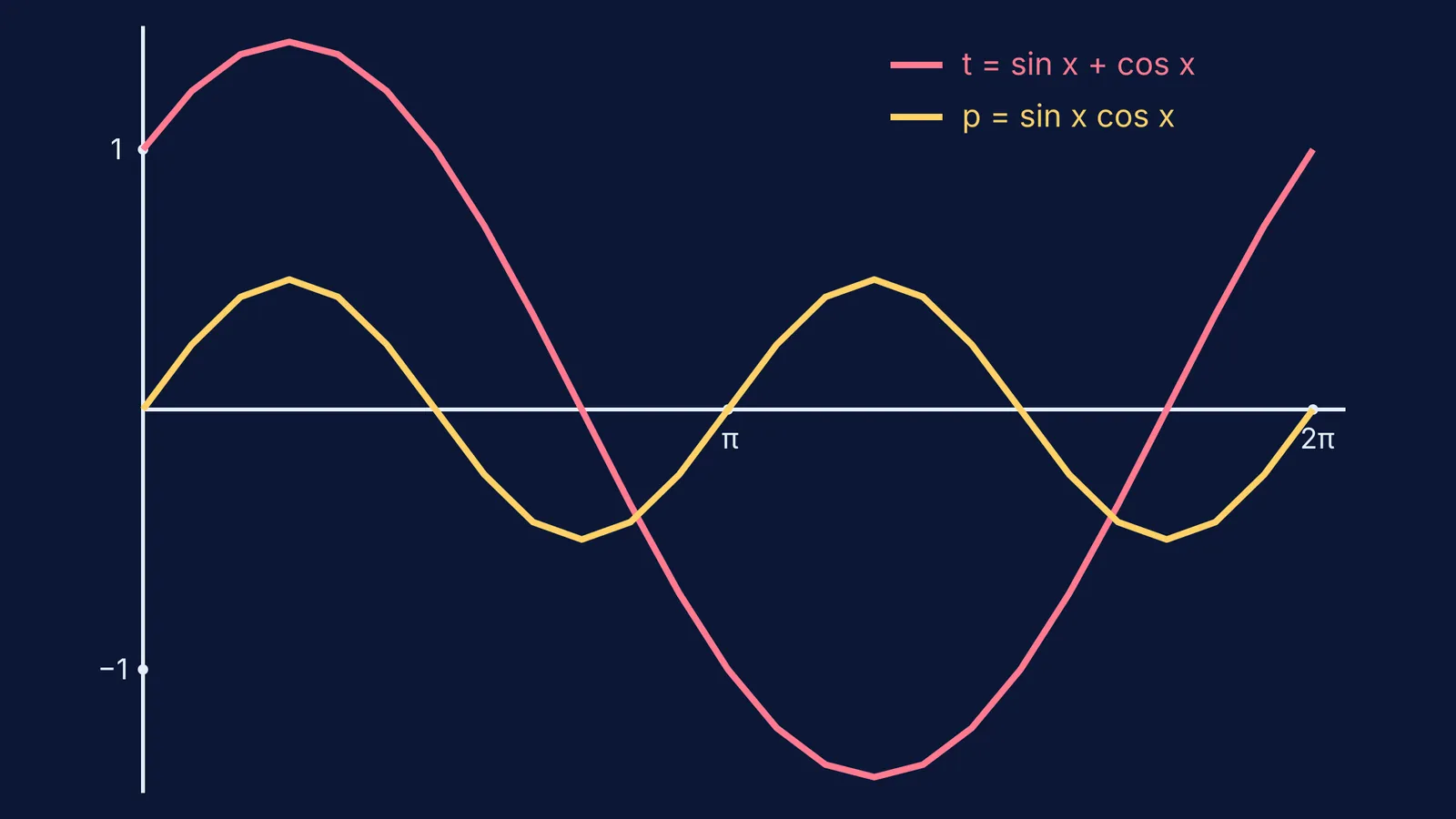
But there is a specific substitution that solves this exact pattern. By setting t = sin x + cos x, you can rewrite the product sin x cos x entirely in terms of t, turning a tricky trigonometric problem into a straightforward polynomial one.
How does the substitution work?
The method relies on the fundamental relationship between the sum and the product of sine and cosine. According to the standard trigonometric identities, the square of the sum is related to the double-angle formula. If you let t = sin x + cos x, squaring both sides gives:
t² = (sin x + cos x)²
Expanding this out, you get t² = sin² x + cos² x + 2 sin x cos x. Since sin² x + cos² x = 1, the equation simplifies to t² = 1 + 2 sin x cos x. Rearranging this gives the core identity for this substitution:
sin x cos x = (t² − 1)/2
This means any sin x cos x or sin 2x term in your problem can be replaced entirely by expressions involving t.
When to use it in integrals?
This substitution is built for integrals where the numerator is the exact derivative of t. If t = sin x + cos x, then the derivative dt is (cos x − sin x) dx.
If you see an integral of the form ∫ (cos x − sin x) / f(sin x cos x) dx, this is your cue. Once you make the substitution, the numerator disappears into dt, and the denominator becomes a simple function of t.
For example, consider ∫ (cos x − sin x) / (1 + sin x cos x) dx. Substitute t = sin x + cos x and dt = (cos x − sin x) dx. The product sin x cos x becomes (t² − 1)/2. The integral transforms into ∫ 1 / (1 + (t² − 1)/2) dt, which simplifies to ∫ 2 / (t² + 1) dt. This is a standard integral that evaluates to 2 tan⁻¹(t) + C.
How does it help with equations?
This substitution is not just for calculus; it is equally powerful for solving trigonometric equations that mix sums and products.
Suppose you need to solve sin x + cos x + sin x cos x = 1. By letting t = sin x + cos x, you can replace the product to get t + (t² − 1)/2 = 1. Multiplying by 2 gives 2t + t² − 1 = 2, which rearranges to the quadratic equation t² + 2t − 3 = 0. Factoring this yields (t + 3)(t − 1) = 0. Since the maximum value of sin x + cos x is √2, the only valid solution is t = 1.
When you use the Fermi Problem Library to work through these types of equations, Fermi's AI tutor points out these hidden patterns. It holds a line of reasoning across the session, showing you why jumping to a substitution is the right move before you write out the steps.
What is the checklist for exams?
When preparing for competitive exams, recognising when to deploy specific techniques is just as important as knowing how to do them. Keep this checklist in mind when you see mixed trigonometric terms:
Look at the numerator: If it is cos x − sin x, substitute t = sin x + cos x. If it is cos x + sin x, substitute t = sin x − cos x.
Look at the denominator: Can all other terms be written using sin x cos x or sin 2x?
Look for standard forms: This method often reduces the problem to basic forms like Integrals of √(a² − x²) and √(x² ± a²): the standard results or algebraic fractions.
Try the half-angle alternative: If the problem lacks the exact numerator needed, you might need a different approach entirely, such as Integrating 1/(a + b cos x) with the tan(x/2) substitution.
This single substitution turns a dense trigonometric puzzle into manageable algebra, giving you a reliable path to the solution.


