

On this page
When a crane lifts a steel beam or an elevator carries people to the top floor, the cable must support more than just the weight of the load. If the load accelerates upward, the cable has to pull harder to overcome both gravity and inertia.
Calculating the stress in that cable is a classic physics problem that bridges classroom mechanics and real-world engineering.
Why does tension increase when accelerating upward?
Imagine standing in an elevator. When the elevator first starts moving upward, you feel heavier for a brief moment. Your feet press down harder on the floor, and the floor pushes back. The elevator cable experiences the exact same effect. It must pull upward hard enough to hold the elevator's static weight, plus an extra pull to accelerate its mass from rest to its cruising speed.
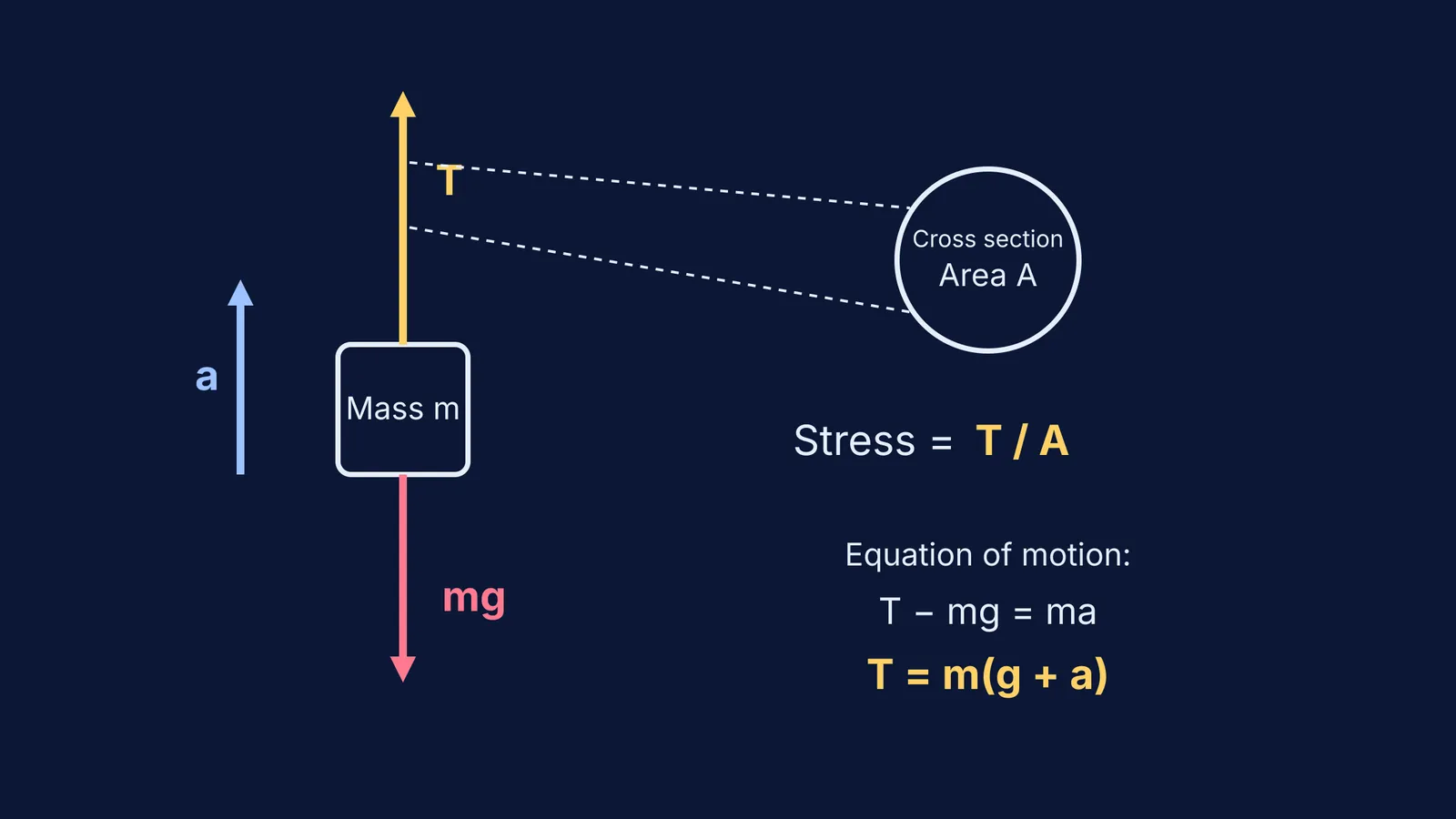
If a mass m hangs from a rope at rest, or moves upward at a constant velocity, the acceleration a is zero. The tension T exactly balances the weight. In this static case, T = mg, where g is the acceleration due to gravity (9.81 m/s²).
But when the load accelerates upward at a rate a, Newton's second law (F_net = ma) states that the net force must equal the mass times the acceleration. The upward tension must beat the downward weight: T − mg = ma. Rearranging this gives the tension formula for an accelerating load: T = m(g + a).
For example, if a 1,200 kg elevator accelerates upward at 1.5 m/s², the static weight is 11,772 N. But the dynamic tension during acceleration is 1,200 × (9.81 + 1.5) = 13,572 N. The acceleration adds about 15% more load to the cable. (You can see a similar effect when a monkey climbing a rope suddenly speeds up.)
How to calculate the stress in the lifting cable?
Tension is a force, but to know if a rope will snap, you must find the stress. Stress (σ) is the force divided by the cross-sectional area (A) of the cable:
σ = T / A
In many physics problems, you are given the diameter of the rope rather than the area directly. If the rope is treated as a solid cylinder of diameter d, its cross-sectional area is A = π(d/2)² = πd² / 4. (Real wire ropes have gaps between the strands, so their actual metallic area is slightly less than a solid circle, but exam problems usually treat them as solid.)
If our elevator is pulled by a solid steel cable with a diameter of 16 mm (0.016 m), the area is A = π × (0.008)² ≈ 2.01 × 10⁻⁴ m². The stress during that upward acceleration is:
σ = 13,572 N / (2.01 × 10⁻⁴ m²) ≈ 67,522,000 N/m²
This is 67.5 Megapascals (MPa).
How do safety factors keep lifts safe?
Once you have the stress, you must compare it to the ultimate tensile strength (breaking stress) of the material. A standard 5/8-inch (about 16 mm) Improved Plow Steel (IPS) wire rope has a minimum breaking strength of 149 kN, which gives it a breaking stress of about 741 MPa.
Our calculated stress of 67.5 MPa is nowhere near this 741 MPa breaking point. This massive gap is intentional. Engineers use a safety factor (the ratio of breaking strength to working stress) to account for wear, shock loads, and metal fatigue over time.
Because human lives are involved, OSHA requires safety factors between 7.6 and 10.7 for suspension wire ropes in personnel hoists, depending on the speed.
In the real world, the metal also wears down. A wire rope sling must be permanently removed from service if there are five broken wires in one strand in one rope lay, because broken wires reduce the cross-sectional area and spike the stress on the remaining metal. You can explore how reducing the area of a rod changes its behaviour in our guide to a rod stretching under its own weight or the elastic potential energy in a stretched wire.
Solving complex rope tension problems
Exam questions often combine these concepts by stringing multiple masses together or adding friction on a pulley.
A checklist for lifting problems
When tackling exam questions about accelerating loads:
Draw the free-body diagram: draw the mass as a dot, with tension T pointing up and weight mg pointing down.
Assign a positive direction: if the load accelerates upward, make up the positive direction.
Write Newton's second law: F_net = ma becomes T − mg = ma.
Calculate stress: divide the tension by the given cross-sectional area.
Check the safety limit: compare your calculated stress to the breaking stress to ensure the rope does not snap.
If you are stuck on setting up the equations or drawing the free-body diagram, the Fermi Problem Library has worked problems with a step-by-step solver that explains the reasoning rather than printing an answer. Fermi teaches — it holds a line of reasoning across a whole session, notices where a student is stuck, and decides whether to explain, ask, or show.


