

On this page
Have you ever wondered why diagrams of fluid flow always show smooth, parallel-looking curves that never touch? In fluid dynamics, these lines are called streamlines.
Whether you are studying for your CBSE Class 11 physics exam or preparing for the JEE, you will encounter the rule that no two streamlines can cross. It is a common viva question and a conceptual trap in numerical problems.
Here is why it happens, what happens when the flow becomes chaotic, and what these lines tell you about the speed of the fluid.
What is a streamline?
A streamline is a curve whose tangent at any point gives the instantaneous direction of the fluid velocity (NCERT, Mechanical Properties of Fluids).
Imagine taking a photograph of a flowing river. A streamline shows the exact path a massless particle would take if placed in the flow at that instant. In steady flow (or laminar flow), the velocity of every passing fluid particle at any given point remains constant over time. While the particle's velocity may change as it moves along the stream, every subsequent particle passing through those exact points will behave identically to the one before it.
Because the flow is entirely predictable, you can map out the entire region of fluid using these steady lines. In steady flow, a streamline is identical to a pathline (the actual trajectory followed by a single fluid particle over time) and a streakline (the pattern formed by all particles that have passed through a fixed point, much like a trail of dye) (Wikipedia). When the velocity at every point remains constant, all three match perfectly because a particle reaching a point will always follow the same fixed velocity vector as the particles before it. However, in unsteady flow, where velocity changes over time, these lines diverge. A streamline only shows the flow direction at one instant, while a pathline records history.
Why do streamlines never cross?
The rule comes down to a strict logical contradiction.
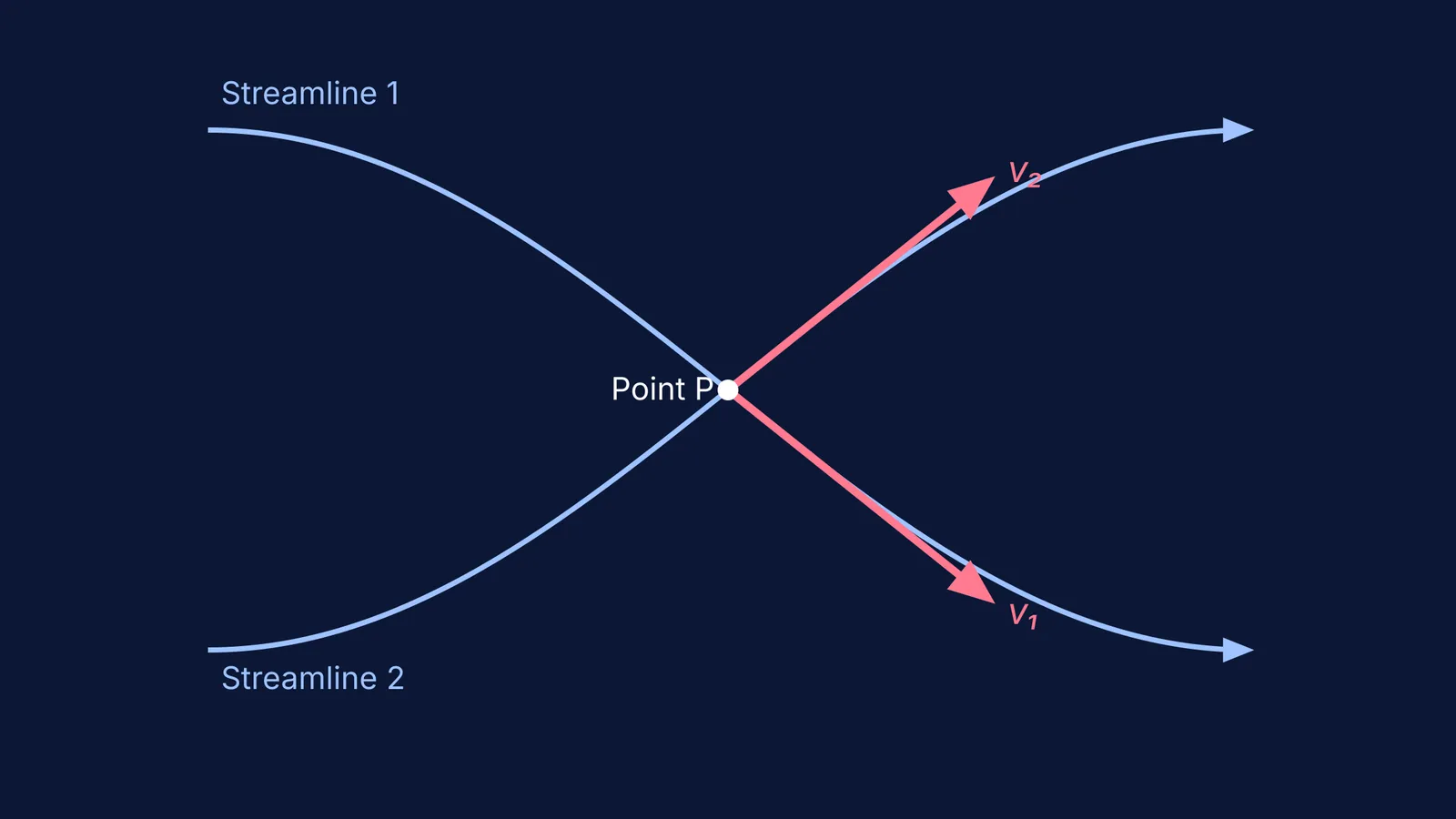
By definition, the tangent to a streamline represents the velocity vector of the fluid at that point. If two streamlines were to cross, an oncoming fluid particle exactly at the intersection point would have two possible tangents to follow. This would mean the fluid at that specific point has two different velocities simultaneously—pointing in two entirely different directions (NCERT).
This is physically impossible. A fluid particle can only travel in one direction at a given moment. Therefore, to maintain a unique, well-defined velocity at every single point in space, streamlines can never intersect. If the flow becomes fast enough to turn turbulent, the steady streamline model breaks down entirely, and you can no longer draw these permanent paths.
What are tubes of flow?
When you bundle a group of streamlines together that pass through a continuous closed curve, they form a tubular surface called a tube of flow or streamtube (Wikipedia).
Because streamlines are always perfectly tangent to the fluid's velocity, there is absolutely no component of velocity perpendicular to the surface of the streamtube. This means fluid cannot cross the "walls" of the tube. It acts just like a physical pipe, guiding the fluid along its length without any lateral leakage. You can think of the entire flowing river as a large pipe made up of countless smaller, invisible streamtubes.
What do streamlines tell you about speed?
Streamlines do not just show direction; their spacing tells you everything about the fluid's speed. This is governed by the equation of continuity, which states that for an incompressible fluid, the product of cross-sectional area and velocity is constant (A × v = constant) (Wikipedia).
Because liquids like water cannot be compressed, the exact same volume of fluid must pass through every section of the streamtube in the same amount of time. If the tube narrows, the fluid cannot be squeezed into a smaller volume. Instead, the water must speed up to ensure that the same volume of fluid passes through the smaller cross-section in the same amount of time. Think of putting your thumb over the end of a garden hose. By forcing the water through a smaller opening, you reduce the area, and the water must speed up to get out of the way.
Crowded streamlines: When the lines are close together, the effective area of the streamtube is small, so the fluid speed must be high.
Spaced out streamlines: When the lines are far apart, the area is large, so the fluid speed must be low.
If you understand physics theory but still fail numericals, it helps to slow down and map out the reasoning. The Concept Library holds every concept in physics, chemistry, biology, mathematics and computing, each with its own lesson and its place in the map. If you know the theory but get stuck on the math, try working through similar examples in the Fermi Problem Library, which features worked problems with a step-by-step solver that explains the reasoning rather than printing an answer.
Understanding the geometry of streamlines gives you a powerful visual shortcut. The next time you draw the diagram first for a Bernoulli's principle problem, those converging lines will immediately tell you where the fluid is speeding up and where the pressure must drop.


