

On this page
When you first study straight lines in coordinate geometry, you often have to find the equation of a line passing through the intersection of two other lines. The standard way is to solve the two equations to find the intersection point, find the slope you need, and then use the point-slope formula. But you can solve these problems much faster by using the "family of lines" concept. By writing the line as L₁ + kL₂ = 0, you skip finding the point first. Even better, you can run this logic in reverse to find the fixed point hidden inside a messy, parameterised equation.
What is the equation of a family of lines passing through a point?
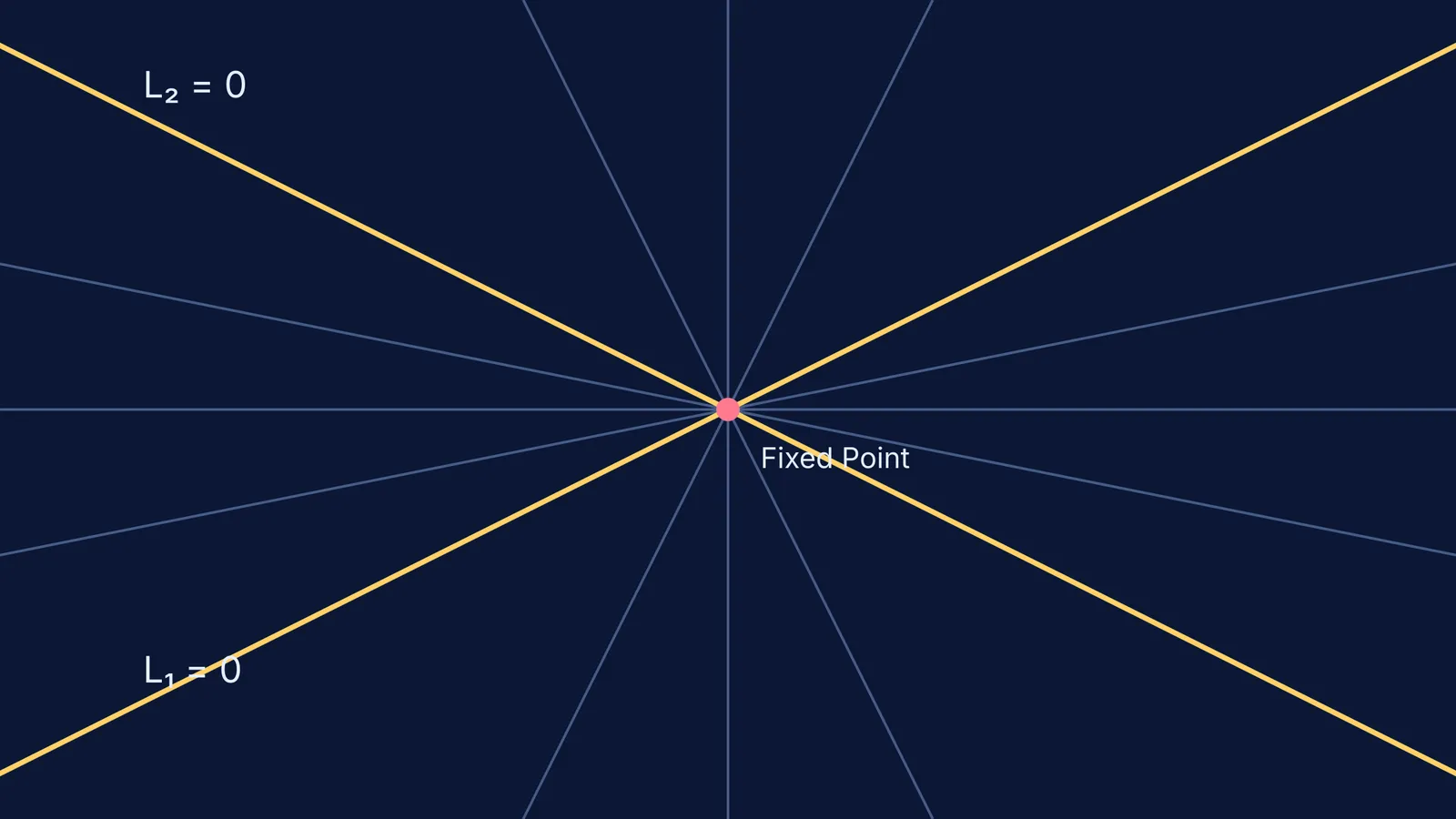
A "family of lines" (formally known as a pencil of lines) is the complete set of lines in a plane that all intersect at one single fixed point.
If you start with any two base lines, say L₁: a₁x + b₁y + c₁ = 0 and L₂: a₂x + b₂y + c₂ = 0, their intersection acts as the anchor. The equation L₁ + kL₂ = 0 represents the entire family of lines passing through that anchor. Here, k is a real-numbered parameter. Every time you pick a different value for k, you get a different line in the family.
If you are exploring these ideas in the Fermi Concept Library, you will find that mastering this form bridges the gap between basic algebra and advanced geometric proofs. Instead of treating the intersection as an unknown coordinate, you treat it as the shared property of an entire algebraic family.
How do you find the fixed point of a family of lines L₁ + kL₂ = 0?
In exams like JEE Main, questions often flip the script. You might be given a complicated linear equation filled with x, y, and a shifting parameter (like k, p, or m), and asked to prove that the line always passes through a fixed point regardless of the parameter's value.
To find that fixed point, you need to force the equation into the L₁ + kL₂ = 0 format:
Multiply everything out so that there are no brackets left.
Group all the terms that do not contain the parameter. This is your L₁.
Group all the terms that are multiplied by the parameter and factor the parameter out. This is your L₂.
Once arranged as L₁ + kL₂ = 0, the fixed point is exactly where the two lines L₁ = 0 and L₂ = 0 cross.
A worked example for JEE
Let's find the fixed point for the family of lines given by the equation: x(2 + k) + y(1 − 3k) − 5 + 8k = 0
First, expand the expression and regroup the terms to separate those with k from those without. 2x + kx + y − 3ky − 5 + 8k = 0 (2x + y − 5) + k(x − 3y + 8) = 0
The equation is now exactly L₁ + kL₂ = 0, which means we have identified the two base lines: L₁: 2x + y − 5 = 0 L₂: x − 3y + 8 = 0
To find the fixed point, treat these as a pair of simultaneous equations and solve L₁ = 0 and L₂ = 0. From L₁, we can isolate y: y = 5 − 2x
Substitute this into L₂: x − 3(5 − 2x) + 8 = 0 x − 15 + 6x + 8 = 0 7x − 7 = 0 x = 1
Now put x = 1 back into our expression for y: y = 5 − 2(1) = 3
The fixed point is (1, 3). For any real value of k, the original line will always safely pass through (1, 3).
Why does L₁ + kL₂ = 0 represent a family of lines?
The algebraic reason this works is elegant. If you plug the coordinates of the intersection point into the expression for L₁, the result is exactly zero, because the point sits on L₁. If you plug those same coordinates into L₂, the result is also zero.
Therefore, when you substitute that specific coordinate into the combined equation L₁ + kL₂, you are left with 0 + k(0), which equals 0. The equation holds true entirely independent of the value of k. This proves that the entire family of lines must cross at that exact coordinate, making them concurrent lines.
This algebraic trick saves vital minutes in timed tests. If you are practising coordinate geometry with the step-by-step solver in the Fermi Problem Library, you will see it repeatedly group complex, parameterised line equations into this form to instantly reveal the intersection point. The same principle even scales up, such as when dealing with planes in 3D or a family of lines through the intersection of two given lines.


