

On this page
The "boat and stone" puzzle is a classic trap in introductory physics. The question is simple: if you are floating in a boat on a small pond, and you throw a heavy stone overboard, does the water level of the pond rise, fall, or stay the same?
The puzzle is famous for its counter-intuitive nature. According to an anecdote detailed in a 1996 article in *The Physics Teacher*, the problem stumped three eminent physicists — George Gamow, J. Robert Oppenheimer, and Felix Bloch — when it was first posed to them.
Does the water level rise or fall?
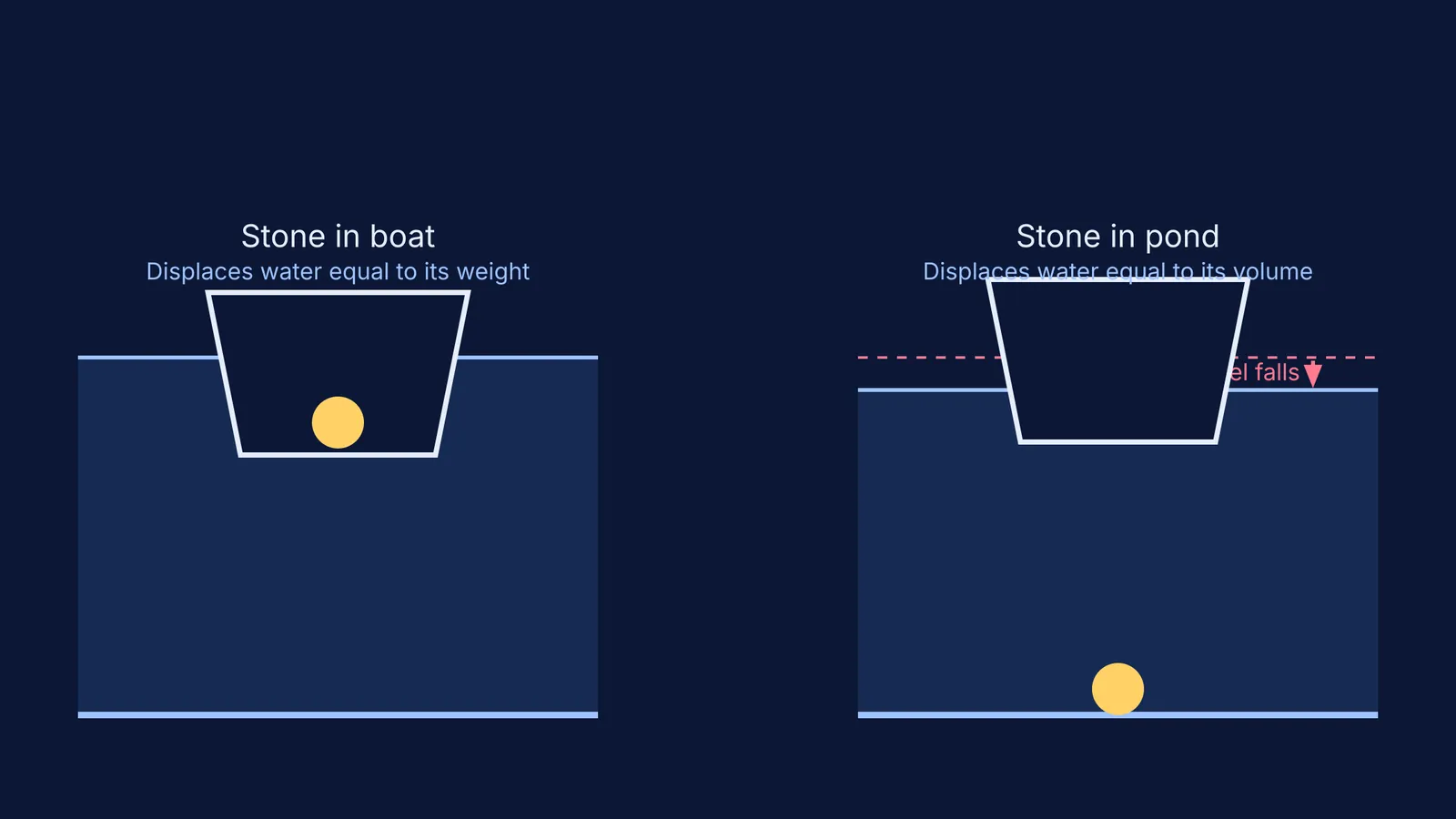
When you throw a stone from a boat into a pond, the water level falls.
To see why, you have to compare the volume of water the stone displaces in each of its two states.
Why does Archimedes' principle predict a drop?
The solution relies on Archimedes' principle, which dictates how floating and submerged objects displace fluid.
When the stone is in the boat: The boat and the stone are floating together. To stay afloat, a floating object must displace a volume of water whose weight equals the object's total weight. Therefore, while in the boat, the stone contributes to the displacement by pushing aside a volume of water equal to its own weight.
When the stone is in the pond: Once thrown overboard, the stone sinks to the bottom. It is no longer supported by the boat's buoyancy, so it merely rests on the pond floor. A submerged object displaces a volume of water equal only to its physical volume.
Because the stone sinks, we know it is denser than water. This means the volume of water required to match the stone's weight (displaced in the boat) is much larger than the stone's actual volume (displaced at the bottom).
Since the total volume of displaced water decreases when the stone moves from the boat to the pond floor, the water level of the pond drops.
The mathematical proof
If you need to prove this in an exam, you can set up a simple equation. Let M_b be the mass of the boat and M_s be the mass of the stone. Let ρ_w be the density of water and ρ_s be the density of the stone.
In the first state, the total floating mass is M_b + M_s. According to Archimedes' principle, the buoyant force equals the weight of the displaced water. The volume of water displaced in this first state (V_1) is:
V_1 = (M_b + M_s) / ρ_w
In the second state, the boat is floating alone, while the stone rests on the bottom. The boat displaces a volume equal to its own mass divided by the density of water. The stone displaces a volume equal to its physical volume, which is M_s / ρ_s. The total volume of water displaced in the second state (V_2) is:
V_2 = (M_b / ρ_w) + (M_s / ρ_s)
To find out what happens to the water level, we subtract V_2 from V_1:
V_1 − V_2 = (M_s / ρ_w) − (M_s / ρ_s)
We can factor out the mass of the stone:
V_1 − V_2 = M_s × (1/ρ_w − 1/ρ_s)
Because the stone sinks in water, we know its density is greater than the density of water (ρ_s > ρ_w). Therefore, 1/ρ_w is greater than 1/ρ_s, making the term in the brackets positive.
Since V_1 − V_2 is a positive number, V_1 must be greater than V_2. The total volume of displaced water is larger when the stone is in the boat, which means the water level is higher in the first state. When the stone is thrown in, the displacement decreases, and the water level falls.
Other variations of the Archimedes' puzzle
Examiners love to test if you genuinely understand displacement, so they frequently change the object in the boat. What happens if you throw a block of wood overboard instead of a stone?
If you throw a block of wood into the pond, the water level stays exactly the same. Wood is less dense than water, so it floats. Whether the wood is floating inside the boat or floating freely on the pond's surface, it continues to displace its own weight in water. Because the displacement remains based on weight in both states, the overall water level does not change.
What if there is a hole in the boat, and the boat sinks? If the boat is made of dense material like steel, the water level will drop as the boat sinks, for the exact same reason the stone caused a drop: the steel transitions from displacing its weight to displacing its much smaller volume.
How to avoid intuition traps in physics?
This problem catches students off guard because human intuition assumes that adding a heavy object to a body of water makes the level rise. It is easy to forget that the stone was already in the pond, pushing down on the boat's hull.
If you want to avoid these traps in your exams, you need to break the system down into states and apply the physical laws strictly. Compare the initial state (floating, displacing weight) to the final state (sunken, displacing volume). Setting the equations up directly gives you the answer without relying on instinct.
If you often find yourself stuck on counter-intuitive mechanics problems, the Fermi Problem Library has worked problems with a step-by-step solver that explains the reasoning rather than printing an answer. You can also experiment with displacement visually in the Fermi Simulation Lab, which provides interactive simulations for the ideas that are easier to see than to read.
Mastering how forces and states change is essential for standard exam problems. You can apply the same rigorous state-comparison method to calculate the elastic potential energy in a stretched wire or to find the tension of a monkey climbing a rope.


