

On this page
When you drop a stone into a well and time how long it takes to hear the splash, that single measurement contains enough information to calculate the depth of the well. However, you cannot simply plug the time into the standard free-fall equation.
The total delay you experience is actually the sum of two different journeys: the stone falling down to the water, and the sound of the splash travelling back up to your ear. Because sound takes a noticeable amount of time to cover large distances, ignoring the second journey will lead you to overestimate the depth.
Here is how to split the total time and set up the equation to find the exact depth.
How do you split the total time?
Let h be the depth of the well, and let T be the total time from when you release the stone until you hear the splash.
The total time T is made up of two parts: T = t₁ + t₂.
The fall time (t₁)
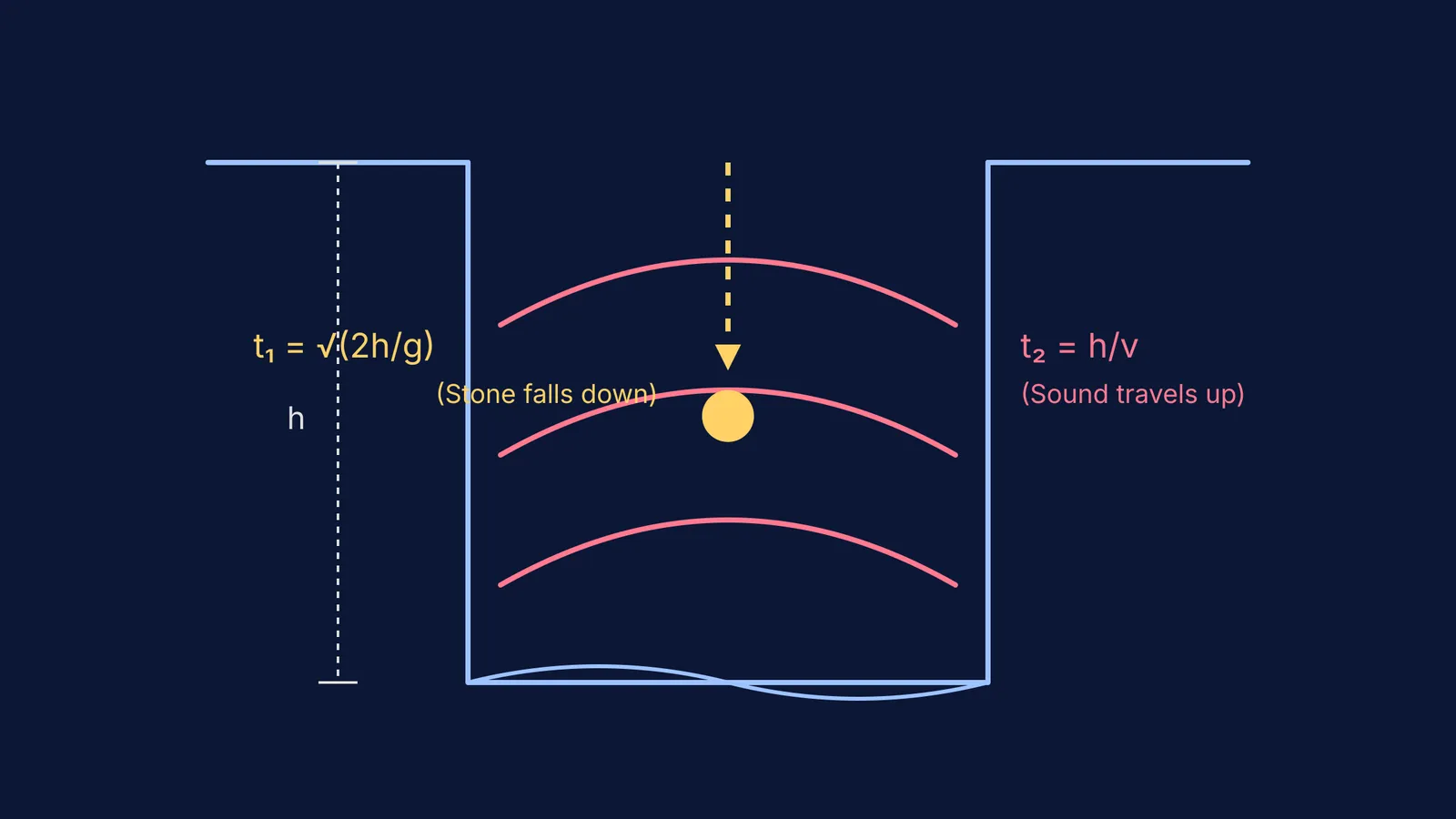
The stone falls freely under gravity from rest. Using the equation of motion s = ut + ½gt², with initial velocity u = 0 and distance s = h, the time it takes the stone to hit the water is: t₁ = √(2h/g)
The sound time (t₂)
Once the stone hits the water, the splash creates a sound wave that travels back up the well at a constant speed v. The time the sound takes to reach the top is simply the distance divided by the speed: t₂ = h/v
Combining these gives the equation for the total time: T = √(2h/g) + h/v
Why does the speed of sound matter?
To solve the equation, you need the physical constants for gravity and the speed of sound.
The standard acceleration due to gravity, g, is typically taken as 9.8 m/s² (Wikipedia).
The speed of sound in air, v, depends on the temperature of the air in the well. At 20 °C, the speed of sound is approximately 343 m/s (Wikipedia).
If you ignore the speed of sound entirely (treating v as infinite), a 3.13-second delay would suggest a well depth of ½ × 9.8 × (3.13)² = 48 metres. But as we will see in the worked example, the real depth is noticeably shallower. The deeper the well, the more the speed of sound skews the basic free-fall calculation. For instance, in a 100-metre well, the sound takes nearly a third of a second just to reach the top, adding a significant delay to your measurement.
How do you calculate the exact depth?
Suppose you drop a stone into a well and hear the splash 3.13 seconds later. What is the actual depth of the well?
Using g = 9.8 m/s², v = 343 m/s, and T = 3.13 s, our equation is: 3.13 = √(2h/9.8) + h/343
This can be simplified to: 3.13 = √(h/4.9) + h/343
This is a quadratic equation disguised in terms of √h. To make it easier to solve, let y = √h. Since h = y², the equation becomes: (1/343)y² + (1/√4.9)y - 3.13 = 0
Converting the fractions to decimals makes it easier to use the quadratic formula (ay² + by + c = 0): 0.0029y² + 0.4518y - 3.13 = 0
Taking the positive root from the quadratic formula gives y ≈ 6.64.
Since h = y², squaring 6.64 gives: h ≈ 44.1 m.
Let's check the result. If the well is 44.1 metres deep, the fall time is √(44.1 / 4.9) = 3.00 seconds. The sound time is 44.1 / 343 = 0.13 seconds. The sum is 3.13 seconds, which perfectly matches our starting measurement. This quick check confirms our arithmetic and validates the exact depth.
How do you picture the paths?
Problems that combine different types of motion—like constant acceleration and constant velocity—are frequent targets in physics exams. Getting the maths right depends on first visualising the two separate journeys.
If you are practising for a physics exam and hit a wall on a problem like this, the Fermi Problem Library has worked problems with a step-by-step solver that explains the reasoning rather than printing an answer. If you get stuck on the algebra, Fermi's AI tutor notices where you are stuck, and decides whether to explain the next step or ask you to write down the expressions for t₁ and t₂.
For more practice with projectile motion and gravity, review the equations for a horizontal projectile from a cliff or check how to find the equation of trajectory of a projectile. If you are struggling with combining multiple motions, the collision of two projectiles midair guide shows how to set up simultaneous paths.


