

On this page
Physical constraints in a molecule can drastically alter its chemical behaviour. Steric inhibition of resonance happens when bulky groups twist a molecule out of shape, breaking electron delocalization.
What is steric inhibition of resonance?
For resonance (electron delocalization) to occur across a molecule, the participating atoms must lie in the same plane. This coplanar geometry allows their p-orbitals to align perfectly side-by-side, creating an unbroken pathway for pi electrons to move.
When bulky substituent groups—such as methyl (−CH₃) or larger alkyl groups—are attached adjacent to one another on a benzene ring, their physical size creates severe steric repulsion or crowding. To relieve this strain, one of the groups is forced to rotate out of the plane of the ring.
Once this group twists out of alignment, its p-orbitals are no longer parallel to the pi-system of the aromatic ring. Resonance is effectively shut off, profoundly changing the molecule's fundamental properties such as its acidity or basicity.
Why does steric inhibition increase basicity in anilines?
Amines act as bases because the lone pair of electrons on the nitrogen atom can be donated to accept a proton (H⁺).
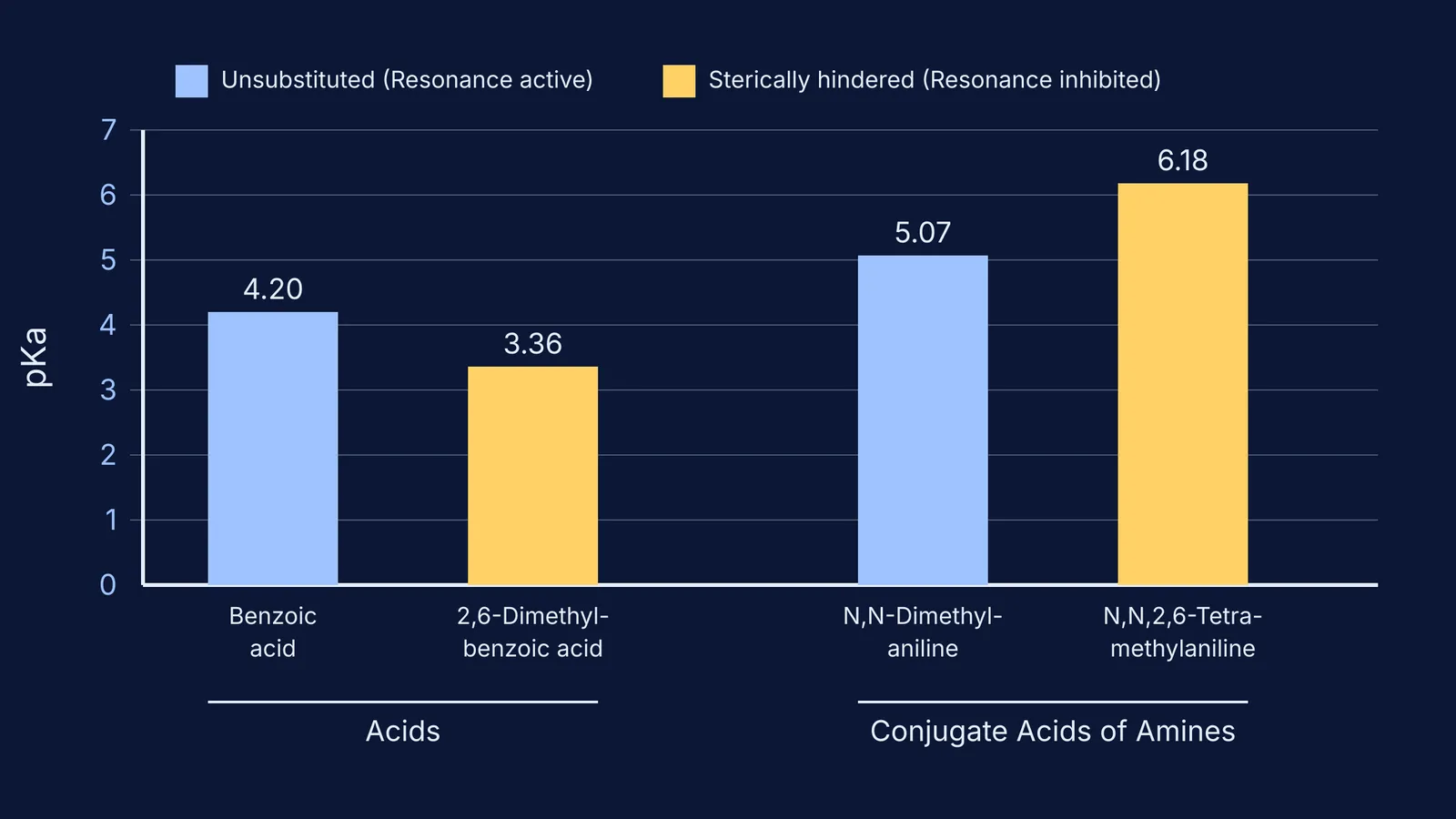
In N,N-dimethylaniline, the dimethylamino group (−N(CH₃)₂) sits in the same plane as the benzene ring. The lone pair of electrons on the nitrogen delocalizes into the ring's pi-system through resonance. Because these electrons are "busy" in resonance, they are less available to bond with a proton; this gives the conjugate acid a pKa of 5.07 (PubChem).
In contrast, N,N,2,6-tetramethylaniline features two additional methyl groups at the *ortho* positions (carbons 2 and 6) on the ring. These bulky groups clash violently with the methyl groups on the nitrogen. To escape this steric crowding, the entire −N(CH₃)₂ group twists perpendicular to the ring.
This rotation breaks the resonance. The lone pair is now localized entirely on the nitrogen atom, making it highly available for protonation. As a result, the basicity increases, pushing the conjugate acid pKa up to roughly 6.18 (PubChem).
How does the ortho effect change acidity?
In benzoic acids, the "ortho effect" is a classic demonstration of steric inhibition of resonance, where substitution at the *ortho* position almost always increases acidity compared to the parent benzoic acid.
Benzoic acid itself has a pKa of 4.20 (PubChem). The carboxylic acid group (−COOH) is roughly coplanar with the ring.
When bulky groups are added, such as in 2,6-dimethylbenzoic acid, the severe steric hindrance forces the carboxyl group out of the plane of the benzene ring. The bulky groups in 2,6-dimethylbenzoic acid drop the pKa to 3.36, indicating it is a much stronger acid (PubChem).
Why does this happen? When the carboxylate group (−COO⁻) twists out of the plane, it can no longer cross-conjugate with the pi-electrons of the benzene ring. Without interference from the ring's electron-donating resonance effect, the negative charge is stabilized entirely by equivalent resonance across the two oxygen atoms. This unhindered stabilization of the carboxylate anion makes the corresponding acid stronger.
Understanding these physical and electronic effects in organic chemistry is crucial for predicting reaction pathways and relative strengths of acids and bases.
How can you spot steric inhibition in exam problems?
If you are asked to rank the acidity or basicity of aromatic compounds, use this three-step checklist to spot steric inhibition of resonance:
Look for adjacent bulky groups: Check if the functional group in question (like −COOH or −NR₂) has bulky substituents (like −CH₃, −NO₂, or halogens) right next to it at the *ortho* positions.
Determine if resonance normally happens: Does the functional group usually share its electrons with the ring (like an amine), or does it rely on cross-conjugation (like a carboxylic acid)?
Assume a twisted geometry: Mentally twist the functional group by 90 degrees so its p-orbitals are perpendicular to the ring. If shutting off resonance localizes a lone pair on nitrogen, basicity increases. If it isolates a carboxylate anion from the ring's electrons, acidity increases.
Organic chemistry often requires you to visualize these three-dimensional twists and rotations in your head. When you are trying to understand why a specific molecule behaves unexpectedly, the Fermi Concept Library offers detailed, structured explorations of stereochemistry and resonance.
If you are stuck on a difficult question about comparing the acidity of carboxylic acids or the basicity of substituted anilines, the Fermi Problem Library provides a step-by-step solver that explains the reasoning rather than just printing an answer. The AI tutor can help you work out what you already know and build a plan for the session, so you sit down to a clear next step.


