

On this page
Thermodynamics cannot measure the absolute enthalpy or Gibbs free energy of a substance in isolation. Only changes relative to a defined baseline can be measured. To compare data across laboratories, physical chemists rely on agreed reference baselines known as standard states.
What are standard state conditions in thermodynamics?
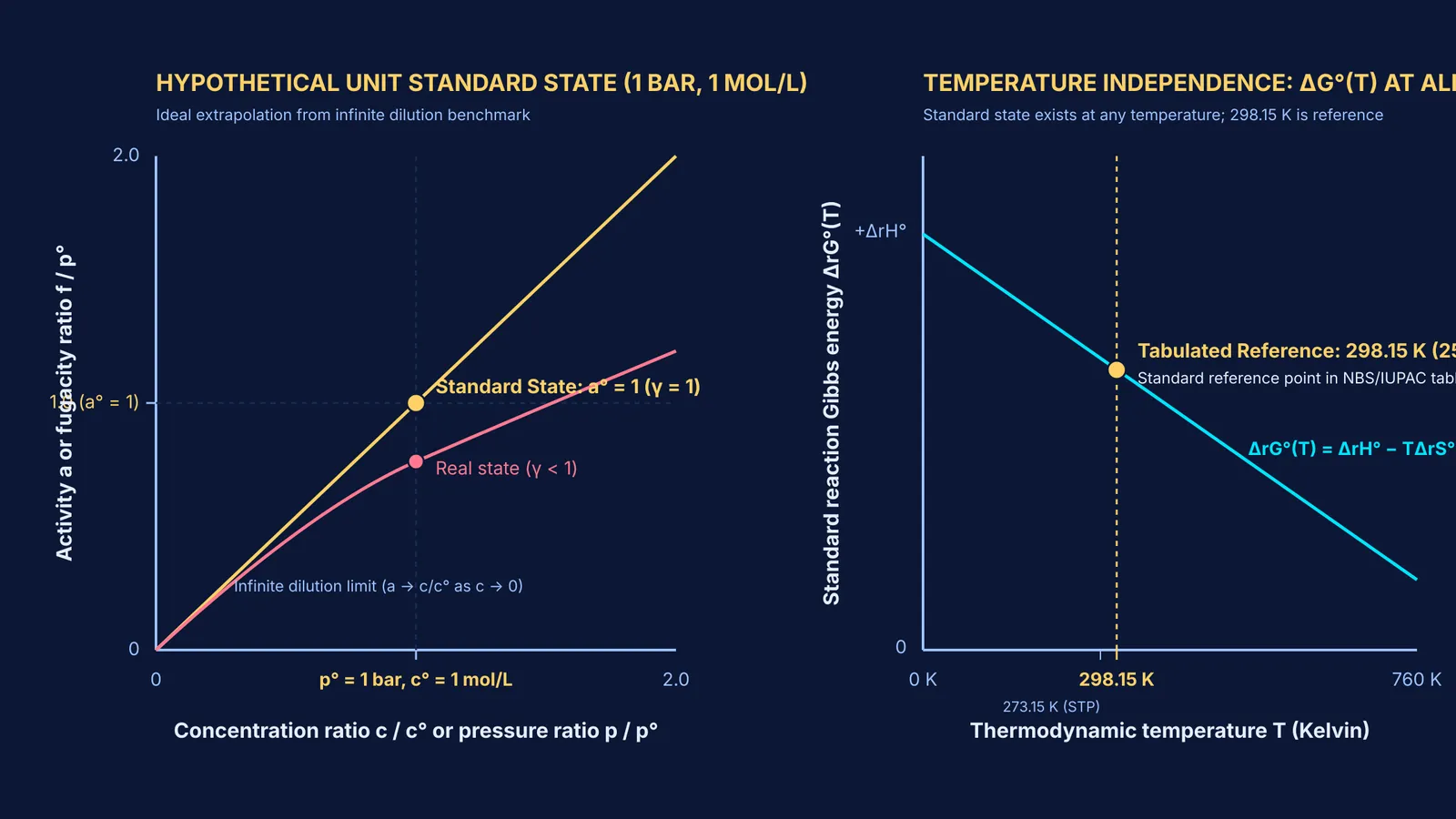
According to the IUPAC Green Book (*Quantities, Units and Symbols in Physical Chemistry*), the standard state of a substance is a reference state chosen to report thermodynamic data:
Pure gases: The hypothetical state of the pure substance behaving as an ideal gas at standard pressure p° = 1 bar (100,000 Pa). Real gas behavior is extrapolated from zero pressure up to 1 bar.
Pure liquids and solids: The pure substance in its most stable physical form at 1 bar. For carbon, this form is graphite; for oxygen, dioxygen gas (O₂).
Solutes in solution: A hypothetical solution at standard concentration c° = 1 mol/L (1 mol/dm³) or standard molality m° = 1 mol/kg at 1 bar, exhibiting infinite-dilution behavior where the activity coefficient equals 1.
Standard quantities carry a superscript circle (°) or Plimsoll symbol (⦵), such as standard enthalpy change ΔH°. This reference baseline ensures that Hess's law enthalpy cycles remain consistent when summing thermochemical equations.
Why is temperature not part of the standard state definition?
A persistent misconception is that a standard state implies 25 °C or 0 °C. Temperature is deliberately excluded from the definition.
A standard state can exist at any temperature of interest. As defined in Pure and Applied Chemistry, standard state conditions fix pressure at 1 bar and solute concentration at 1 mol/L, while leaving temperature as an independent variable.
Standard reaction Gibbs energy ΔrG°(T) varies with temperature according to ΔrG°(T) = ΔrH°(T) − TΔrS°(T), setting the equilibrium constant via ΔrG°(T) = −RT ln K(T). If temperature were fixed by definition, chemists could not define standard states at metallurgical furnace temperatures or use them when calculating standard Gibbs energy from cell potential at non-ambient conditions.
When students confuse standard states with STP, the Fermi Concept Library offers dedicated lessons for every concept in chemistry and physics, clarifying how state variables are defined.
How did 298.15 K become the universal reference temperature?
If temperature is not part of the definition, why do data tables almost always report values at 298.15 K?
In 1923, physical chemists Gilbert N. Lewis and Merle Randall published *Thermodynamics and the Free Energy of Chemical Substances*. They compiled free energies at 25 °C because typical laboratories operated near room temperature. Measuring reaction heats in benchtop water calorimeters near 25 °C minimized heat exchange with room air, avoiding the ice baths required at 0 °C.
In 1952, Frederick D. Rossini and the United States National Bureau of Standards (NBS) published NBS Circular 500, compiling chemical thermodynamic properties at 25 °C. In 1954, the 10th Conférence Générale des Poids et Mesures adopted Resolution 3, fixing the triple point of water at exactly 273.16 K. This set the ice point at 273.15 K, turning 25 °C into exactly 298.15 K.
Subsequent compilations, including the NBS Tables of Chemical Thermodynamic Properties by Donald D. Wagman and colleagues in 1982, maintained 298.15 K to keep reference data consistent across decades of published measurements.
Why did IUPAC switch standard pressure from 1 atm to 1 bar?
Before 1982, standard pressure was defined as 1 standard atmosphere (1 atm), set by the 10th CGPM in Resolution 4 as exactly 101,325 Pa.
In 1982, the International Union of Pure and Applied Chemistry (IUPAC) Commission on Thermodynamics, chaired by J. D. Cox, published recommendations in Pure and Applied Chemistry changing standard pressure to 1 bar (100,000 Pa). This reform aligned chemistry with the SI system by replacing an arbitrary column of mercury with an exact power of ten.
Because 1 bar is approximately 1.31% lower than 1 atm (or 1 atm is 1.325% higher than 1 bar), certain values shifted. Ideal gas enthalpies were unaffected because ideal gas enthalpy depends only on temperature. However, gas entropy increases at lower pressure: the shift added R ln(1.01325) ≈ 0.109 J/(mol K) to standard molar entropies, lowering the standard molar Gibbs energy of an ideal gas by 32.6 J/mol at 298.15 K (and shifting formation Gibbs energies by −32.6 J/mol per mole of net gas produced). At 273.15 K and 1 bar, an ideal gas occupies a standard molar volume of 22.711 L/mol, compared to 22.414 L/mol under the older 1 atm baseline.
How do you solve standard state problems in exams?
Competitive examinations frequently test whether students understand standard baselines versus real conditions. Use this four-step checklist:
Check for standard notation: The Plimsoll or degree symbol (ΔG°, E°) denotes standard conditions where gases are at 1 bar and solutes at 1 mol/L. If actual concentrations differ, use the reaction quotient Q: ΔG = ΔG° + RT ln Q.
Confirm reference allotropes: Elements in their standard states have ΔfH° = 0. According to the NBS Tables of Chemical Thermodynamic Properties, graphite has ΔfH° = 0, while diamond has ΔfH° ≈ 1.9 kJ/mol.
Separate STP from standard states: For gas stoichiometry at STP, use 273.15 K and 1 bar. For thermochemical energy differences, use the principles in relating ΔH and ΔU with ΔngRT.
Recalculate for temperature changes: For reactions at 500 K, do not use ΔG°(298.15 K). Calculate the new value using ΔrG°(T) ≈ ΔrH°(298.15 K) − TΔrS°(298.15 K) before finding the equilibrium constant.
For students tackling non-standard reaction calculations, the Fermi Problem Library provides worked problems with a step-by-step solver that explains the reasoning rather than printing an answer.


