

On this page
Trigonometry becomes much easier when you realise that many exam problems are just simple algebra problems wearing a mathematical disguise. A common question in Class 10 mathematics tests your knowledge of standard angles by hiding two linear equations inside sine and cosine functions.
Here is exactly how to break down the classic problem: given that sin(A − B) = 1/2 and cos(A + B) = 1/2 (where 0° < A + B ≤ 90° and A > B), find the values of A and B.
How do you solve sin a minus b equals half and cos a plus b equals half?
The trick is to remove the trigonometric functions entirely. You do this by asking yourself: *Which angle gives this specific ratio?*
According to mathematical principles, certain angles have simple, exact trigonometric values expressed purely through arithmetic; for instance, both the sine of 30° and the cosine of 60° equal exactly 1/2 (Wikipedia).
Using these standard angles, we can translate the problem:
Since sin(A − B) = 1/2 and we know sin(30°) = 1/2, it must be that:
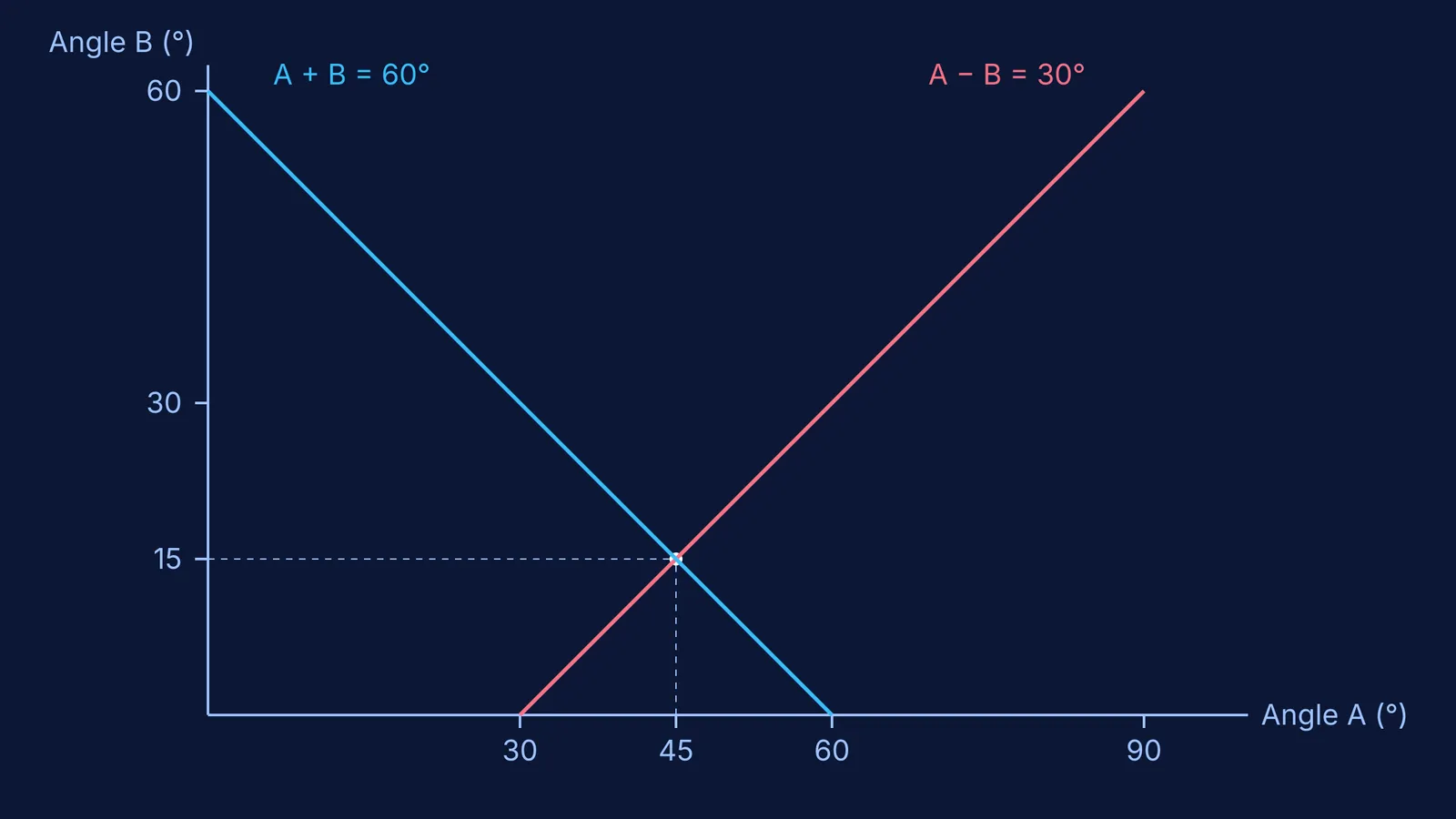
A − B = 30°
Since cos(A + B) = 1/2 and we know cos(60°) = 1/2, it must be that:
A + B = 60°
You now have a system of two linear equations. To solve them, simply add the two equations together: (A − B) + (A + B) = 30° + 60° 2A = 90° A = 45°
Now substitute the value of A back into the first equation: 45° − B = 30° B = 15°
So, the final angles are A = 45° and B = 15°. If you ever hit a wall with problems like this, the Fermi Problem Library has worked problems with a step-by-step solver that explains the reasoning rather than printing an answer.
What do the conditions 0° < A + B ≤ 90° and A > B mean?
Exam questions rarely give you the equations on their own; they usually include boundary conditions. These are not just decorations; they ensure the problem has a single, unique solution.
0° < A + B ≤ 90°: This tells you that the sum of the angles sits in the first quadrant of the unit circle. Trigonometric functions repeat their values periodically (for instance, the sine of 150° is also 1/2). By restricting A + B to an acute or right angle, the question guarantees you only need the standard 60° angle for the cosine equation, keeping you out of higher-level quadrant rules.
A > B: This condition guarantees that A − B is a positive number. If B were larger than A, A − B would be negative, which would mean looking for a negative angle that yields a positive sine value (pushing you outside the simple first-quadrant standard angles).
If you want to read more about how angles behave across different quadrants, read our guide to conditional identities when A + B + C = π, worked, or see how to apply the exact values of sin 18° and cos 36°, derived step by step.
A step-by-step checklist for trigonometric angle conditions
When you face a similar question in a test, follow this repeatable framework:
Identify the standard angles: Look at the ratio on the right side of the equals sign (like 1/2, 1/√2, or √3/2) and recall which angle from your standard 0–90° table gives that value for the given function.
Write the linear equations: Drop the sine, cosine or tangent functions and set the inside expression (like A + B) equal to the standard angle you found.
Solve algebraically: Use simultaneous equations (usually by adding or subtracting them) to find the individual variables.
Check the boundaries: Verify that your final values fit the constraints (such as A > B) given in the problem statement.
Whether you are working with double angles or standard ones, finding the linear relationship is the key. For more advanced practice, you can explore using sin 3x, cos 3x and tan 3x formulas in trigonometry problems.


