

On this page
The method of finding square roots digit by digit using a place-value system dates back as early as 499 CE to the Indian mathematician Aryabhata (MacTutor). Prime factorisation is a great way to find the square root of a perfect square like 144 or 400. But when a numerical in a physics or mathematics exam ends with an awkward, non-perfect square, prime factorisation is no longer enough. The long division method steps in exactly where factorisation stops, allowing you to calculate the square root of any number, including decimals, to as many places as you need.
When you find yourself stuck on the mechanics of a mathematical calculation, you can always visit the Fermi Concept Library to bridge the gap. If you do not know where to start, Fermi works out what you already know, builds a plan for the session, and teaches through it—writing on a board, drawing the figure, running the simulation, and checking understanding as it goes.
Why use the long division method for square roots?
The method is faster and far more robust than guessing or relying purely on memorisation. It unravels the number digit by digit, much like standard long division, but with a shifting divisor. It is the only manual way to evaluate irrational numbers (like √2 or √3) in an exam hall without a calculator. While estimation can get you close, the long division method gives you exact, rigorous precision up to whatever decimal place you require.
If you are using this method inside larger calculations, you might also find our guides on Quadratic word problems in Class 10: speed, age and area helpful, or learn how to count roots visually in How many roots? Counting intersections of two sketched curves.
How do you group digits before dividing?
The first and most crucial step is pairing the digits correctly. If you group them wrong, the entire calculation will be fundamentally off. This grouping step ensures you process the magnitude of the number correctly before division begins.
For whole numbers, start at the unit's place (the rightmost digit) and place a bar over pairs of digits moving left. If there is a single digit left over at the far left, it gets its own bar and acts as the starting point.
For decimals, start at the decimal point and move right. Pair every two digits. Unlike whole numbers, you can add as many pairs of zeros as you need at the very end to reach your desired number of decimal places without changing the number's value.
For example, the number 529 becomes paired as 5 and 29. A decimal like 152.275 becomes paired as 1, 52, 27, and 50 (adding a zero to complete the final pair on the right side).
What are the steps for the long division method?
Once your numbers are paired under bars, you can begin the cycle. Think of each pair as one "period".
Find the first divisor. Look at the leftmost pair (or single digit). Find the largest integer whose square is less than or equal to this number. Write this integer as both your first divisor and the first digit of your quotient.
Subtract and bring down. Subtract the square of your quotient digit from the leftmost pair. Bring down the next pair of digits and place them next to your remainder. This creates your new dividend.
Double the divisor. Take your entire current quotient (ignoring the decimal point) and double it. Write this number down with a blank space to its right. This is the prefix for your new divisor.
Find the next digit. Find a single digit (let's call it x) to fill the blank, such that your new divisor multiplied by x is less than or equal to your current dividend.
Repeat the cycle. Write x as the next digit in your quotient. Subtract the product from your dividend, bring down the next pair of digits, and repeat step 3.
How do you find the square root of 2?
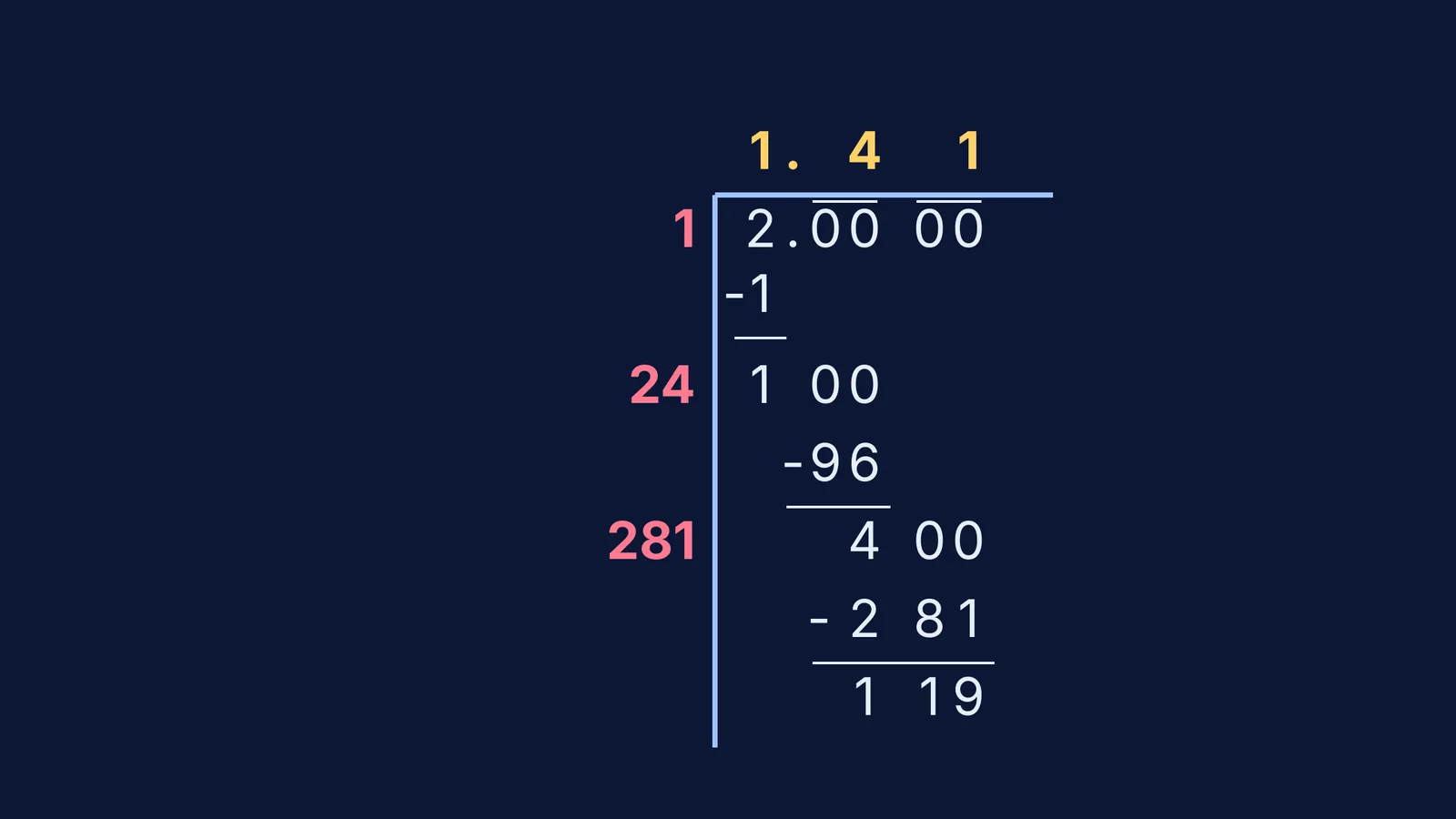
Irrational numbers do not terminate, so we use the long division method by appending pairs of zeros. Let us find √2 up to two decimal places.
Write the number as 2.0000.
Step 1: The leftmost digit is 2. The largest square less than 2 is 1 (since 1² = 1). The first digit of the quotient is 1. Subtract 1 from 2 to leave a remainder of 1.
Step 2: Bring down the first pair of zeros, making the new dividend 100. Place a decimal point in your quotient to match the decimal in the dividend.
Step 3: Double the quotient (1) to get 2. The new divisor starts as "2_". We need a digit x such that the divisor "2x" multiplied by x is ≤ 100. Since 24 × 4 = 96, the digit is 4. Subtract 96 from 100 to leave a remainder of 4. Your quotient is now 1.4.
Step 4: Bring down the next pair of zeros, making the dividend 400.
Step 5: Double the current quotient (14) to get 28. The new divisor starts as "28_". We need a digit x such that the divisor "28x" multiplied by x is ≤ 400. Since 281 × 1 = 281, the digit is 1. Subtract 281 from 400 to leave a remainder of 119.
Your quotient is 1.41. You can continue bringing down pairs of zeros infinitely to calculate further decimal places if required.


