

On this page
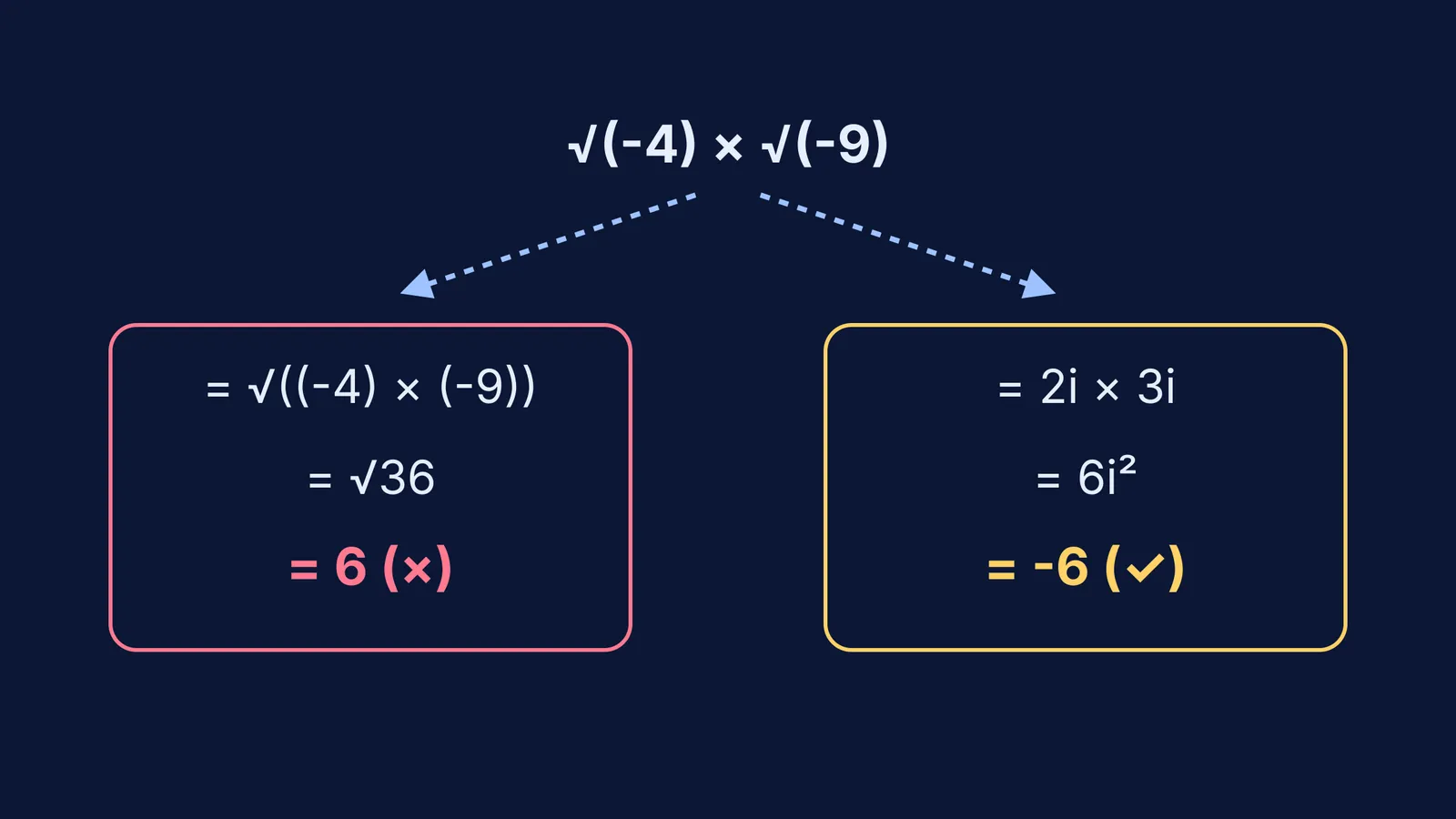
A classic algebra trap catches many students when they first meet complex numbers. When asked to evaluate √(-4) × √(-9), the intuitive leap is to multiply the numbers under the roots to get √36, which is 6. However, the correct answer is -6.
This mistake reveals a hidden restriction in a rule you learned in middle school. Here is why the familiar formula breaks down, and how to work with the square roots of negative numbers safely when studying for exams.
Why does the rule √a × √b = √(ab) fail?
For years, you have used the property √a × √b = √(ab) to simplify surds. But as noted in standard algebra rules—such as those covered in Wikipedia's guide to square roots—this identity is true only when at least one of a or b is a non-negative real number.
If both numbers are positive, the rule works perfectly (√4 × √9 = √36 = 6). It even works if one number is negative and the other is positive. For instance, √(-4) × √9 = √(-36) = 6i. In this case, the negative sign is preserved under the root, and pulling it out correctly yields an imaginary number.
But when a and b are both negative, the rule snaps. Blindly writing √(-4) × √(-9) = √((-4) × (-9)) assumes that the root of a product behaves the same way in the complex plane as it does on the real number line. It does not. Square roots are technically multi-valued functions, meaning every non-zero number has two square roots (one positive and one negative). To keep mathematics consistent, mathematicians define the "principal square root." The product rule you learned only applies to principal square roots of positive real numbers.
If this rule held for two negative numbers, it would lead to a famous mathematical contradiction. Consider multiplying the square root of negative one by itself: 1 = √1 = √((-1) × (-1)) = √(-1) × √(-1) = i × i = i² = -1.
Because 1 does not equal -1, the rule cannot be used here without breaking the foundations of arithmetic.
How to multiply square roots of negative numbers?
To avoid the trap, always rewrite the square root of a negative number in terms of the imaginary unit i before doing any multiplication. The definition of i is √(-1), meaning that i² = -1.
Let us step through the problem √(-4) × √(-9) the right way:
Pull out the negative signs as i: √(-4) = √(4 × -1) = 2i.
Do the same for the second term: √(-9) = √(9 × -1) = 3i.
Now, multiply the two complex terms together: 2i × 3i = 6i².
Replace i² with -1: 6 × (-1) = -6.
This method guarantees you will never accidentally cancel out the negative signs before evaluating the roots.
Applying this to variables and polynomials
This rule is not just a trick for integers; it applies to algebraic variables as well. If you are given an expression like √(-x) × √(-y) where both x and y are positive real numbers, you cannot simplify it to √(xy).
Using the correct method, you first factor out the i from both terms. The expression becomes (i√x) × (i√y). Multiplying these together yields i²√(xy), which simplifies to -√(xy). If you see a question in your exam asking to evaluate √(-a) × √(-b), pausing to define the signs of the variables will save you from losing marks.
Checking your complex number concepts
Complex numbers introduce rules that do not behave like real arithmetic. The modulus and the principal argument change depending on which quadrant your number lands in, making it vital to grasp the definitions rather than just memorising formulas. You can explore Finding arg z in each quadrant: the principal value rules to see how angles shift, or look at Solving equations in complex numbers by putting z = x + iy to handle algebraic geometry.
If you keep falling into algebraic traps like the negative root problem, you are not alone. When a student attempts this exact problem in the Fermi Problem Library, the step-by-step solver explains the reasoning rather than printing an answer. Fermi's AI tutor notices where they are stuck and explains why the property breaks, asking the student to rewrite each term with i first. You can also explore the theory behind multi-valued functions and principal roots in the Fermi Concept Library.
By treating the imaginary unit i as a first step rather than an afterthought, you lock down the correct sign every time.


