

On this page
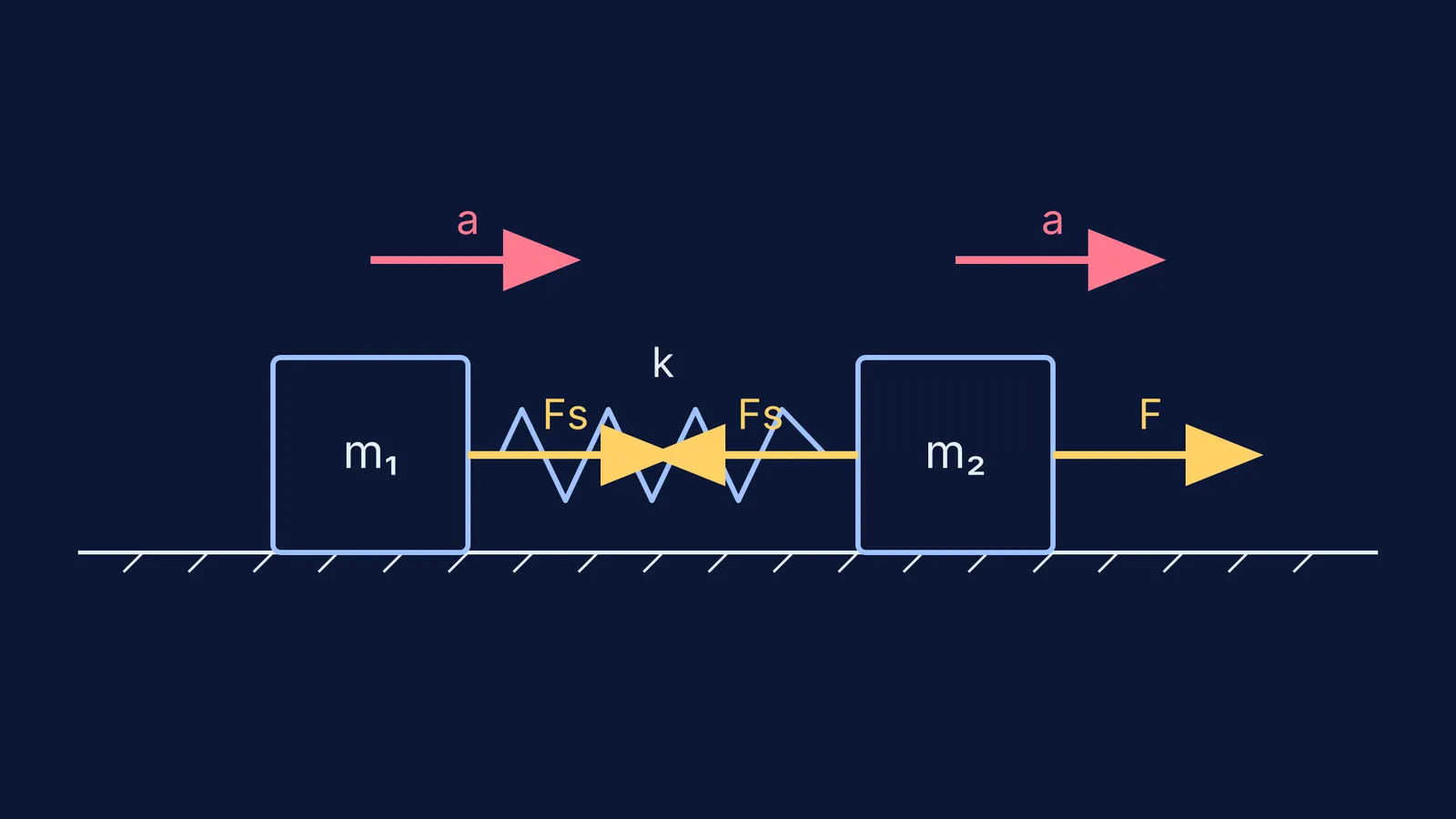
You often encounter physics problems where two masses are joined by a spring and a constant force pulls one of them. While the initial motion is a messy combination of moving forward and bouncing, the blocks eventually settle into a steady state once the oscillations die out. Finding the spring's extension in this state is a classic test of Newton's laws.
What is the acceleration of the two blocks?
When a constant force F is first applied to the front block, it darts forward and stretches the spring. The spring then pulls back on the front block and forward on the trailing block. For a while, the distance between them fluctuates. But as these oscillations damp out due to internal friction, the blocks settle into moving together at a constant distance apart.
At this steady state, both blocks share the same acceleration. According to Newton's second law for a system, the internal spring forces cancel out, meaning the acceleration of the center of mass is determined solely by the net external force (OpenStax). Because the entire system acts like a single object of mass m₁ + m₂ driven by the external force F, the common acceleration is:
a = F / (m₁ + m₂)
How do you find the extension of the spring?
To find how much the spring stretches, we isolate the trailing block (let us call it m₁) by drawing its free-body diagram.
The only horizontal force pulling m₁ forward is the spring force, Fs. Since we know m₁ is accelerating at the common rate a, Newton's second law gives us the magnitude of this spring force:
Fs = m₁a
Substituting our expression for acceleration into this equation:
Fs = m₁ [ F / (m₁ + m₂) ]
Now we apply Hooke's law, which states that the spring force is proportional to its extension x and the spring constant k (Fs = kx). Equating the two expressions for the spring force yields:
kx = m₁F / (m₁ + m₂)
Dividing by k gives the final extension of the spring:
x = m₁F / k(m₁ + m₂)
This result shows that the spring stretches exactly enough to provide the force required to accelerate the trailing block at the system's overall rate.
How do you verify the answer using the front block?
A robust way to check your work during an exam is to isolate the other mass. Let us apply Newton's second law to the front block (m₂), which is being pulled by the external force F.
The net force on the front block is the forward force F minus the backward pull of the spring Fs. This net force must equal the block's mass times the common acceleration:
F − Fs = m₂a
Substituting the acceleration a = F / (m₁ + m₂) into this equation gives:
F − Fs = m₂ [ F / (m₁ + m₂) ]
If you rearrange this to solve for Fs, you will find:
Fs = F − [ m₂F / (m₁ + m₂) ] Fs = F [ (m₁ + m₂ − m₂) / (m₁ + m₂) ] Fs = m₁F / (m₁ + m₂)
This perfectly matches the spring force we found by isolating the trailing block. The mathematics is self-consistent, confirming that our steady-state extension is correct.
What happens to the energy during the initial oscillations?
Before the blocks reach their steady state, their motion is much more complex. When the constant force F is first applied, the front block accelerates faster than the rear block. The spring stretches beyond its final steady-state extension, then snaps back, causing the blocks to oscillate around their center of mass.
Over time, internal friction within the spring material damps out these vibrations. The kinetic energy of this bouncing motion is dissipated as heat. By the time the blocks reach a steady extension, the work done by the external force F has been distributed into three parts:
The kinetic energy of the steadily moving two-block system.
The elastic potential energy stored in the stretched spring.
The energy lost to heat during the damping phase.
What happens if you pull the other block?
If you apply the same force F to m₁ instead of m₂, the system's overall acceleration remains exactly the same because the total mass has not changed. However, the roles of the blocks reverse.
The trailing block is now m₂. The spring only has to pull m₂, so the new spring force becomes m₂F / (m₁ + m₂). Consequently, the spring extension changes to m₂F / k(m₁ + m₂). The spring always works exactly as hard as it needs to drag the mass left behind it.
This principle of isolating a single block to find an internal force is identical to finding the contact force between blocks pushed together on a smooth floor. And if you want to test your understanding of springs further, try predicting what happens when a string is cut in a spring system to find the instantaneous accelerations.
Working through multi-body problems requires keeping track of which force acts on which mass. If you find yourself confusing internal and external forces, Fermi's AI tutor can work out what you already know and build a plan for the session, checking understanding as it goes. To see more worked mechanics examples, you can explore the Fermi Problem Library.


