

On this page
A classic mechanics problem in Class 11 physics connects the static properties of a spring balance to its dynamic behaviour. The question gives you the scale's maximum reading and length, and asks you to find the mass or weight of an object that oscillates with a specific time period.
Understanding this connection is essential because it shows how a single physical property—the stiffness of the spring—determines both how much it stretches under a steady weight and how fast it bounces when disturbed.
Spring balance scale reading: how to find the period of oscillation?
To solve this, you need to break the problem into two parts. A spring balance measures weight by the extension of a spring, which obeys Hooke's Law. Hooke's Law states that the force needed to extend or compress a spring by some distance is proportional to that distance. The maximum reading on the scale corresponds to the maximum extension of the spring.
First, use the static information to find the spring constant (k). The spring constant is a measure of how stiff the spring is. If a balance reads from 0 to M_max kg and the length of the scale is L metres, the maximum force applied is the weight of that maximum mass: F = M_max × g. The spring constant is the force per unit extension: k = (M_max × g) / L
Once you have k, you can use the formula for the time period (T) of a spring-mass system. For a mass m suspended from the spring, the period of oscillation is determined entirely by the mass and the spring constant: T = 2π√(m/k)
If the time period is given, you can rearrange this to find the unknown mass: m = (k × T²) / (4π²)
This method works because the spring constant k is a property of the spring itself. It does not change whether the spring is hanging still with a heavy weight or bouncing up and down with a lighter one.
How do you solve the NCERT spring balance problem?
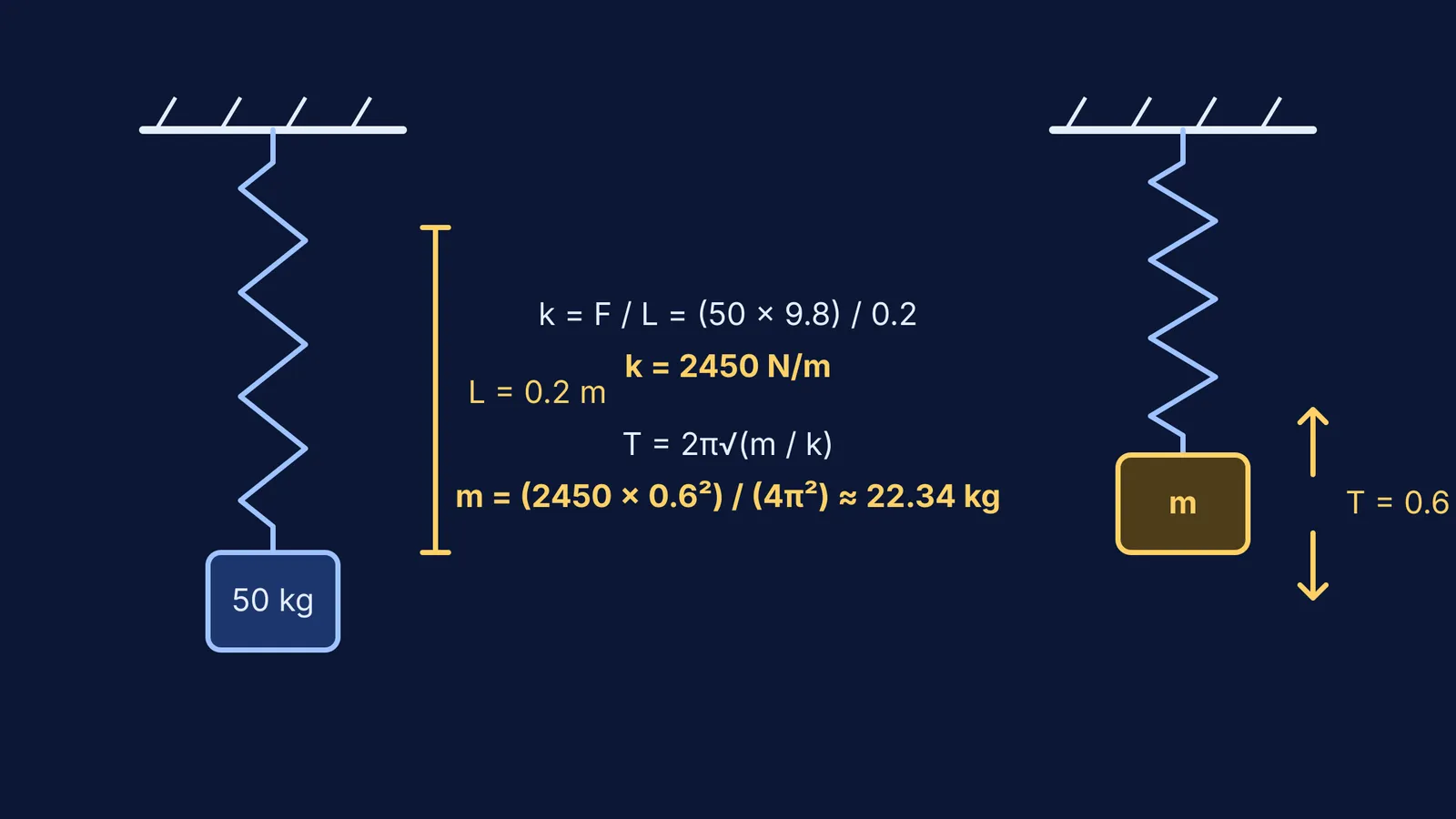
Let us apply this to a standard NCERT Class 11 Physics problem. A spring balance has a scale that reads from 0 to 50 kg, and the length of the scale is 20 cm. A body suspended from this balance, when displaced and released, oscillates with a period of 0.6 s. What is the weight of the body?
1. Find the spring constant: The maximum mass the scale can read is 50 kg, which stretches the spring by 0.2 m (20 cm). Taking g = 9.8 m/s², the maximum force is: F = 50 × 9.8 = 490 N
The spring constant is: k = 490 / 0.2 = 2450 N/m
2. Find the mass of the body: We know the period of oscillation is 0.6 s. We now substitute the known values into the rearranged time period formula: m = (k × T²) / (4π²) m = (2450 × 0.6²) / (4 × π²) m = (2450 × 0.36) / (4 × 9.87) m = 882 / 39.48 ≈ 22.34 kg
3. Calculate the weight: The final step is to convert this mass back into a weight, which is the force of gravity acting on the body. We multiply the mass we just found by the acceleration due to gravity: W = m × g = 22.34 × 9.8 ≈ 219 N.
What are the steps to tackle complex mechanics problems?
When a problem combines multiple concepts—such as statics and simple harmonic motion—it helps to have a reliable framework. Here is a checklist for solving connected mechanics questions:
Identify the bridge variable: Look for the physical property that connects the different parts of the problem. In this case, the spring constant k links the static stretching to the dynamic oscillation.
List your knowns separately: Write down the given values for the static situation (maximum mass, length of scale) in one column, and the dynamic situation (time period) in another.
Check your units: Ensure all units are in standard SI form (metres, kilograms, seconds, newtons) before you start calculating.
Rearrange before substituting: It is usually easier to rearrange your algebraic formula to make the unknown variable the subject (like m = (k × T²) / (4π²)) before plugging in the numbers. This reduces rounding errors.
How can you practice for JEE and NEET?
Understanding how to link static force and dynamic oscillation is crucial for competitive exams, where questions often test two or more topics at once. You can test your understanding of similar mechanics problems in the Fermi Problem Library.
When you face these questions, remember that finding the "bridge" property is half the battle. For more practice with connected systems, you might want to look at Simple pendulum string tension at any angle: mg cos θ + mv²/l or Finding the mass of a metre scale with the principle of moments.


