

On this page
If you take two unbroken eggs from your refrigerator—one fresh and raw, the other hard-boiled—they look completely indistinguishable from the outside. Both have the same oval shape, smooth calcium carbonate shell, and similar weight. Yet place them on a flat countertop, give each a sharp twist with your fingers, and their physical identities reveal themselves in seconds.
The hard-boiled egg spins briskly and stably like a well-balanced top, whereas the raw egg drags, wobbles, and slows down almost immediately. Even more startling is what happens when you momentarily halt each egg with a fingertip: the boiled egg stays dead still, but the raw egg starts spinning again on its own. This everyday kitchen demonstration is one of the most elegant illustrations of fluid dynamics, inertia, and rotational mechanics in physics.
How do you do the spinning egg test?
You can test any egg on a kitchen counter using a simple two-step diagnostic protocol:
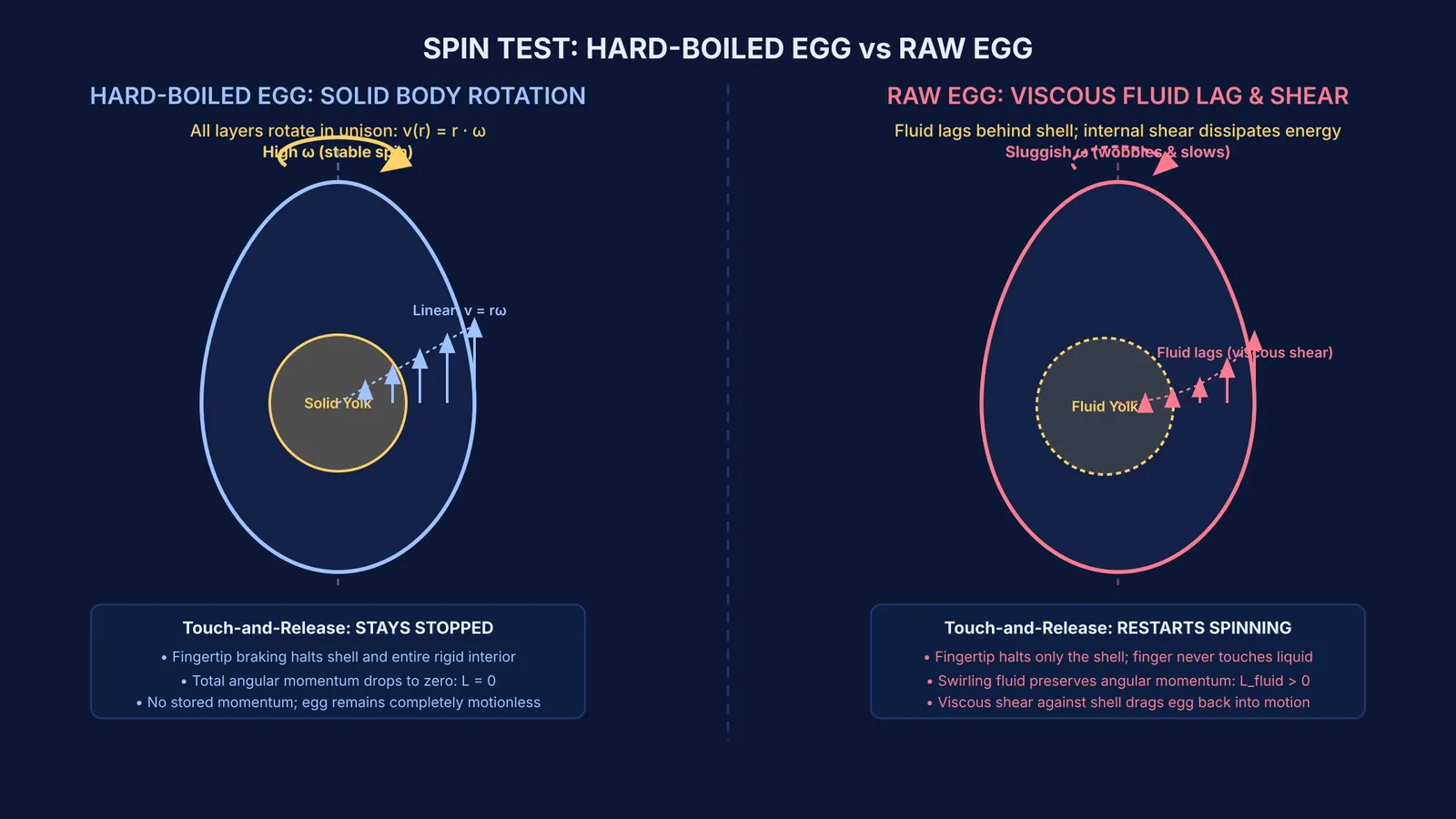
The Spin Stability Test: Place the egg on a smooth, flat surface and spin it firmly between your thumb and forefinger. A hard-boiled egg accelerates cleanly, rotates at a high angular velocity, and maintains a stable axis. If you spin it fast enough, it will even stand upright on its narrow tip. This vertical rising motion was analyzed by Cambridge mathematician H. K. Moffatt and Yutaka Shimomura in *Nature*, showing that sliding friction at the contact point exerts a torque that turns horizontal rotation into upright precession. In contrast, a raw egg feels sluggish, wobbles irregularly from side to side, and grinds to an early halt.
The Touch-and-Release Test: While the egg is spinning, touch the top of the shell lightly with the tip of your index finger for just a fraction of a second—just long enough to bring the shell to a complete stop—and then lift your finger immediately. A hard-boiled egg stays completely motionless. A raw egg pauses for an instant, then spontaneously resumes rotating in the original direction.
Why does a raw egg spin more slowly and wobble?
The difference in spin speed and stability boils down to the distinction between a rigid body and an unconstrained fluid system.
In a hard-boiled egg, cooking has heated the proteins past their denaturation thresholds, forming a cross-linked solid gel. The shell, white, and yolk are locked into a single continuous mass. When you apply an external torque τ with your fingers, Newton's second law for rotation (τ = Iα) applies uniformly across the entire body. The egg accelerates smoothly as an ideal rigid body with a fixed moment of inertia.
A raw egg, however, consists of a rigid shell enclosing roughly 60% liquid albumen (egg white) and 30% viscous yolk suspension by mass. As characterized in *Physics of Fluids*, when your fingers twist the shell, they do not exert torque directly on the internal fluid. Instead, rotational motion must diffuse inward across fluid boundary layers through viscous shear stress.
Because of rotational inertia—Newton's first law applied to rotating frames—the liquid interior resists angular acceleration and initially stays at rest while the shell spins around it. Physicists Yann Bertho, Baptiste Darbois Texier, and Ludovic Pauchard measured how the shear-thinning and viscoelastic properties of egg white govern this internal flow. As the rigid shell slips past the sluggish liquid core, viscous friction rapidly dissipates rotational kinetic energy into heat, causing the egg to spin at a noticeably lower speed.
Furthermore, as the fluid sloshes inside the spinning shell, the mass distribution shifts continuously. This dynamic movement constantly displaces the centre of gravity and centre of mass relative to the geometric spin axis, producing the characteristic wobble and precession.
Why does a raw egg start spinning again after you stop it?
The second half of the experiment—where a stopped raw egg restarts itself—is a classic demonstration of Newton's first law of motion and the conservation of angular momentum.
As characterized in *Physics of Fluids*, when a raw egg is spun for several rotations, viscous shear gradually drags the internal fluid along until the liquid white and yolk are swirling in unison with the shell. At this moment, the egg's total angular momentum is distributed across both the outer shell and the rotating internal liquid: L_total = L_shell + L_fluid.
When you touch the shell with your fingertip, your finger applies an external braking torque to the outer shell. Because the touch lasts only a fraction of a second, it halts the shell alone, reducing L_shell to zero. But your finger never touches the liquid inside. Due to fluid inertia, the yolk and albumen continue swirling inside the motionless shell.
The moment you lift your finger, there is no longer any external torque acting on the egg. The swirling internal liquid is now rotating faster than the stationary shell. In their 2022 laboratory measurements in *Physics of Fluids*, researchers recorded that for a fingertip pause of about 160 milliseconds, the released egg resumes spinning at roughly half its initial angular velocity. The fluid exerts a forward viscous shear stress on the inner wall of the shell. In accordance with Newton's third law of rotational motion, this internal torque transfers angular momentum from the swirling liquid back into the shell. The shell starts turning again on its own until viscous dissipation and table friction bring the entire system to rest.
A hard-boiled egg cannot do this because it is a solid unit. Stopping the outer shell halts every particle inside simultaneously. Its angular momentum drops to zero instantly, leaving no stored motion to restart the spin.
What does the egg test teach us about rotational motion?
For students studying mechanics in Class 11 and preparing for competitive exams like JEE Advanced, the spinning egg illustrates critical rotational dynamics concepts:
Moment of inertia in real bodies: In standard textbook problems on calculating moment of inertia, objects are treated as ideal rigid bodies. The raw egg shows how dynamic mass redistribution alters rotational inertia and stability under torque.
Energy dissipation in non-rigid systems: The rapid slowing of a raw egg shows why engineers must design baffles in fuel tanks for rockets, aircraft, and tankers to prevent liquid sloshing from destabilizing vehicle control.
Contact friction as a torque generator: As physicist Rod Cross demonstrated in the *American Journal of Physics*, contact friction on rounded bodies does not merely oppose motion; it generates torques that can alter the spin axis and cause spinning tops to rise vertically against gravity.
Mastering mechanics requires looking past static formulas to build physical intuition for how torques, angular momentum, and friction interact, helping you avoid common rotational motion mistakes on exam day. If you want to visualize how mass distribution, torque, and friction govern rotating systems, the Fermi Simulation Lab provides interactive simulations for the ideas that are easier to see than to read.


