

On this page
Electron configuration is only the first step in predicting an atom's behaviour. To understand its magnetic properties and its lowest-energy ground state, you must also know how its electrons align. This is measured by spin multiplicity.
Here is how you find it, why the formula simplifies to a quick counting trick, and how it applies to elements like carbon, nitrogen and oxygen.
How to calculate spin multiplicity of an atom?
Spin multiplicity is a quantum mechanical value that describes the number of possible orientations of an atom's total spin in space. It is calculated using a straightforward formula:
Multiplicity = 2S + 1
Here, S stands for the total spin angular momentum 1. Every single electron possesses an intrinsic spin of 1/2. However, when two electrons pair up inside the same orbital, they must take opposite spins (one spin-up at +1/2, and one spin-down at -1/2). These opposite spins cancel each other out, leaving a net spin of zero.
Therefore, to calculate the total spin S, you only need to look at the unpaired electrons. If an atom has n unpaired electrons, its total spin is simply S = n × 1/2.
In an exam, you can skip the fractions. Just count the unpaired electrons and add one.
What is the spin multiplicity of carbon, nitrogen and oxygen?
The best way to see this formula in action is by drawing orbital boxes for the p-block elements.
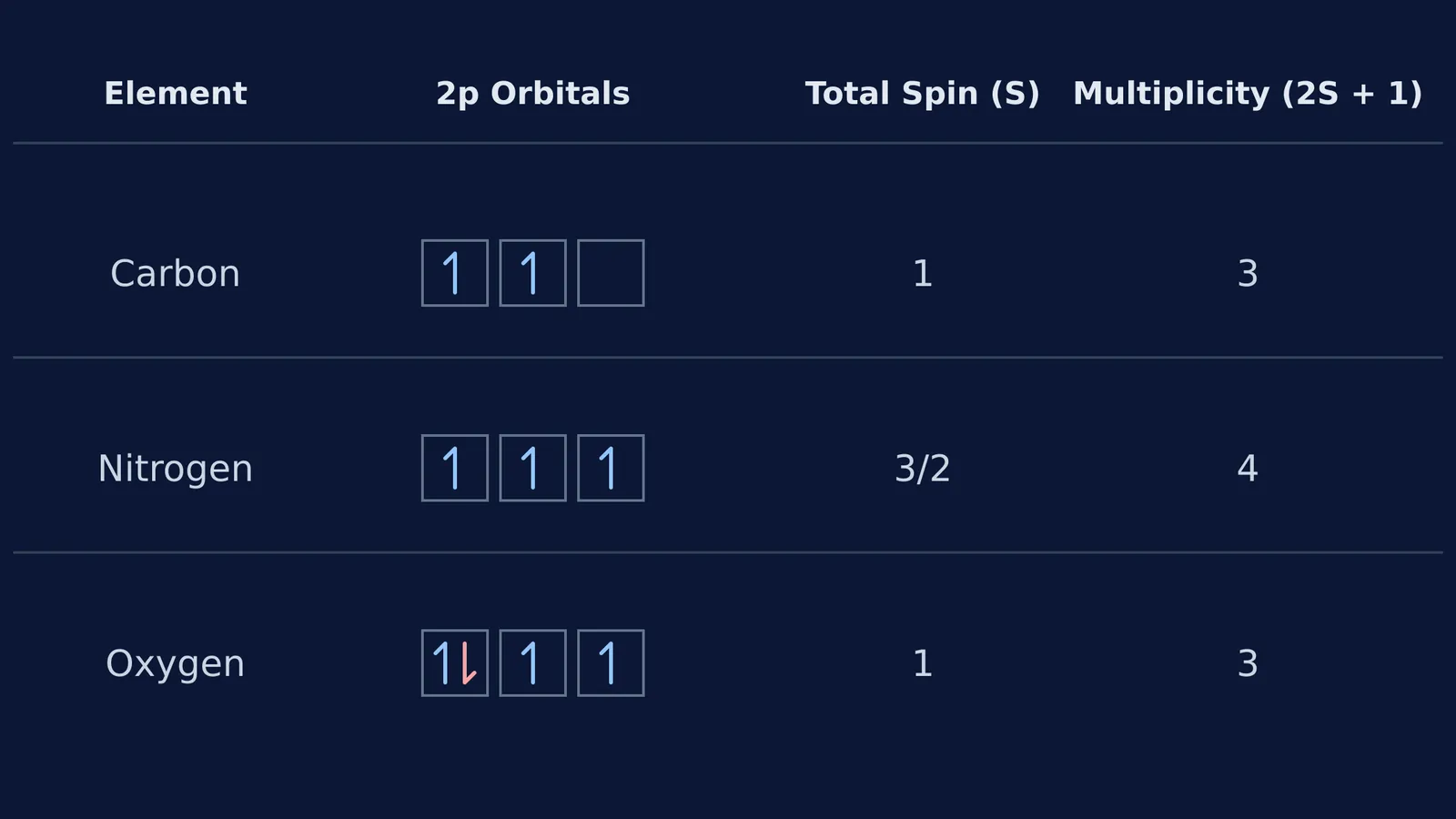
Carbon (Z = 6) Carbon has an electron configuration of 1s² 2s² 2p². The two electrons in the 2p subshell occupy separate orbitals with parallel spins.
Number of unpaired electrons (n): 2
Total spin (S): 1/2 + 1/2 = 1
Multiplicity: 2(1) + 1 = 3
Because its multiplicity is 3, carbon's ground state is referred to as a triplet state.
Nitrogen (Z = 7) Nitrogen's configuration is 1s² 2s² 2p³. It has three degenerate 2p orbitals, and it places one electron in each of them.
Number of unpaired electrons (n): 3
Total spin (S): 3/2
Multiplicity: 2(3/2) + 1 = 4
Nitrogen exists in a quartet ground state.
Oxygen (Z = 8) Oxygen has the configuration 1s² 2s² 2p⁴. It has four electrons to distribute across three 2p orbitals. Two of these orbitals will hold one electron each, while the third must hold a paired set.
Number of unpaired electrons (n): 2 (the paired electrons cancel to zero)
Total spin (S): 1
Multiplicity: 2(1) + 1 = 3
Like carbon, oxygen is a triplet.
This process of distributing electrons is also the foundational logic required when predicting the electron configuration of ions like Fe³⁺ and Cu⁺.
Why does Hund's rule maximise multiplicity?
In 1925, the German physicist Friedrich Hund analysed atomic spectra and formulated three empirical rules to determine an atom's most stable ground state 2. His first guideline is the rule of maximum multiplicity. It states that for a given electron configuration, the arrangement with the highest possible spin multiplicity has the lowest energy.
If you have ever wondered why electrons fill degenerate orbitals singly before pairing up—which is the essence of how Hund's rule counts unpaired electrons—it comes down to minimising repulsion.
Maximising total spin S forces electrons into different spatial orbitals with parallel spins. According to the Pauli exclusion principle (discovered shortly after the spin of the electron was identified), electrons with the same spin cannot share the same space. Keeping them in separate orbitals pushes them further apart on average.
This spatial separation reduces the strong electrostatic repulsion between negatively charged electrons. When electron-electron repulsion drops, electrons are pulled closer to the positively charged nucleus, settling the atom into a lower-energy state.
How to find spin multiplicity in chemistry exams?
When you are asked to find the multiplicity of an atom or ion in a test, follow these steps to avoid common mistakes:
Write the full configuration: Do not guess how many electrons are in the outer shell based only on the atomic number.
Watch out for transition metals: Elements like chromium (3d⁵ 4s¹) and copper (3d¹⁰ 4s¹) shift an electron from the 4s orbital to the 3d orbital to achieve stability. Always check for these exceptions before counting, because chromium has six unpaired electrons (Multiplicity = 7), not four.
Draw the boxes: Visualise the degenerate orbitals (three boxes for p, five for d, seven for f).
Fill them singly first: Place one up-arrow in each box until you run out of empty boxes, then start pairing them.
Ignore the pairs: Strike through any box that contains two electrons. They contribute nothing to the total spin.
Use the shortcut: Count the remaining single arrows and add one.
Atomic structure problems often look abstract. If you are struggling to map out orbital diagrams or if transition metal exceptions are throwing off your calculations, the Fermi Concept Library maps out every concept in chemistry, each with its own lesson. Instead of just giving the final configuration, Fermi's AI tutor works through the problem with you, drawing the figure to show exactly where each electron goes.


