

On this page
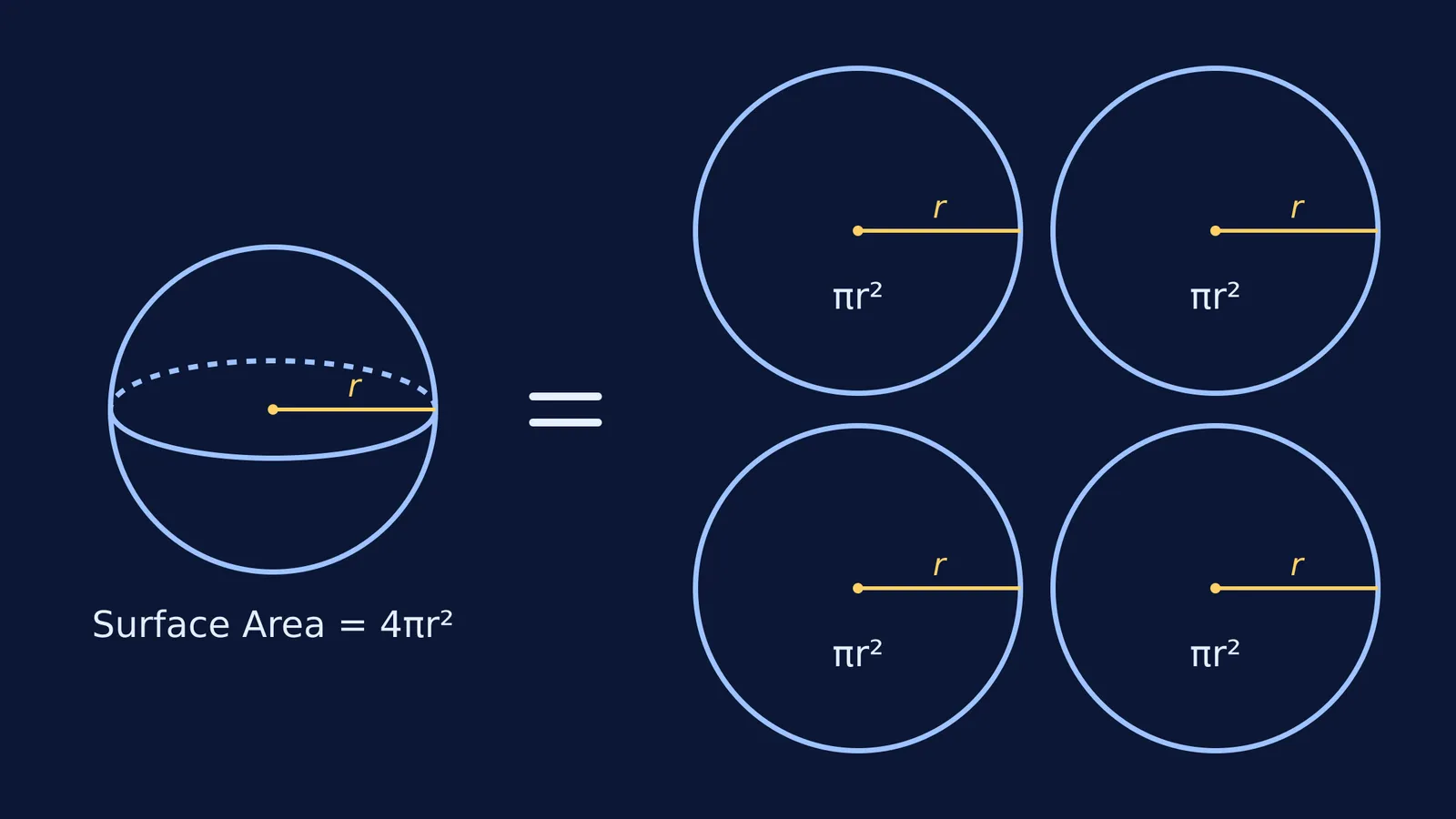
Archimedes of Syracuse was particularly proud of this discovery: he proved that the surface area of a sphere is exactly four times the area of its great circle. Because the area of that central circle is πr², the sphere's total surface area is 4πr².
This is not just an abstract rule. From calculating how much leather is needed to stitch a football, to finding out how the Earth's surface compares to the Moon's, 4πr² is the tool you need.
What is the surface area of a sphere formula?
If you cut a sphere exactly in half, the flat face is a great circle with an area of πr². Archimedes proved that it would take exactly four of these flat circles to completely wrap the outside of the sphere.
He did this by showing that a sphere has the exact same surface area as the curved side of a cylinder that perfectly encloses it. Since the cylinder's height is 2r and its circumference is 2πr, its curved area is (2πr) × 2r = 4πr².
Archimedes proved this using the method of exhaustion, a mathematical technique that paved the way for modern calculus. By fitting shapes with increasing numbers of sides inside the sphere and cylinder, he closed in on the exact value of their curved areas.
How much leather is needed for a football?
To see this formula in action, consider a standard football. According to FIFA's Laws of the Game, a Size 5 football must have a circumference between 68 and 70 cm, giving it a radius of about 11 cm.
How much leather or synthetic casing is required to cover it? Using the surface area formula:
r = 11 cm
Surface Area = 4πr²
Area = 4 × 3.14 × 11²
Area = 4 × 3.14 × 121 ≈ 1,520 cm²
Modern footballs are traditionally made from flat panels stitched or thermally bonded together. When these panels are inflated, they stretch to form a near-perfect sphere. While the seams and panel overlaps mean the factory will order slightly more than 1,520 cm² of raw material per ball to account for the stitching margins, the 4πr² formula determines the exact surface area of the finished product.
Similar calculations apply whether you are designing cricket balls, hot air balloons, or spherical and cylindrical capacitors.
What is the ratio of surface areas of two spheres?
When you compare two spheres, you do not always need to calculate their full areas. Because the 4π part of the formula is constant, the ratio of their surface areas depends only on the square of their radii.
A classic problem in the NCERT Class 9 Mathematics textbook asks you to compare the surface area of the Moon and the Earth. The diameter of the Moon is approximately one-fourth the diameter of the Earth.
Because the diameters are in a 1:4 ratio, their radii are also in a 1:4 ratio. Therefore, the ratio of their surface areas is: Ratio = 1² / 4² = 1/16
The Earth has roughly 16 times the surface area of the Moon. While the Earth is not a perfect sphere—it is an oblate spheroid, meaning it bulges slightly at the equator—the sphere formula gives an extremely close approximation that scientists still use for global climate models and mapping.
If you are tackling geometry problems like this and find yourself unsure how to set up the ratios or which formula to use, the Fermi Problem Library has worked problems with a step-by-step solver that explains the reasoning rather than printing an answer.
A quick checklist for sphere problems
When you see a sphere question in an exam, check these details first:
Radius vs diameter: Did the question give you the diameter? Always divide by 2 to find r before squaring.
Curved vs total area: A solid hemisphere has a curved surface area of 2πr², but its total surface area is 3πr² because you must add the flat base. A full sphere is always 4πr².
Ratios: If radius A is x times radius B, the surface area of A is x² times the surface area of B. You can skip the 4π entirely when comparing them.
Related geometry: If you are finding an area using horizontal strips in calculus or calculating a circle through three given points, remember that 4πr² is exclusively for the 3D surface of a sphere, not flat 2D shapes.


