

On this page
Many students assume that if a shape becomes twice as wide, it automatically holds twice as much. This mistake is so common that researchers call it the "illusion of linearity", where we wrongly apply linear reasoning to area and volume (De Bock et al., 2002). However, the geometry of 3D objects is governed by the square-cube law, a principle first set out by Galileo Galilei in 1638 (Galilei, 1638).
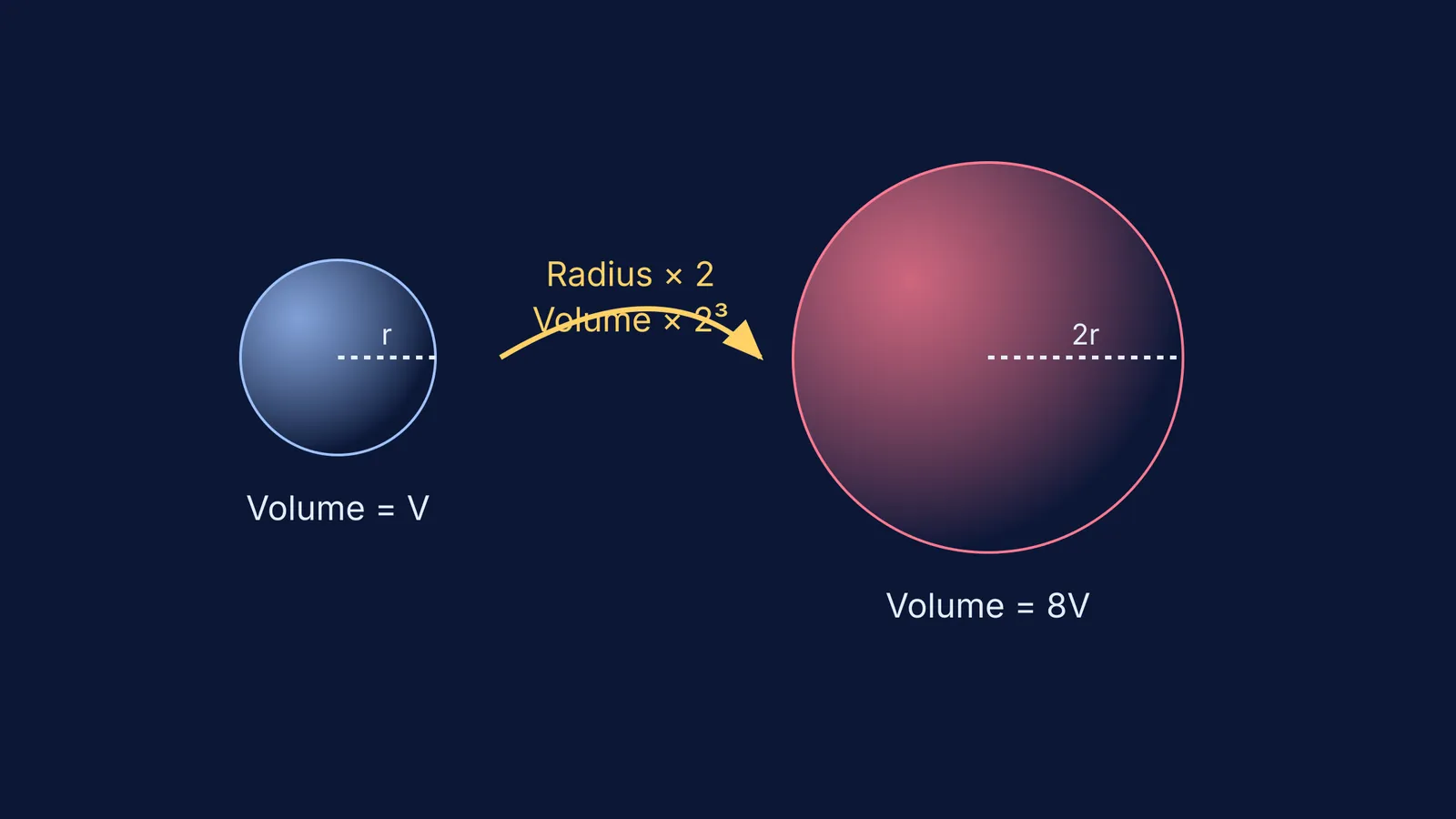
What happens to volume when the radius is doubled?
The formula for the volume of a sphere is V = (4/3)πr³.
If you double the radius, you do not simply multiply the final answer by 2. Instead, you substitute 2r in place of r in the formula. The new volume becomes:
V_new = (4/3)π(2r)³
V_new = (4/3)π(8r³)
V_new = 8 × (4/3)πr³
V_new = 8V
The volume becomes exactly eight times larger. This happens because the scale factor (k = 2) must be cubed (k³ = 8) for three-dimensional measurements.
How do you calculate the percentage change in volume?
In competitive exams like JEE and NEET, examiners rarely ask for the final volume. Instead, they test your understanding of percentage increase.
Since the new volume is 8V, the actual change in volume is the new volume minus the original volume (8V − V = 7V). To find the percentage increase, you divide this change by the original volume and multiply by 100:
Percentage increase = (7V / V) × 100 = 700%.
If a question gives you a different percentage increase in radius, the same logic applies. For example, if the radius increases by 10%, the new radius is 1.10 times the original (k = 1.10). The new volume will be scaled by k³, which is 1.10³ = 1.331. This means the volume increases by 33.1%.
What happens to the surface area of the sphere?
While volume scales by the cube of the dimension (k³), area always scales by the square of the dimension (k²). This is true whether you are calculating the surface area of a sphere or integrating to find area using horizontal strips.
The formula for the surface area of a sphere is A = 4πr².
If you double the radius (r → 2r), the new area is:
A_new = 4π(2r)²
A_new = 4π(4r²)
A_new = 4 × (4πr²)
A_new = 4A
The surface area becomes four times larger, which is a 300% increase.
Does this rule apply to cubes and cylinders?
Yes, the square-cube law applies to any three-dimensional shape, provided all its dimensions are scaled by the exact same factor. This consistency is helpful when converting a quantity between unit systems using dimensions.
For a cube: The volume is V = s³. If you double the side length (2s), the new volume is (2s)³ = 8s³.
For a cylinder: The volume is V = πr²h. If you double both the radius and the height, you scale all three dimensions. The new volume is π(2r)²(2h) = π(4r²)(2h) = 8πr²h, which is exactly 8V.
For a cone: The volume of a cone is V = (1/3)πr²h. If you double its radius and its height, the new volume becomes (1/3)π(2r)²(2h) = (1/3)π(4r²)(2h) = 8 × (1/3)πr²h = 8V. Once again, scaling all three dimensions by a factor of 2 increases the total volume by a factor of 8.
If you find it difficult to remember when to square and when to cube a scale factor, the Fermi Concept Library has its own lesson for every concept in mathematics, each with its place in the map.


