

On this page
When a ball is projected straight up under uniform gravity, as modeled in OpenStax University Physics Volume 1, many students assume it loses half its speed by the time it reaches half its maximum height. In reality, the ball is still traveling at more than 70% of its initial launch speed at midpoint. This discrepancy arises from the quadratic relationship between velocity and displacement in free-fall kinematics, a core topic across board physics and competitive entrance examinations.
How do you calculate the speed at half the maximum height?
When an object is thrown vertically upward with initial speed u against uniform gravitational acceleration g, it decelerates until it stops at peak height H. Under the constant acceleration equations in OpenStax University Physics Volume 1, the velocity-displacement relation is: v² = u² − 2g s
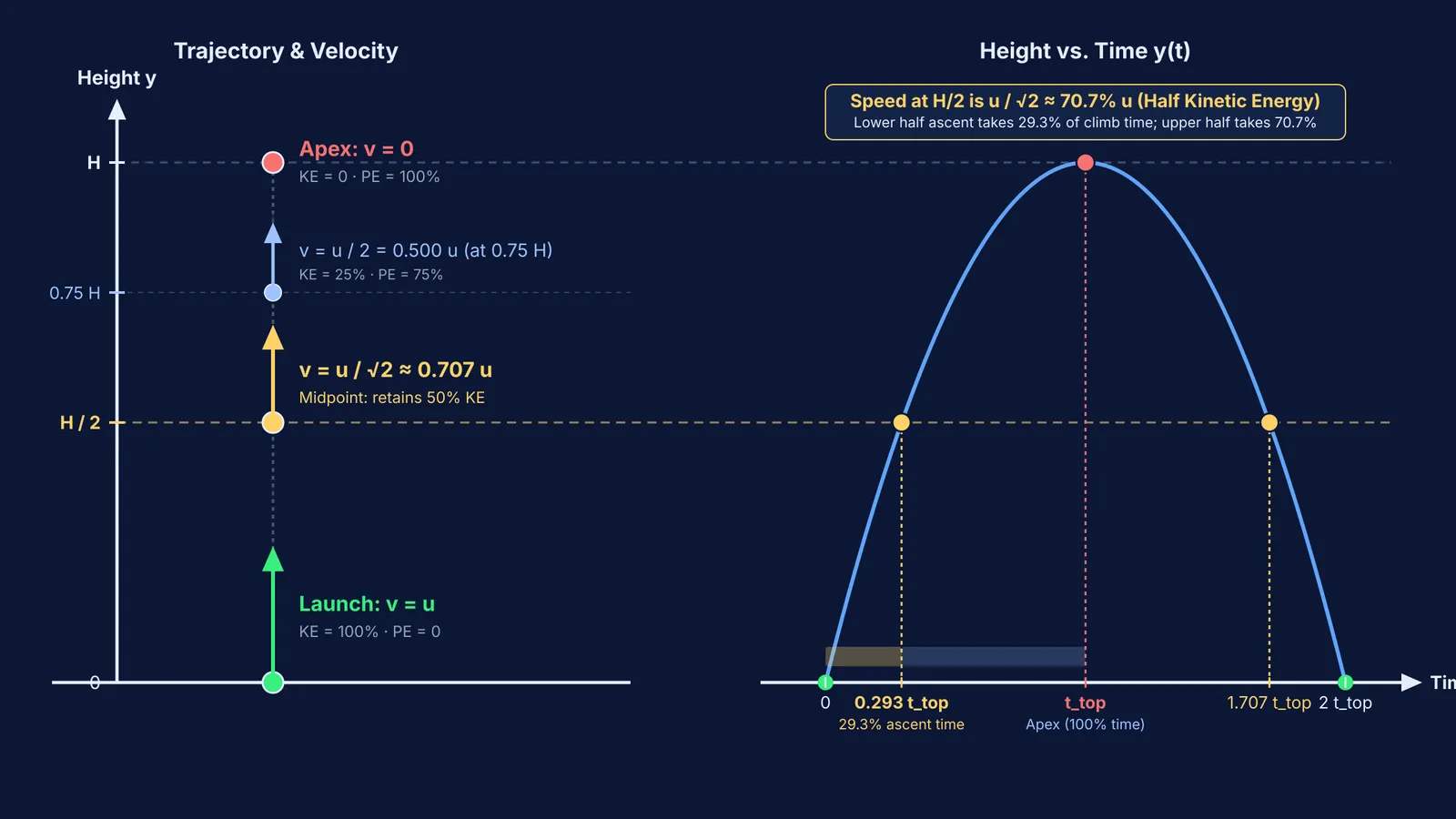
At maximum height H, vertical velocity v = 0, giving H = u² / (2g). Setting displacement s = H / 2 and substituting H gives: v² = u² − 2g(H / 2) = u² − g[u² / (2g)] = u² / 2
Taking the square root for upward motion gives: v = u / √2 ≈ 0.7071 u
At half the maximum height, the ball retains 1 / √2 of its launch speed, or approximately 70.7% of its initial value. On the descent, symmetry ensures it passes through H / 2 at the same speed directed downward. For sign conventions across coordinate frames, review our guide on choosing equations of motion and signs.
Why is speed not halved at half the maximum height?
Many students expect speed to halve when height halves. In physics education research, Trowbridge and McDermott (1980) demonstrated that introductory students frequently confuse position with velocity, using position criteria to infer speed. Similarly, Halloun and Hestenes (1985) showed that students often assume speed varies linearly with distance.
The work-energy theorem clarifies why speed is not halved. Gravity reduces kinetic energy by an amount equal to the gain in gravitational potential energy: (1/2) m u² − (1/2) m v² = m g h
At midpoint h = H / 2, potential energy is mg(H/2) = (1/2)[(1/2)mu²]. Exactly 50% of launch kinetic energy converts to potential energy, leaving half the kinetic energy intact: (1/2) m v² = (1/2) [ (1/2) m u² ] = u² / 4 v² = u² / 2 v = u / √2
Because kinetic energy is proportional to the square of velocity (v²), halving kinetic energy divides speed by √2 rather than 2. When visualising multi-step energy conversions and trajectories, the Fermi Simulation Lab provides interactive simulations for ideas that are easier to see than to read.
How long does it take to reach half the maximum height?
A related insight involves flight time. Under uniform gravitational acceleration detailed in OpenStax University Physics Volume 1, upward velocity follows v = u − g t. At the apex where v = 0, total ascent time is t_top = u / g.
Setting v = u / √2 gives the ascent time t₁ to reach H / 2: u / √2 = u − g t₁ t₁ = (u / g)(1 − 1 / √2) = t_top (1 − 1 / √2) ≈ 0.2929 t_top
The ball reaches half-height after only 29.3% of its total ascent time, spending the remaining 70.7% (0.7071 t_top) climbing the upper half:
Lower half (y = 0 to H / 2): High average speed allows the ball to cover this elevation quickly.
Upper half (y = H / 2 to H): Decreasing speed causes the ball to linger near the apex.
On the descent, symmetry ensures the ball takes that same duration (0.7071 t_top) to drop from the apex back to H / 2. For more on turnaround points, see our guide on vertical motion under gravity.
At what height does the speed drop to half?
To find where speed drops to half the launch value (v = u / 2), substitute into the kinematic relation from OpenStax University Physics Volume 1: (u / 2)² = u² − 2g y 2g y = (3/4) u² y = (3/4) [ u² / (2g) ] = 0.75 H
Speed drops to half only after completing 75% of the vertical rise, where three-quarters of kinetic energy has become potential energy: (1/2)m(u/2)² = (1/4)[(1/2)mu²].
To master problems connecting heights, velocity components, and launch angles, study projectile motion on level ground. When practicing multi-step mechanics questions, the Fermi Problem Library provides worked problems with a step-by-step solver that explains the reasoning rather than printing an answer.
Worked example: a vertical throw at 20 m/s
Consider a stone thrown straight upward with initial speed u = 20 m/s and g = 9.8 m/s² from OpenStax University Physics Volume 1:
Maximum height: H = 20² / (2 × 9.8) ≈ 20.41 m
Total climb time: t_top = 20 / 9.8 ≈ 2.04 s
Half maximum height: h = H / 2 ≈ 10.20 m
Speed at half maximum height: v = 20 / √2 ≈ 14.14 m/s
Time to reach half maximum height: t₁ = 2.04 × (1 − 1 / √2) ≈ 0.60 s
The stone climbs the first 10.20 m in just 0.60 s, while the remaining 10.21 m to the apex takes 1.44 s. Mastering these non-linear relationships turns what looks like an exam trap into an intuitive shortcut for vertical projectile problems.


