

On this page
In a redox reaction, oxidation means losing electrons (increasing the oxidation state) and reduction means gaining electrons (decreasing the oxidation state) (Source: Wikipedia). When a species acts as an oxidising agent, it takes electrons from another substance and gets reduced itself. When it acts as a reducing agent, it gives electrons away and gets oxidised.
To do both, a molecule must have "room" to move its oxidation state up or down. You will often see this when you look up an oxidation number from structure.
Why do MnO₄⁻ and H₂S act only one way?
Some famous compounds are strictly one-way streets because they sit at the absolute limits of their electron-sharing capacity.
Take the permanganate ion (MnO₄⁻). Manganese sits in group 7, and in permanganate, it has an oxidation state of +7 (Source: Wikipedia). Because it has effectively lost all seven of its valence electrons, it cannot be oxidised any further. It can only gain electrons and reduce, making it a strict, strong oxidising agent.
On the other end of the scale is hydrogen sulfide (H₂S). Sulfur is in group 16 and needs two electrons to complete its octet. In H₂S, sulfur has an oxidation state of -2. It cannot gain any more electrons, so it cannot be reduced. It can only lose electrons (oxidise to 0 or +4), meaning H₂S acts exclusively as a reducing agent. (This is related to why zinc, cadmium and mercury are not transition elements — they have full d-orbitals and limited oxidation states).
Which species have intermediate oxidation states?
If a molecule's central atom is somewhere between its maximum and minimum limits, it can swing either way depending on what it reacts with. Here are the three most common examples in chemistry exams:
Hydrogen peroxide (H₂O₂): Oxygen usually sits at -2 in most compounds. But in peroxides, oxygen has an intermediate oxidation state of -1. If it reacts with a strong oxidiser, it can lose electrons and oxidise to O₂ (oxidation state 0). If it reacts with a strong reducer, it can gain an electron and reduce to H₂O (oxidation state -2).
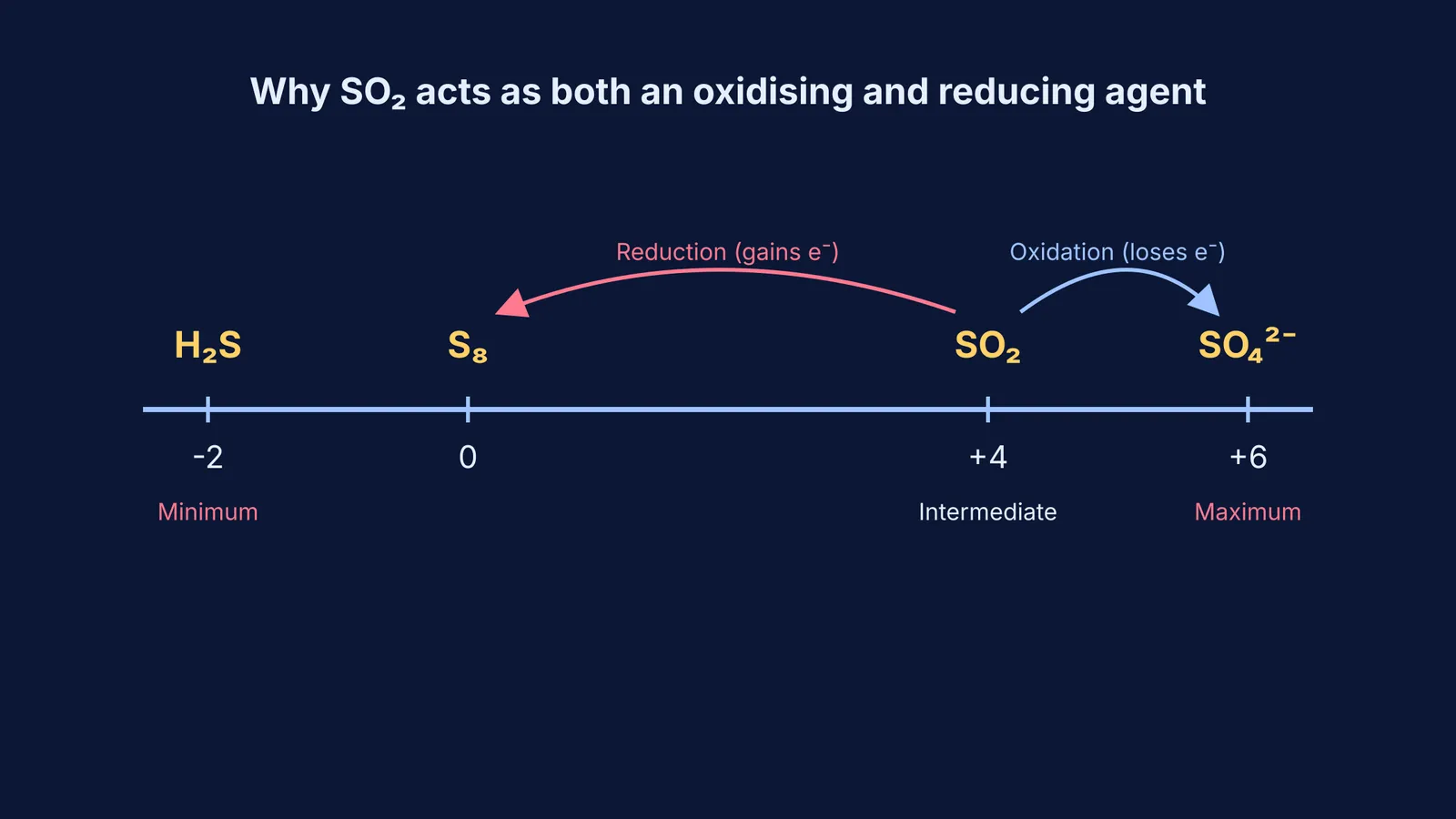
Sulfur dioxide (SO₂): Sulfur can range from +6 down to -2. In SO₂, sulfur is at +4. It can easily oxidise to +6 (forming the sulfate ion, SO₄²⁻) or reduce to lower states like 0 or -2.
Nitrous acid (HNO₂): Nitrogen ranges from +5 (like in nitric acid, HNO₃) down to -3 (like in ammonia, NH₃). In nitrous acid, nitrogen is at +3, giving it plenty of room to either oxidise or reduce.
These intermediate species frequently undergo disproportionation, a special redox reaction where the compound simultaneously oxidises and reduces itself to form two different products (Source: Wikipedia). For example, if you read the Fermi Concept Library lesson on redox, you will see hydrogen peroxide break down naturally into water and oxygen.
How can you test a species in an exam?
When a multiple-choice question asks which species can act as both an oxidant and a reductant, follow this three-step framework:
Find the oxidation state of the central atom using basic algebra (for example, set oxygen to -2 and hydrogen to +1).
Determine the limits for that element. The maximum is usually the element's group number (or group number minus 10 for p-block elements like nitrogen and sulfur). The minimum is usually the group number minus 18 (or minus 8).
Compare the state to the limits. If it equals the maximum, it is only an oxidant. If it equals the minimum, it is only a reductant. If it is in between, it can be both.
This simple check takes only a few seconds but ensures you never have to guess. Similar logic applies when predicting whether a substance will undergo the Cannizzaro reaction, which involves disproportionation of aldehydes.
If you are stuck on how to calculate these limits, Fermi's AI tutor can build a plan for the session and teach you through it by writing the oxidation rules on a board.


