

On this page
When a sound wave travels from the air above a swimming pool into the water below, you might wonder if it becomes lower pitched or slower. In fact, the pitch you hear stays exactly the same, but the physical wave stretches out as it speeds up dramatically.
What changes when sound enters water from air?
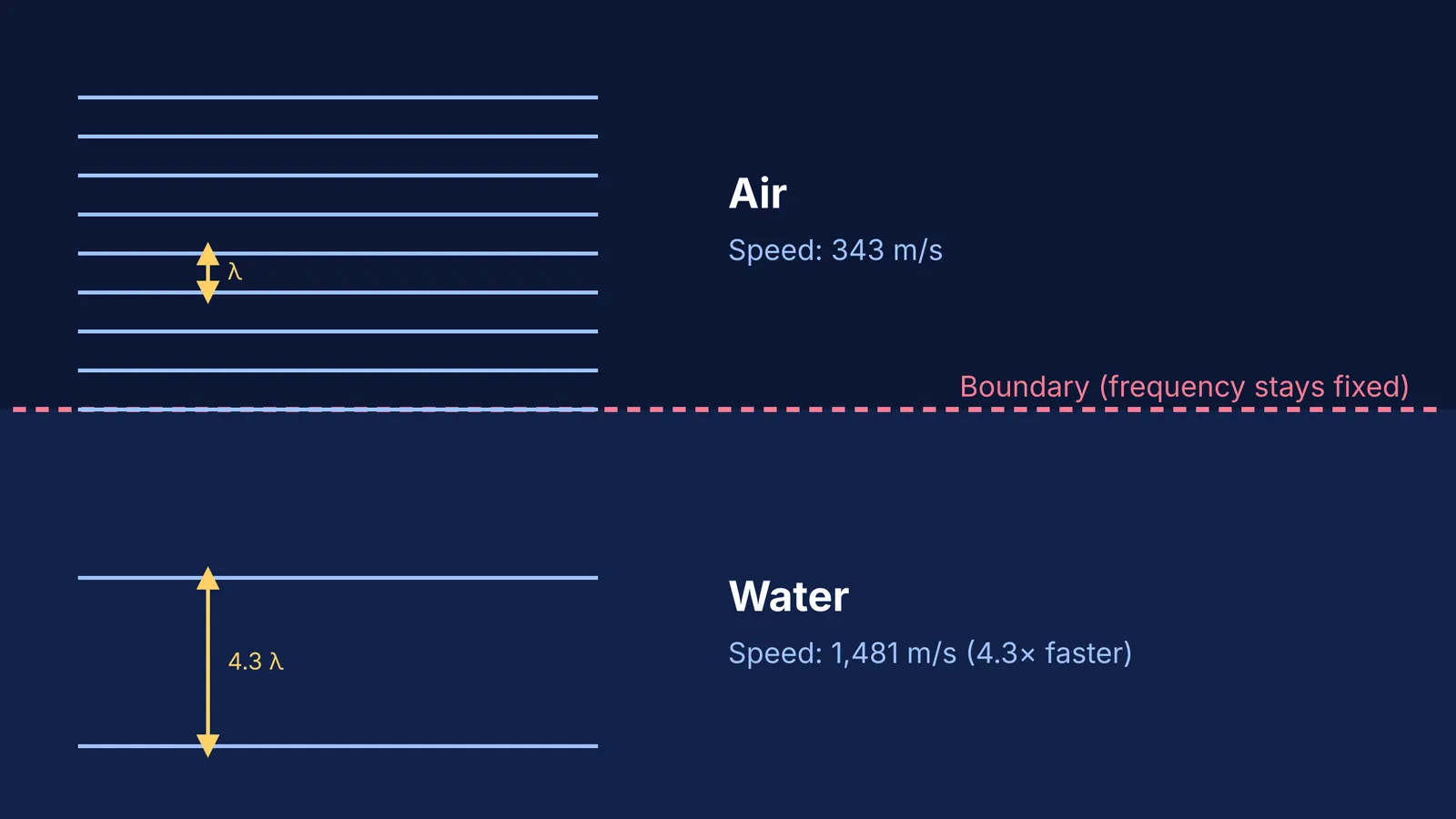
The speed of sound in dry air at 20 °C is approximately 343 meters per second (Wikipedia). When that same sound enters fresh water at 20 °C, its speed jumps to roughly 1,481 m/s.
Because the frequency of the sound (the number of waves passing a point every second) does not change when it crosses the boundary, its wavelength must increase. Because the sound is travelling 4.3 times faster in the water, its wavelength becomes 4.3 times longer.
Why does sound travel faster in water?
To understand the speed jump, you have to look at how sound moves. Sound is a mechanical wave that transmits energy through collisions between molecules. The speed of these collisions depends on two factors: the density of the medium and its stiffness (measured by the bulk modulus).
Water is much denser than air. If density were the only factor, this would slow the sound down, because heavier molecules are harder to push. However, water is also overwhelmingly stiffer than air. The bulk modulus of water is roughly 2.2 GPa (gigapascals), meaning it strongly resists being compressed and snaps back into place almost instantly (Wikipedia). This extreme stiffness more than makes up for the higher density, propelling the sound wave forward much faster.
Why does the frequency of sound remain constant across a boundary?
Frequency is entirely determined by the source creating the sound, not the medium it travels through.
You can think of the air-water boundary like a handshake between two materials. If a loudspeaker in the air pushes the boundary at a specific frequency, the water molecules right at the surface are forced to vibrate at that exact same frequency in response. If the frequencies were different, the particles would eventually move out of sync. This would create a physical gap or tear at the boundary, which the laws of continuous waves do not allow. Because the boundary cannot create or destroy wave cycles, the number of cycles entering the water per second must perfectly match the number arriving from the air.
Because frequency (f) stays locked, the wave must adjust its speed (v) and wavelength (λ) together to obey the fundamental wave equation, v = fλ. If a wave moves faster but pulses at the same rate, it must space its peaks further apart. You can see how these peaks map to high and low density in our guide to displacement and pressure waves in sound.
What happens when light enters glass?
The physics of light entering a dense medium is the exact opposite of sound. Light is an electromagnetic wave and does not rely on mechanical collisions to travel.
When light enters crown glass from the air, it interacts with the electrons of the material and slows down. The refractive index of typical crown glass is about 1.52, meaning the light drops from 300,000 km/s in a vacuum to roughly 197,000 km/s in the glass (CK-12). Just as with sound, the frequency of light is locked by its source and stays constant across the boundary. Because the light is now moving slower, its wavelength must shrink to fit the same number of wave cycles into a smaller space. We explored this thoroughly in our breakdown of light entering glass.
How do you calculate the wavelength change?
If you are studying for your physics exams, you will often need to trace what happens at a boundary step by step. Here is how a standard 1,000 Hz tone changes when it hits the water (speeds from Wikipedia):
In the air: The speed is 343 m/s. Using the formula λ = v / f, the wavelength is 343 / 1000 = 0.343 m (or 34.3 cm).
At the boundary: The frequency remains exactly 1,000 Hz.
In the water: The speed jumps to 1,481 m/s. The new wavelength is 1481 / 1000 = 1.481 m.
If you find it hard to picture how wavelength and speed change together without affecting the frequency, the Fermi Concept Library maps out these wave mechanics visually. The AI tutor will notice where you are stuck and help you draw out the wave fronts, connecting the phase difference to path difference step by step on a shared board until the equations click.


