

On this page
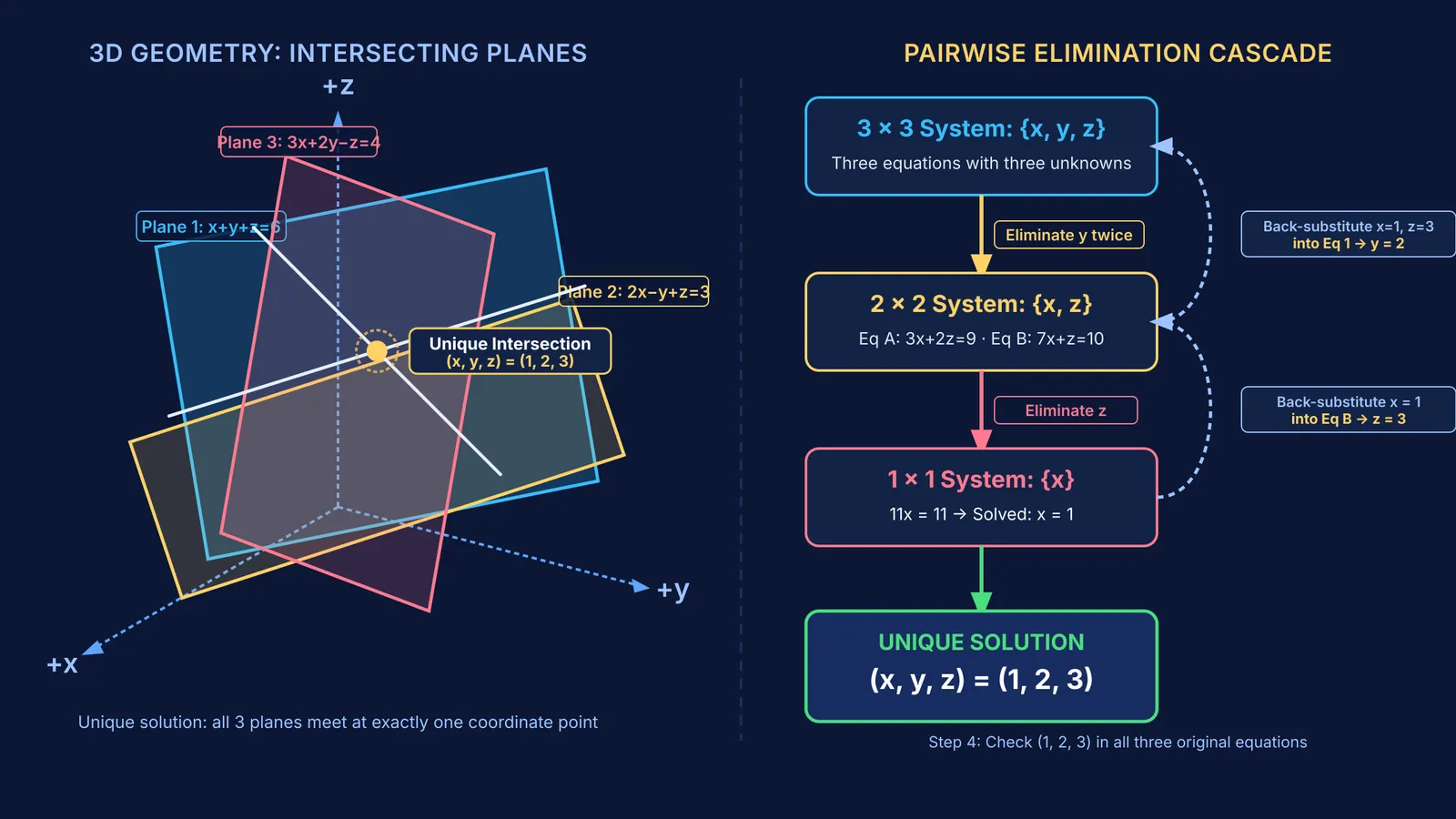
A system of three linear equations in three variables requires finding values for three unknowns—typically x, y, and z—that satisfy every equation. Geometrically, each equation represents a flat plane in three-dimensional space, as defined in OpenStax College Algebra. When three planes meet at a single point, the system has a unique solution written as an ordered triple (x, y, z). The standard method to solve this system is systematic elimination, reducing the problem dimension by dimension.
How do you solve three linear equations in three variables by elimination?
The elimination method works by removing one unknown at a time until only one remains. Rather than manipulating all three equations at once, you use a pairwise reduction strategy:
Pair two equations to eliminate one variable: Choose equations (1) and (2). Multiply if needed so coefficients cancel when added or subtracted.
Pair another combination to eliminate the same variable: Combine equations (2) and (3), or (1) and (3), eliminating the exact same variable.
Solve the resulting two-variable system: Solve the resulting pair using elimination, as in two-variable linear systems in Class 10.
Back-substitute to find all unknowns: Substitute the known value into either two-variable equation for the second variable, then substitute both into an original equation for the third.
How do you work through a 3 × 3 linear system step by step?
Consider this system of three equations:
Equation (1): x + y + z = 6 Equation (2): 2x − y + z = 3 Equation (3): 3x + 2y − z = 4
Adding Equation (1) and Equation (2) eliminates y immediately because its coefficients are +1 and −1:
(x + y + z) + (2x − y + z) = 6 + 3 3x + 2z = 9 (Equation A)
Next, eliminate y from Equation (2) and Equation (3). Multiply Equation (2) by 2 to get 4x − 2y + 2z = 6, and add it to Equation (3):
(4x − 2y + 2z) + (3x + 2y − z) = 6 + 4 7x + z = 10 (Equation B)
Now solve the two-variable system of Equation A and Equation B. Multiply Equation B by 2 to get 14x + 2z = 20, and subtract Equation A:
(14x + 2z) − (3x + 2z) = 20 − 9 11x = 11 x = 1
Back-substitute x = 1 into Equation B: 7(1) + z = 10, which gives z = 3. Then substitute x = 1 and z = 3 into Equation (1): 1 + y + 3 = 6, giving y = 2.
The solution is the ordered triple (1, 2, 3). When an algebraic system becomes dense or multi-step calculations leave you uncertain of your progress, the Fermi Problem Library provides worked problems with a step-by-step solver that explains the reasoning rather than printing an answer.
Why do students make mistakes when solving three-variable equations?
Solving three equations in three variables requires dozens of arithmetic steps. In a 2021 classroom study published in the Journal of Physics: Conference Series, researchers R. B. Wiyah and Nurjanah analyzed 33 high school students solving three-variable linear equations through George Polya's problem-solving model.
The study revealed clear differences across stages: 71.67% of students succeeded at understanding the problem, but only 51.25% could devise a plan. Accuracy dropped to 48% when carrying out algebraic calculations, and fell to just 38% for looking back to verify answers.
The researchers identified three primary errors during execution:
Inconsistent elimination targets: Eliminating x from equations (1) and (2), but eliminating y from equations (2) and (3), leaving two equations that still have three variables.
Sign distribution errors: Forgetting to distribute negative signs across every term when subtracting equations.
Disorganized record-keeping: Failing to label intermediate equations leads to substituting values into the wrong expressions.
Mastering systematic organization here prepares you for higher-level algebra, including analyzing the consistency of linear systems by the matrix method and working with matrices and determinants for JEE.
How can you check whether your solution is correct?
Because Wiyah and Nurjanah found that only 38% of students check their work, building a checking habit prevents lost marks. However, checking must never be circular. If you check your answer only in the equation you used for back-substitution, an earlier calculation slip will remain hidden.
Testing (1, 2, 3) across our original equations confirms the solution:
Equation (1): 1 + 2 + 3 = 6 (True)
Equation (2): 2(1) − 2 + 3 = 3 (True)
Equation (3): 3(1) + 2(2) − 3 = 4 (True)
If elimination ever produces a false statement like 0 = 5, the system is inconsistent and has no solution. If it yields an identity like 0 = 0, the system is dependent with infinitely many solutions. If you want to review the underlying theory, the Fermi Concept Library maps every concept in mathematics with its own lesson and its place in the map.
A four-step checklist for multi-step linear systems
Before writing out scratch work, run through this four-step checklist:
Inspect coefficients: Label equations (1), (2), and (3). Choose the variable with a coefficient of 1 or −1 as your target.
Eliminate the same variable twice: Pair (1) with (2), and (2) with (3), eliminating the identical variable each time.
Solve and back-substitute: Solve the two-by-two system for two unknowns, then substitute into an original equation for the third.
Verify in all three equations: Plug the ordered triple into all three initial equations before finishing.


