

On this page
When a problem asks for unknown matrices X and Y from two equations, it can look intimidating. A typical question gives X + Y and X − Y as numerical grids and asks for both individual matrices. Because matrices have rows, columns, and strict multiplication rules, students often assume they need inverses, determinants, or row operations.
In reality, you can solve these pairs using the same elimination method learned in Class 10 linear equations. Because matrix addition is commutative and associative, you add and subtract matrix equations term by term.
How do you find matrices X and Y from X + Y and X − Y?
Given two matrix equations of equal dimensions:
X + Y = A
X − Y = B
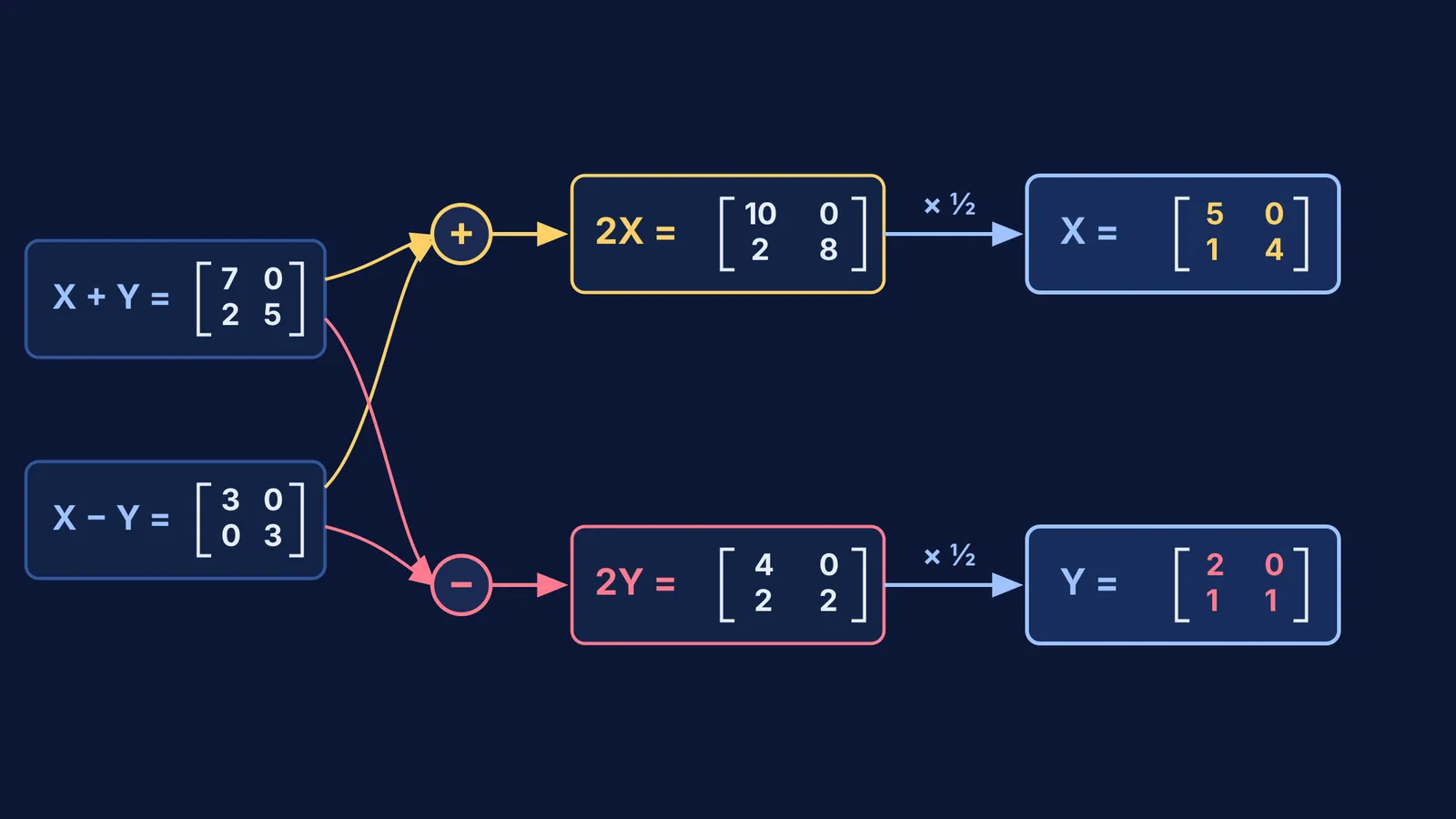
To eliminate Y, add the equations: (X + Y) + (X − Y) = A + B. Because Y + (−Y) = O (the zero matrix), this simplifies to 2X = A + B. Multiplying each entry by 1/2 isolates X = (1/2)(A + B).
To find Y, subtract the second equation from the first: (X + Y) − (X − Y) = A − B. Because X cancels and Y − (−Y) = 2Y, this yields 2Y = A − B, or Y = (1/2)(A − B).
For example, take A = [7 0; 2 5] and B = [3 0; 0 3]:
Adding gives 2X = [10 0; 2 8], so X = [5 0; 1 4].
Subtracting gives 2Y = [4 0; 2 2], so Y = [2 0; 1 1].
Checking confirms X + Y = [7 0; 2 5], which matches matrix A.
How do you solve the 2X + Y and X − Y variant?
Exam questions often vary coefficients, presenting pairs like 2X + Y = A and X − Y = B. Because Y has opposite coefficients (+1 and −1), adding gives (2X + Y) + (X − Y) = A + B, simplifying to 3X = A + B, so X = (1/3)(A + B).
Back-substituting into the second equation yields Y = X − B. Alternatively, multiply the second equation by 2 to get 2X − 2Y = 2B; subtracting this from the first eliminates X, giving 3Y = A − 2B, so Y = (1/3)(A − 2B).
For example, let 2X + Y = [5 −1; 8 2] and X − Y = [1 4; 1 4]:
A + B = [6 3; 9 6].
Divide by 3: X = [2 1; 3 2].
Y = X − B = [2−1 1−4; 3−1 2−4] = [1 −3; 2 −2].
Checking with the first equation confirms 2X + Y = [4 2; 6 4] + [1 −3; 2 −2] = [5 −1; 8 2].
Why does linear elimination work for matrices?
This method works because m × n matrices form a vector space under entry-wise addition and scalar multiplication. In 1858, British mathematician Arthur Cayley established the algebraic foundation of matrix arithmetic (Cayley, 1858). Understanding Arthur Cayley's rules of matrix algebra shows why matrices obey the same additive associativity, commutativity, and scalar distributivity as real numbers.
Because solving involves only addition, subtraction, and scaling, non-commutativity of matrix multiplication (where AB ≠ BA) never enters the calculation. As long as X and Y share identical dimensions, linear elimination remains sound.
What mistakes do students make during matrix elimination?
Educational research shows distinct cognitive patterns when students transition from school algebra to matrix systems. A 2007 experimental study in the Journal of Educational Psychology by Bethany Rittle-Johnson and Jon R. Star tested 70 students and found that comparing solution methods enabled students to use direct shortcut procedures on 38% of posttest problems, compared to 11% for sequential drill.
Similarly, an empirical study of 131 undergraduate students by Benjamin Tatira in the Eurasia Journal of Mathematics, Science and Technology Education revealed that students frequently make sign errors when coordinating subtractions across equations.
In CBSE Class 12 mathematics, where Unit II (Algebra) carries 10 marks out of the 80-mark theory paper (CBSE Academic), three recurring errors cost marks:
Forgetting to distribute the scalar factor to every single entry.
Mishandling negative entries during subtraction, writing 1 − (−4) as −3 instead of 5.
Attempting to add matrices of different dimensions.
When practice problems involve fractions or higher-order systems, the Fermi Problem Library provides worked problems with a step-by-step solver that explains the reasoning rather than printing an answer.
What is the step-by-step matrix elimination protocol?
To solve any pair of linear matrix equations reliably, follow this four-step checklist:
Check dimensions: Confirm all matrices have the same order m × n so entry-wise addition is defined.
Align coefficients: If one variable has opposite coefficients, add the equations; if coefficients match, subtract them.
Scale entry by entry: When isolating X or Y, divide every element by the leading coefficient.
Verify by substitution: Substitute your matrices back into both equations to confirm both sides match.
For students reviewing matrices and determinants for JEE, mastering this clean elimination protocol saves crucial examination minutes. To explore how matrix operations connect to broader algebra, the Fermi Concept Library covers every concept in mathematics, each with its own lesson and its place in the map. When preparing for timed tests, Fermi's AI tutor can work out what you already know and build a plan for the session, highlighting calculation slips before they become ingrained habits.


