

On this page
When you pass an electric current through a solution of sodium chloride (brine), you might expect to see solid sodium metal collecting at the negative electrode (the cathode). Instead, bubbles of hydrogen gas appear. This happens because in an aqueous solution, water molecules and sodium ions compete for the electrons supplied by the battery, and water is much easier to reduce.
Why is hydrogen gas produced at the cathode?
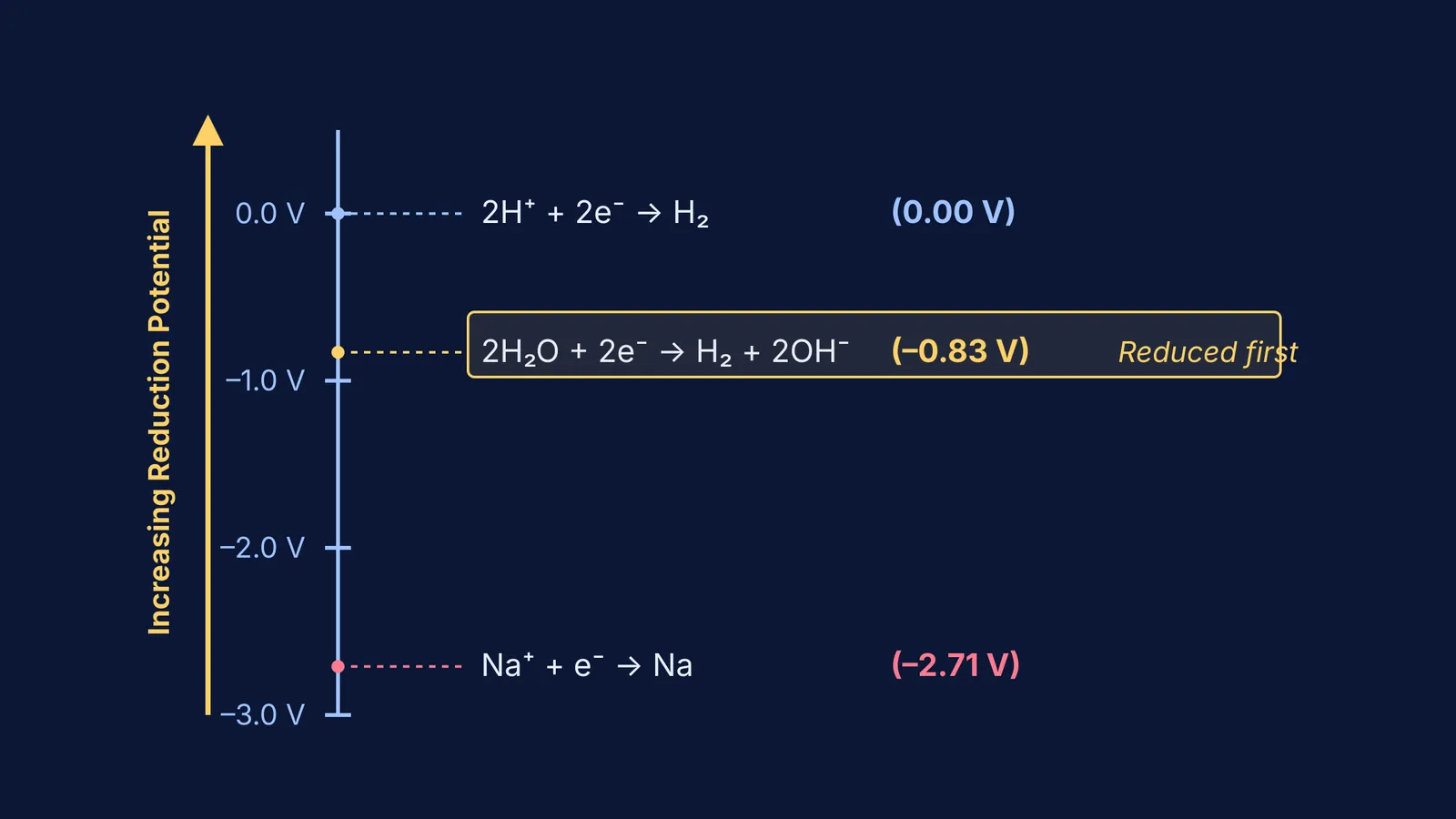
In any electrolytic cell, the chemical species with the higher (more positive) standard reduction potential is reduced first. In an aqueous solution of sodium chloride, there are two possible reduction reactions at the cathode:
Reduction of sodium ions: Na⁺(aq) + e⁻ → Na(s)
Standard reduction potential (E°): –2.71 V)
Reduction of water: 2H₂O(l) + 2e⁻ → H₂(g) + 2OH⁻(aq)
Standard reduction potential (E°): –0.83 V)
Because –0.83 V is much higher than –2.71 V, water wins the competition for electrons. The sodium ions remain dissolved in the solution, and hydrogen gas bubbles off.
Even if a few sodium atoms were somehow formed at the cathode, they would not survive. Sodium metal is highly reactive and would instantly react with the surrounding water in an exothermic reaction to produce sodium hydroxide (NaOH) and more hydrogen gas.
Why does chlorine form at the anode instead of oxygen?
At the positive electrode (the anode), negative ions are drawn in to lose electrons in an oxidation reaction. In brine, both chloride ions (Cl⁻) and water molecules compete to be oxidized. Theoretically, water is easier to oxidize than chloride ions, so you would expect oxygen gas to form.
However, a kinetic factor called overpotential changes the result. Overpotential is the extra voltage required beyond the theoretical value to make a gas form at a visible, practical rate. The overpotential for oxygen gas production on most electrodes is quite high. Because of this kinetic barrier, when the sodium chloride solution is concentrated, chloride ions are oxidized to chlorine gas (Cl₂) instead. If the solution is very dilute, the balance shifts back, and oxygen gas is produced.
What happens to the remaining solution?
While hydrogen gas bubbles off at the negative electrode and chlorine gas is collected at the positive electrode, the remaining ions left behind in the water are sodium (Na⁺) from the salt and hydroxide (OH⁻) from the reduced water. Together, these form a concentrated solution of sodium hydroxide (NaOH).
This overall reaction is famously known as the chlor-alkali process. Rather than being a failed attempt to make sodium metal, the electrolysis of brine is actually one of the most important industrial methods for manufacturing sodium hydroxide, chlorine gas, and hydrogen gas worldwide.
How is sodium metal extracted industrially?
To obtain pure sodium metal, you must remove water from the equation entirely. This is done using the Downs process, which electrolyses molten (fused) sodium chloride instead of an aqueous solution.
When solid NaCl is melted, it breaks down into freely moving Na⁺ and Cl⁻ ions. With no water present, Na⁺ is the only positive ion available to accept electrons at the cathode:
Cathode reaction: Na⁺(l) + e⁻ → Na(l)
The sodium ions are reduced to liquid sodium metal, which floats to the top of the cell and is collected.
Why is calcium chloride added in the Downs process?
Pure sodium chloride melts at 801 °C. Maintaining this temperature requires a large amount of energy, and at such extreme heat, the extracted sodium metal can form a corrosive metallic fog in the electrolyte.
To solve this, industrial plants use a mixture of roughly 40% sodium chloride and 60% calcium chloride (CaCl₂). This mixture melts at a much lower temperature of about 600 °C. Because calcium has a lower reduction potential than sodium at these conditions, the calcium ions remain safely in the molten state while the sodium is extracted.
The Downs cell is carefully engineered to handle these extreme conditions. It typically uses a central carbon anode surrounded by a cylindrical steel cathode. An iron mesh screen separates the two electrodes. This physical barrier is crucial because it prevents the freshly extracted liquid sodium and chlorine gas from coming into contact and reacting explosively to reform sodium chloride. Because liquid sodium metal is less dense than the molten salt bath, it naturally rises to the surface of the cell where it can be safely siphoned off.
If you find it hard to picture the competition between ions at the electrodes, the Fermi Concept Library gives standard reduction potentials its own lesson and place in the map. You can follow how electrons choose their targets based on these voltage values.
To see how electrode potentials apply to other elements, read our guide on the E° values of 3d metals. You can also learn how to calculate equilibrium constants from cell EMF.
How do you predict the products of electrolysis?
When working out what forms at the electrodes in an aqueous solution, follow these three steps:
Identify all ions: List the ions from the dissolved salt (e.g., Na⁺ and Cl⁻) and the ions from water (H⁺ and OH⁻).
Check the cathode (reduction): Compare the standard reduction potentials of the positive ions and water. The one with the highest (most positive) E° is reduced. For Group 1 and 2 metals, water always wins.
Check the anode (oxidation): Compare the oxidation potentials of the negative ions and water. The one that is easiest to oxidize wins. Remember the overpotential exception: concentrated chloride ions will oxidize to chlorine gas instead of water oxidizing to oxygen.


