

On this page
When you have an unknown organic compound in a test tube and need to identify its functional group, chemistry relies heavily on characteristic colour changes. For carbonyl compounds, the sodium nitroprusside test is a standard laboratory method used to spot methyl ketones such as acetone. This is much like how Tollens' and Fehling's tests are used to selectively identify aldehydes.
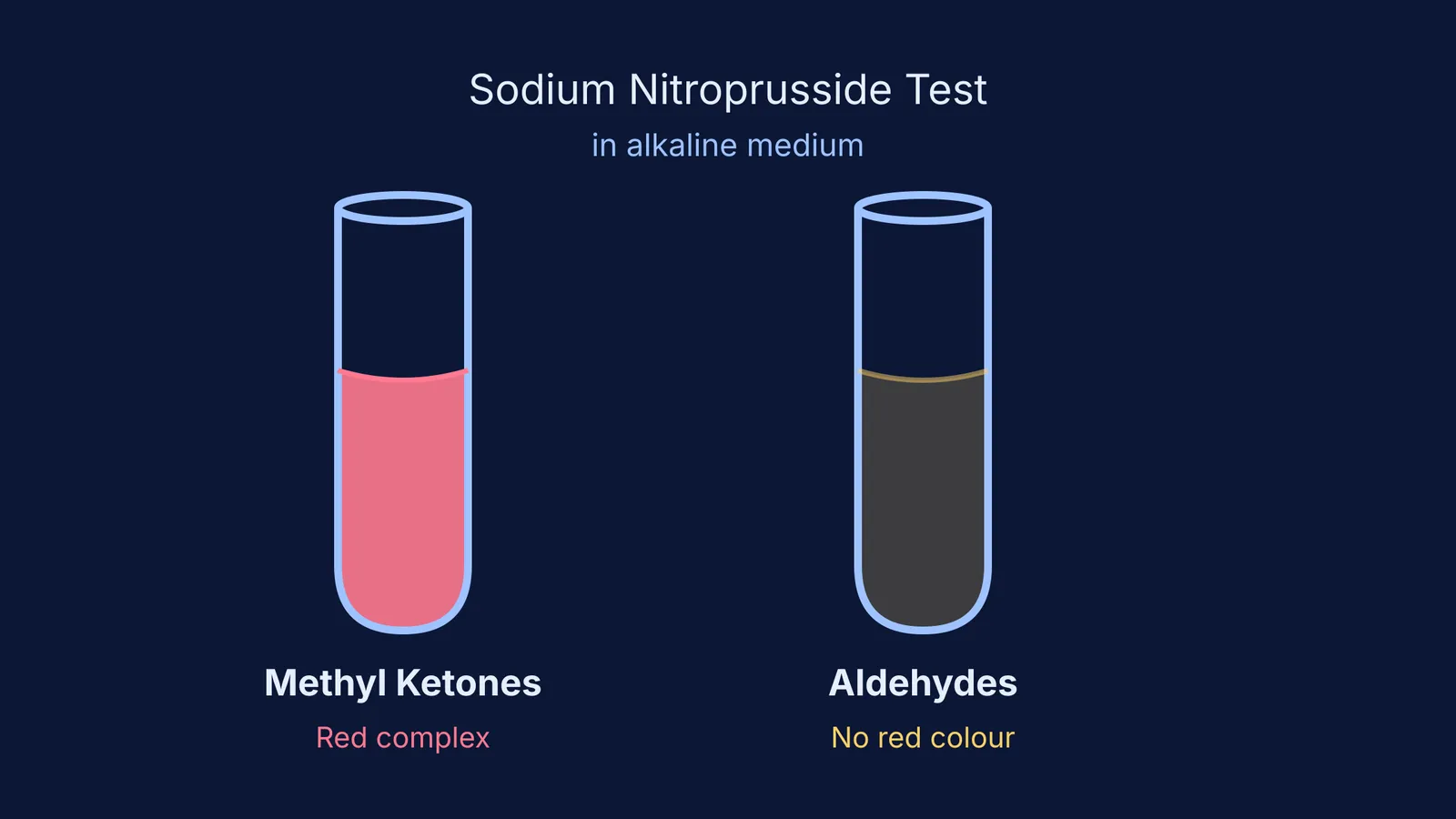
Because aldehydes generally do not respond to this test, it offers a quick, reliable and clear way to tell the two families of compounds apart in qualitative analysis and practical chemistry exams. The test provides a visually striking result, shifting from a pale yellow to a deep wine red when methyl ketones are present.
What is the sodium nitroprusside test?
The sodium nitroprusside test is a chemical procedure that detects the presence of a methyl ketone group, which is a carbonyl group bonded directly to at least one methyl (CH₃) group (Wikipedia).
In a typical lab setting, you dissolve a small crystal of sodium nitroprusside—also known chemically as sodium nitroferricyanide—in distilled water to make a fresh solution. It is crucial to prepare this reagent freshly because the complex can slowly decompose when exposed to light and air. Once the solution is ready, you add a few drops of the organic compound you want to test and shake the mixture thoroughly. Finally, you add an alkali like sodium hydroxide (NaOH) drop by drop.
If the compound is a methyl ketone, the solution turns a bright red or deep wine-red colour (Wikipedia). If it is an aldehyde or a ketone that lacks the necessary alpha-hydrogens (such as benzophenone or a symmetrical ketone like 3-pentanone), the solution remains its original yellowish-brown colour and no red complex appears.
Why does acetone give a red colour?
The reaction relies on the alkaline medium created by the sodium hydroxide. Acetone (CH₃COCH₃) is a methyl ketone, meaning it has a methyl group attached directly to the carbonyl carbon.
First, the alkali removes a weakly acidic alpha-hydrogen from the acetone molecule. This turns the neutral acetone into a negatively charged enolate ion. This step requires the high pH environment to proceed efficiently.
CH₃COCH₃ + OH⁻ → [CH₃COCH₂]⁻ + H₂O
Next, this enolate ion reacts with the nitroprusside ion, [Fe(CN)₅NO]²⁻. The enolate coordinates with the iron-containing complex to form a new, larger complex ion that absorbs light differently, producing the characteristic red colour. The nitrogen atom in the nitroso (NO) ligand is directly involved in this interaction.
[Fe(CN)₅NO]²⁻ + [CH₃COCH₂]⁻ → [Fe(CN)₅NO(CH₂COCH₃)]³⁻
Do aldehydes give the sodium nitroprusside test?
For the purpose of school and competitive exams, aldehydes do not give a positive sodium nitroprusside test.
While aldehydes do possess alpha-hydrogens and can form enolates in a basic medium, their enolates do not go on to form the deep red iron complex under these specific conditions. Because methyl ketones reliably turn red and aldehydes do not, the test is widely taught alongside the Cannizzaro reaction as a key property of carbonyls. This specific reactivity highlights the subtle differences in electronic structure between the two classes of carbonyl compounds.
If you struggle to remember which compounds give which test, the Fermi Concept Library has a lesson for every concept in chemistry and its place in the map, so you can see the patterns.
Why is it used to test for ketone bodies?
Beyond the chemistry lab, this exact reaction is used in medicine and biology. The human body can sometimes produce acidic by-products known as "ketone bodies," which include methyl ketones like acetone and acetoacetic acid. These compounds accumulate when the body breaks down fats for energy instead of glucose.
A common variation of this test, known as Rothera's test, uses sodium nitroprusside and ammonia to check for these methyl ketones in urine (Wikipedia). In this method, the sample is treated with sodium nitroprusside, ammonium sulfate, and ammonia. A positive result — often appearing as a bright red or purple coloration — indicates ketonuria, which is a diagnostic symptom of conditions like diabetes (Wikipedia).
When you are stuck on a reaction mechanism or do not know where to start with qualitative analysis, Fermi's AI tutor can work out what you already know and build a plan for the session, teaching you the chemistry step by step. If you want to practise these concepts, the Fermi Problem Library has worked problems with a step-by-step solver that explains the reasoning rather than printing an answer.


