

On this page
When you watch a snake slither across the ground, it looks like a continuous, effortless glide. But beneath the skin, it is a masterclass in biomechanics and physics. Without limbs to push off the ground, a snake relies on a precise combination of spinal flexibility, muscle coordination, and the microscopic structure of its belly scales.
How do snakes move without legs?
The foundation of a snake's movement is its skeleton. While humans have just 33 vertebrae, a snake's spine is made up of anywhere from 130 to 500 vertebrae (Wikipedia). These vertebrae are connected by highly flexible ball-and-socket joints.
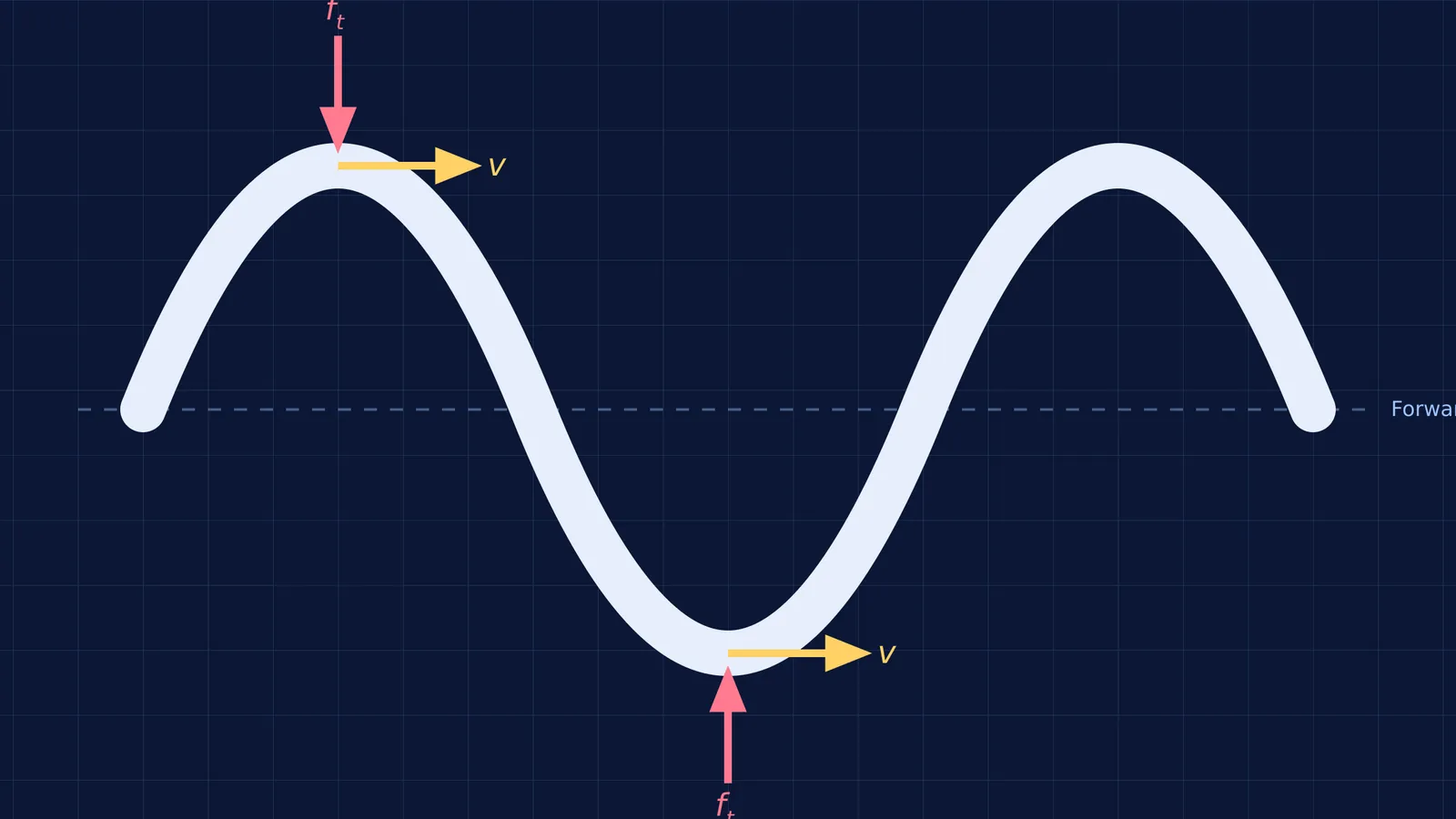
Almost every vertebra (except those in the tail and neck) has a pair of ribs attached to it. A complex network of muscles spans these ribs. By activating these muscles sequentially from head to tail, the snake throws its body into a series of S-shaped curves. This is called lateral undulation.
On uneven terrain, the snake pushes the back edges of these curves against rocks, branches, or clumps of dirt to propel itself forward. But how does a snake move across flat, featureless ground where there is nothing to push against?
How does friction push them forward?
The secret lies in the snake's belly scales, known as ventral scales. These scales are arranged like shingles on a roof, overlapping towards the tail.
In 2009, a study led by David Hu and published in *PNAS* investigated the mechanics of this slithering motion (Crossref). They found that snake scales exhibit "frictional anisotropy"—meaning they generate different amounts of friction depending on which way they are pushed.
The researchers measured the friction coefficients of snake scales sliding on cloth. They discovered that the forward friction coefficient (μ_f) was approximately 0.11, while the transverse or sideways friction coefficient (μ_t) was roughly 0.20.
Because the sideways friction is about twice as high as the forward friction, the scales "catch" on the microscopic roughness of the ground when the snake pushes its body laterally. The ground pushes back with an equal and opposite force, and because forward resistance is so low, the snake slides smoothly ahead.
How do snakes redistribute their weight?
Hu's study also revealed that snakes do not lie completely flat while moving. If their entire body pressed evenly against the ground, the total friction would be too high, wasting energy.
Instead, a snake subtly lifts parts of its body by fractions of a millimetre as it slithers. It concentrates its weight specifically on the curved sections of its body that are pushing laterally against the ground.
In physics, frictional force is the product of the friction coefficient and the normal force (f = μN). By pressing down harder on the active "push points," the snake increases the normal force exactly where it needs the most lateral grip. It unweights the sliding sections of its body to minimise forward drag.
If you want to review how these forces interact on different surfaces, the Fermi Concept Library has a lesson for every concept in physics, including normal force, friction coefficients, and vectors. You can also explore related mechanics problems, such as finding the angle of friction or calculating the minimum force to drag a block on a rough floor.
A framework for analysing mechanics
The same physics that propels a snake can help you solve exam problems involving friction and motion. When you face a mechanics question with moving parts, use this checklist:
Draw the normal forces: Friction depends entirely on how hard the surfaces are pressed together. Identify where the weight is concentrated.
Find the friction coefficients: Check if the problem states a single coefficient of friction (μ) or if it implies directional differences (like wheels that roll forward but resist sliding sideways).
Resolve the vectors: Break the forces down into parallel (forward motion) and perpendicular (transverse pushing) components.
Look for the asymmetry: Motion happens when forces are unbalanced. Find the direction with the lowest resistance.
By applying these steps, you can map out the forces in any system, whether it is a block sliding down an incline or a snake gliding across the sand.


