

On this page
Why do we make the small-x approximation in equilibrium?
When you set up an ICE (Initial, Change, Equilibrium) table for an aqueous reaction or weak acid-base dissociation, writing the equilibrium constant expression frequently produces a quadratic equation. For a generic weak monoprotic acid dissociating as HA(aq) ⇌ H⁺(aq) + A⁻(aq) with an initial concentration c, the equilibrium concentration of unionized acid is c − x, where x represents the equilibrium concentration of hydrogen ions. The equilibrium constant expression becomes Ka = x² / (c − x).
Solving this relationship directly requires expanding the denominator and applying the quadratic formula. In competitive exams like JEE Main, JEE Advanced, and NEET-UG, doing so by hand consumes precious minutes. When the acid is weak and its equilibrium constant Ka is very small, typically below 10⁻⁴, the reaction proceeds toward products only to a minimal degree. In OpenStax Chemistry 2e, educators note that assuming x is negligible compared to c allows you to approximate (c − x) as c. This small-x approximation simplifies the expression to Ka ≈ x² / c, turning a quadratic equation into a direct square-root calculation: x ≈ √(Ka × c).
Setting up equilibrium expressions cleanly before performing any algebraic simplification prevents recurring signs and stoichiometry errors. Our guide on ICE tables for equilibrium constant problems walks through building these balance sheets step by step. When practicing problem setups, the Fermi Problem Library provides worked problems with a step-by-step solver that explains the reasoning rather than printing an answer.
How does the 5 percent rule decide when to neglect x?
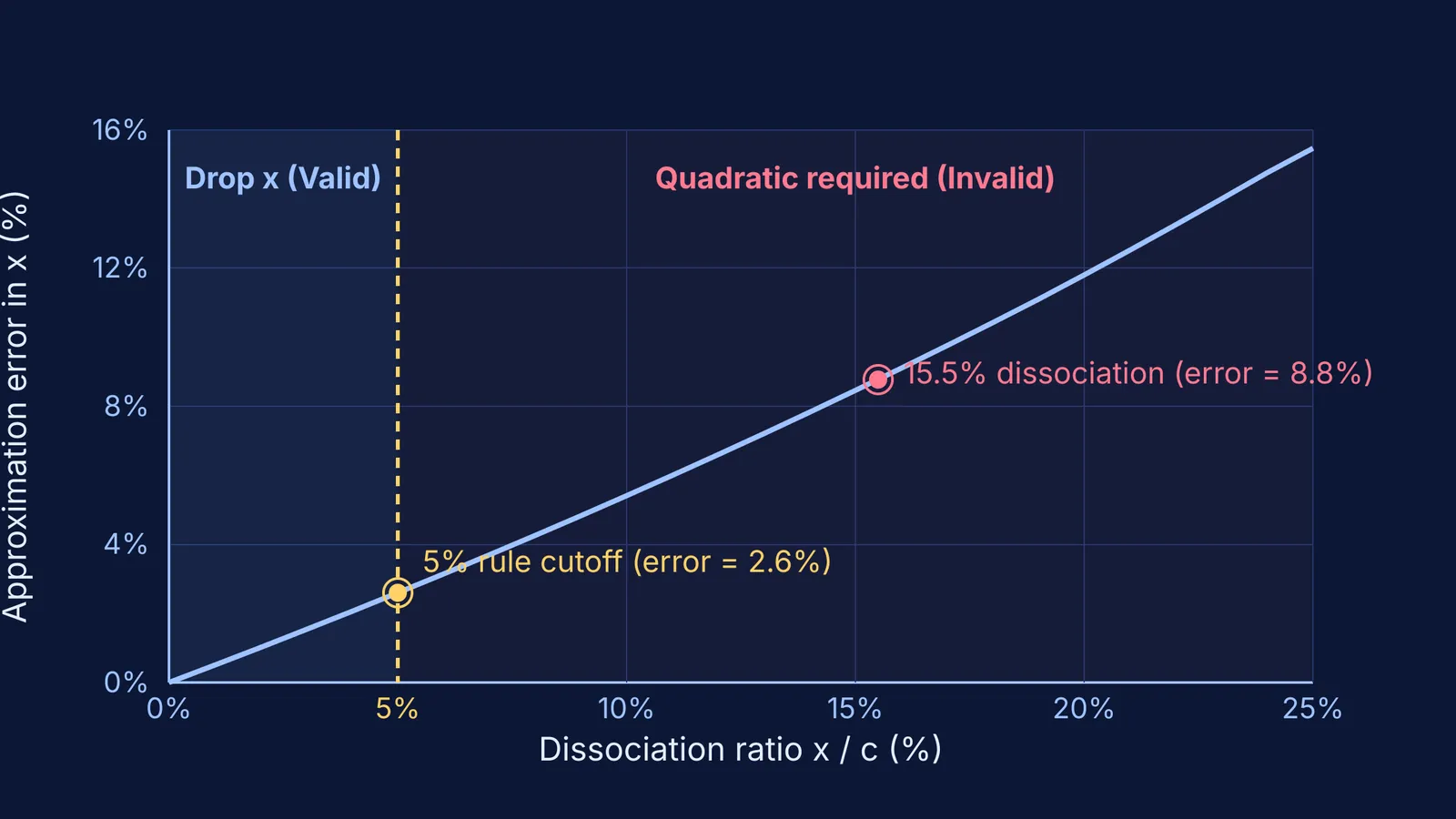
Dropping x from (c − x) is an assumption that must always be validated. The standard criterion in chemistry is the 5 percent rule. According to OpenStax Chemistry 2e, the small-x approximation is acceptable if the calculated change x represents less than 5% of the initial concentration c from which it was subtracted. In the *Journal of Chemical Education*, Harry L. Pardue and colleagues (2004) noted that a 5% dissociation boundary restricts the relative error in the calculated ion concentration to approximately 2.6%, well within the typical experimental margin of error for measured equilibrium constants.
Consider calculating the hydronium ion concentration of a 0.10 M acetic acid solution with Ka = 1.8 × 10⁻⁵.
Write the equilibrium expression: Ka = x² / (0.10 − x) = 1.8 × 10⁻⁵.
Apply the small-x approximation: assume 0.10 − x ≈ 0.10.
Solve for x: x² = 1.8 × 10⁻⁵ × 0.10 = 1.8 × 10⁻⁶, giving x = √(1.8 × 10⁻⁶) = 1.34 × 10⁻³ M.
Test the 5 percent rule: (1.34 × 10⁻³ M / 0.10 M) × 100% = 1.34%.
Because 1.34% is well below 5%, the assumption is justified. The equilibrium concentration of H⁺ is 1.34 × 10⁻³ M, corresponding to a pH of 2.87. This shortcut applies across many weak electrolyte systems, as explored in our guide on ionic equilibrium and pH calculations.
What happens when the small-x approximation fails?
The small-x approximation fails when an acid is moderately strong or when a weak acid is so dilute that Ostwald's dilution law forces a large percentage of it to dissociate. In these regimes, x is not negligible relative to c, and dropping it introduces substantial error.
In OpenStax Chemistry 2e, an example using 0.50 M hydrogen sulphate ion (HSO₄⁻) with Ka = 1.2 × 10⁻² demonstrates this failure.
Write the expression: Ka = x² / (0.50 − x) = 1.2 × 10⁻².
Naive approximation: assume 0.50 − x ≈ 0.50, yielding x² = 1.2 × 10⁻² × 0.50 = 6.0 × 10⁻³, so x = √(0.0060) ≈ 0.0775 M.
Test the 5 percent rule: (0.0775 M / 0.50 M) × 100% = 15.5%.
Because 15.5% greatly exceeds 5%, the simplification fails. To find the true concentration, you must rearrange the full expression into standard quadratic form: x² + 0.012x − 0.0060 = 0. Solving with the quadratic formula x = [−b ± √(b² − 4ac)] / (2a) yields x = [−0.012 + √(0.000144 + 0.0240)] / 2 = 0.0717 M (discarding the negative root). The approximate answer of 0.0775 M overestimated the true concentration by more than 8.0%. Similar precision pitfalls arise when calculating the pH of very dilute acid solutions, where omitting key contributions distorts the final value.
How do you know when to use the quadratic formula from the start?
As established in OpenStax Chemistry 2e, you do not need to guess and repeat calculations blindly. You can predict whether the 5 percent rule will pass by checking the ratio of initial concentration to the equilibrium constant before doing any algebra:
If c / K ≥ 400, the degree of dissociation is almost always below 5%, so the small-x shortcut will succeed.
If c / K < 400, dissociation frequently exceeds 5%, meaning you should solve the quadratic equation immediately.
For 0.10 M acetic acid, c / Ka = 0.10 / (1.8 × 10⁻⁵) = 5,556, safely above 400. For 0.50 M hydrogen sulphate, c / Ka = 0.50 / 0.012 = 41.7, signaling that a quadratic equation is mandatory.
Here is the decision workflow for equilibrium numericals:
Identify the initial reactant concentration c and write the equilibrium constant expression.
Check the ratio c / K: if it is below 400, skip the shortcut and use the quadratic formula directly.
If c / K ≥ 400, drop x from (c − x) and evaluate x ≈ √(K × c).
Verify your answer with the 5 percent check: ensure (x / c) × 100% < 5%.
If the check passes, report your answer; if it fails, set up ax² + bx + c = 0 and solve for the positive root.
If you want to review the underlying theory of equilibrium constants and acid-base dissociation, the Fermi Concept Library covers every concept in physics, chemistry, biology, mathematics and computing, each with its own lesson and its place in the map.


