

On this page
A classic geometry trap appears in exams ranging from Class 10 boards to competitive tests: *How many small cubes of side 3 cm can fit into a cuboid of dimensions 10 cm × 12 cm × 14 cm?*
The instinct of most students is to find the volume of the large box, find the volume of one cube, and divide the two. But doing this assumes you can melt the cubes like wax and pour them in. Cubes are rigid, and if they do not fit the sides perfectly, they leave empty space.
Why does dividing the volumes fail?
Let us test the division method on our example. The volume of the cuboid is 10 × 12 × 14 = 1680 cm³. The volume of one cube is 3 × 3 × 3 = 27 cm³. Dividing the volumes gives 1680 / 27 = 62.22. Many students will round this down and declare that 62 cubes can fit.
But this is incorrect. In a foundational study on spatial structuring, researchers Michael T. Battista and Douglas H. Clements (1996) found that students often fail to conceptualise 3D arrays as space-filling, struggling to coordinate separate views into a single mental model. When you divide the total volumes, you treat the space as a single continuous capacity, ignoring the solid geometry of the cubes.
How do you calculate how many small cubes fit in a cuboid?
Because the cubes must remain whole, you have to pack them along each dimension independently. Here is the correct framework:
Divide each dimension of the cuboid by the side length of the small cube.
Discard the decimals (take the integer part or 'floor' of the result). This tells you how many whole cubes fit along that specific edge.
Multiply these three whole numbers together.
Let us apply this to the 10 cm × 12 cm × 14 cm cuboid and the 3 cm cubes:
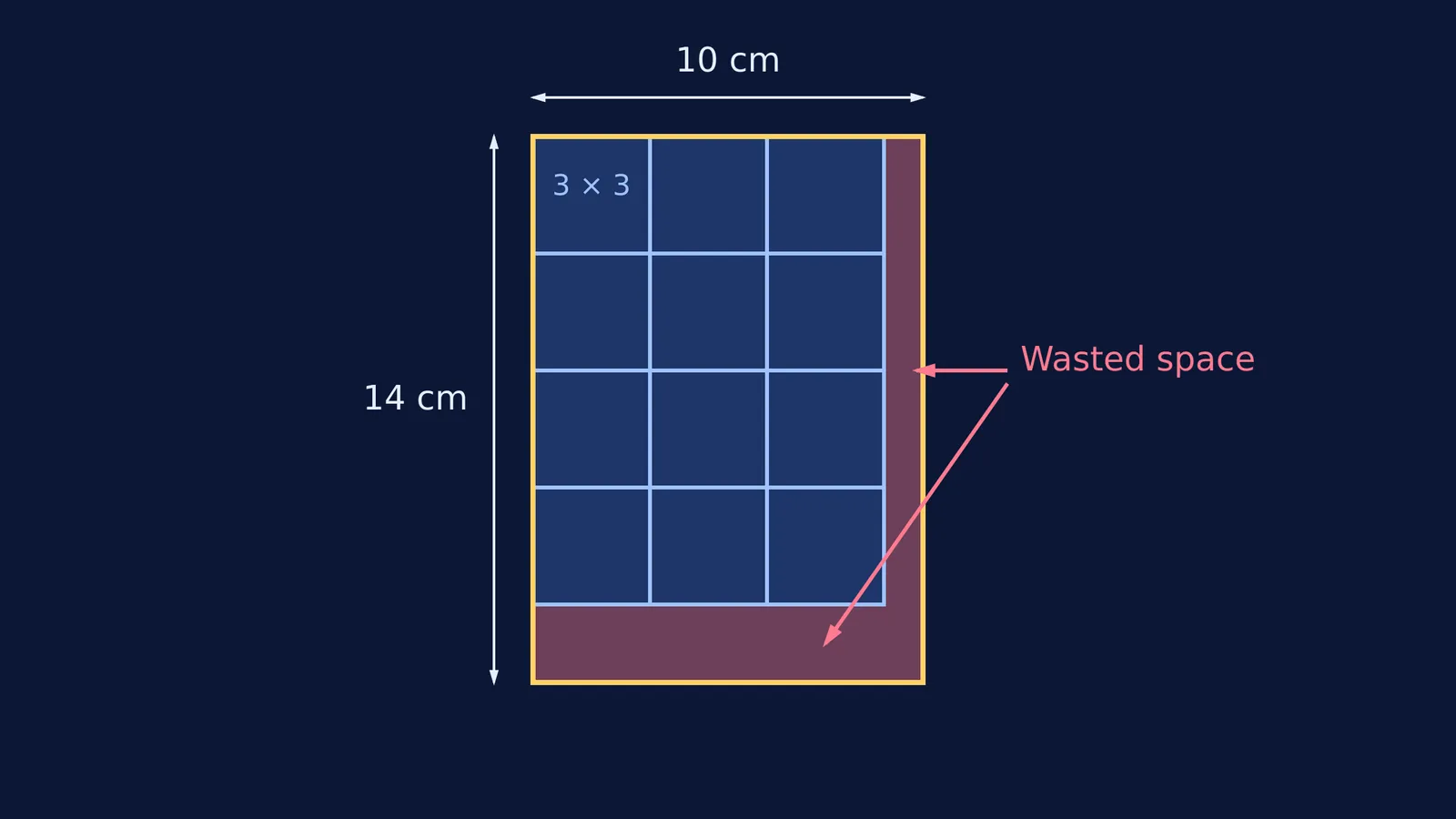
Length: 10 / 3 = 3.33. We can fit 3 whole cubes along this edge, leaving a 1 cm gap.
Width: 12 / 3 = 4. We can fit exactly 4 whole cubes, leaving no gap.
Height: 14 / 3 = 4.66. We can fit 4 whole cubes along the height, leaving a 2 cm gap.
Now multiply the whole cubes that fit along each dimension: 3 × 4 × 4 = 48 cubes.
The true answer is 48 cubes, which is significantly fewer than the 62 cubes predicted by the volume method. The volume method counted the 14 units of "wasted space" as if it could be chopped up and rearranged into 14 extra cubes.
When do the two methods agree?
There is only one scenario where dividing the volumes gives the correct answer: when the cuboid's length, width, and height are all exact multiples of the cube's side.
If we packed 2 cm cubes into the same 10 cm × 12 cm × 14 cm cuboid:
Length: 10 / 2 = 5
Width: 12 / 2 = 6
Height: 14 / 2 = 7
Number of cubes = 5 × 6 × 7 = 210. Using the volume method: 1680 / 8 = 210.
Because there are no remainders, there is no wasted space. The cubes fill the cuboid perfectly, and the mathematics agrees.
If you struggle to picture how gaps form when stacking shapes, the Fermi Simulation Lab lets you build 3D arrays interactively, so you can see exactly where the unused space hides.
What about fitting small cuboids into larger cuboids?
The same principle applies if you are asked to fit small cuboids (like matchboxes or bricks) into a larger cuboid (like a packing crate). However, because a cuboid has three different dimensions, the orientation of the small boxes matters.
Suppose you are packing 2 cm × 3 cm × 4 cm boxes into a 15 cm × 16 cm × 17 cm crate. You must test the division across the dimensions in different orientations to find the maximum number. If you align the 2 cm side with the 15 cm edge, the 3 cm side with the 16 cm edge, and the 4 cm side with the 17 cm edge:
15 / 2 = 7.5 (fits 7)
16 / 3 = 5.33 (fits 5)
17 / 4 = 4.25 (fits 4)
Total in this orientation = 7 × 5 × 4 = 140 boxes.
If you rotate the boxes so the 3 cm side aligns with the 15 cm edge, the 2 cm side with the 16 cm edge, and the 4 cm side with the 17 cm edge:
15 / 3 = 5 (fits 5)
16 / 2 = 8 (fits 8)
17 / 4 = 4.25 (fits 4)
Total = 5 × 8 × 4 = 160 boxes.
Finding the best orientation can yield a completely different number of packed boxes. The rule remains constant: divide the individual dimensions, never the overall volumes.
How do you know which method to use in an exam?
When you meet a packing problem in an exam, ask yourself this question before calculating: *"Am I packing solid objects, or am I pouring a liquid?"*
Solid objects (cubes, bricks, boxes): Divide dimensions, round down, then multiply.
Liquids (water, melted metal): Find the total volume, then divide.
For more practice on volume and surface area traps, head to the Fermi Concept Library, where Fermi's AI tutor will guide you through the reasoning step by step. You can also explore finding Aⁿ for a matrix by spotting the pattern or review when a quadratic is always positive.


