

On this page
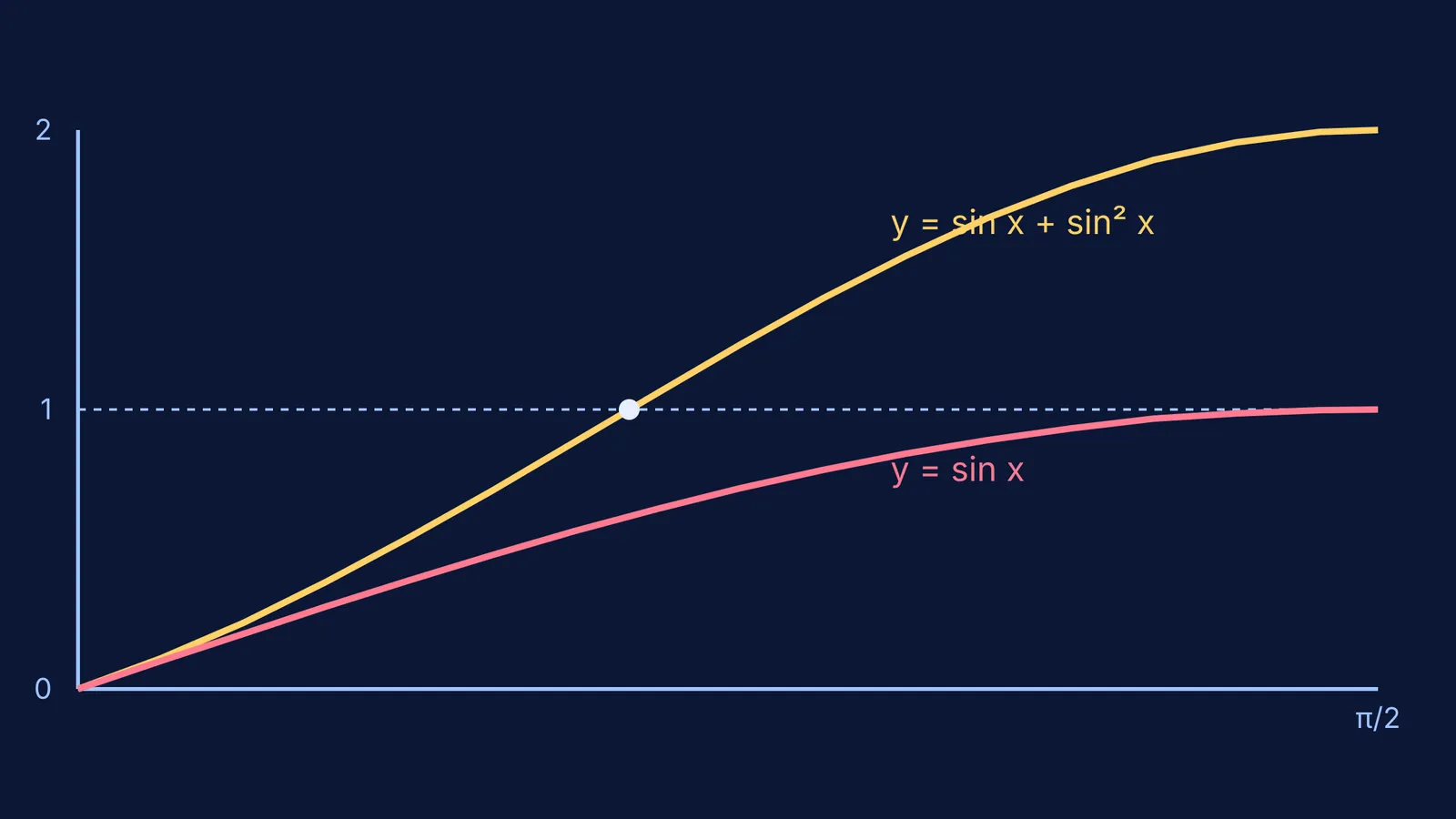
If you are preparing for exams like the JEE Main, you will likely encounter trigonometric puzzles that look impossible at first glance. One classic problem gives you the condition sin x + sin² x = 1 and asks you to find the value of a long expression like cos¹² x + 3cos¹⁰ x + 3cos⁸ x + cos⁶ x.
While you might be tempted to find the exact angle x, the true test is your ability to use algebraic substitution.
What does the condition sin x + sin² x = 1 mean?
When you see this equation, the first step is to rearrange it into a form you can use. Subtracting sin² x from both sides gives:
sin x = 1 − sin² x
According to the fundamental Pythagorean identity, 1 − sin² x = cos² x. Therefore, the given condition simplifies to:
sin x = cos² x
This is the key to the entire problem. It means that every time you see a cos² x in the target expression, you can replace it with a single sin x. This drops the power by half and shifts the function from cosine to sine.
If you are curious about the geometry, solving the quadratic equation sin² x + sin x − 1 = 0 gives sin x = (√5 − 1)/2. This value is exactly the reciprocal of the golden ratio, roughly 0.618. However, you do not need to calculate this decimal to answer the question.
How do you find cos¹² x + 3cos¹⁰ x + 3cos⁸ x + cos⁶ x?
The target expression looks intimidating because of the high powers:
cos¹² x + 3cos¹⁰ x + 3cos⁸ x + cos⁶ x
Using our rule (cos² x = sin x), we can rewrite each term by substituting the cosine powers for sine powers:
cos¹² x = (cos² x)⁶ = sin⁶ x
3cos¹⁰ x = 3(cos² x)⁵ = 3sin⁵ x
3cos⁸ x = 3(cos² x)⁴ = 3sin⁴ x
cos⁶ x = (cos² x)³ = sin³ x
The expression becomes: sin⁶ x + 3sin⁵ x + 3sin⁴ x + sin³ x
At this point, look at the coefficients: 1, 3, 3, 1. These are the classic numbers from Pascal's triangle for a cubic expansion. Remember the binomial theorem for a perfect cube: (a + b)³ = a³ + 3a²b + 3ab² + b³
If we set a = sin² x and b = sin x, let's see what happens:
a³ = (sin² x)³ = sin⁶ x
3a²b = 3(sin² x)²(sin x) = 3sin⁵ x
3ab² = 3(sin² x)(sin x)² = 3sin⁴ x
b³ = (sin x)³ = sin³ x
This matches our expression perfectly! Therefore, the entire block simplifies to: (sin² x + sin x)³
But look closely at what is inside the bracket: sin² x + sin x. The very first sentence of the problem told us that sin x + sin² x = 1.
Substituting 1 into the bracket, we get: 1³ = 1
The answer is simply 1.
Why do exams test this pattern?
Questions like this appear frequently because they test pattern recognition over calculation. If you try to find x using inverse trigonometry, you will run out of time. The examiner wants to see if you can connect trigonometric identities with polynomial expansions.
If you struggle with knowing which substitution to make, you are not alone. When a problem expects you to use triple angle formulas or higher powers, look for a hidden binomial cube or square.
For students who need help spotting these algebraic shortcuts, the Fermi Concept Library covers every concept in physics, chemistry, biology, mathematics and computing, each with its own lesson and its place in the map. And if you get stuck in the middle of an expansion, the Fermi Problem Library provides worked problems with a step-by-step solver that explains the reasoning rather than printing an answer.


