

On this page
Students often freeze when they see a fraction full of sines and cosines inside an integral sign. You might try integration by parts or a complex substitution, only to end up with a mess. But calculus is much easier when you step back and use trigonometric identities first.
A study of 72 high-school students found that applying general trigonometry formulas and performing algebraic calculations were the main reasons they struggled with identities (Rohimah & Prabawanto, 2020). By taking a moment to simplify the expression algebraically, you can turn a page of working into a single line.
How do you integrate cos 2x / (cos x + sin x)?
The integral ∫ cos 2x / (cos x + sin x) dx looks like it requires the quotient rule—which does not exist in integration.
Instead, look at the numerator. The double-angle identity tells us that cos 2x = cos²x − sin²x. This is a difference of two squares, which expands as a² − b² = (a − b)(a + b).
cos²x − sin²x = (cos x − sin x)(cos x + sin x)
When we put this back into the fraction, the (cos x + sin x) term cancels out from the numerator and denominator:
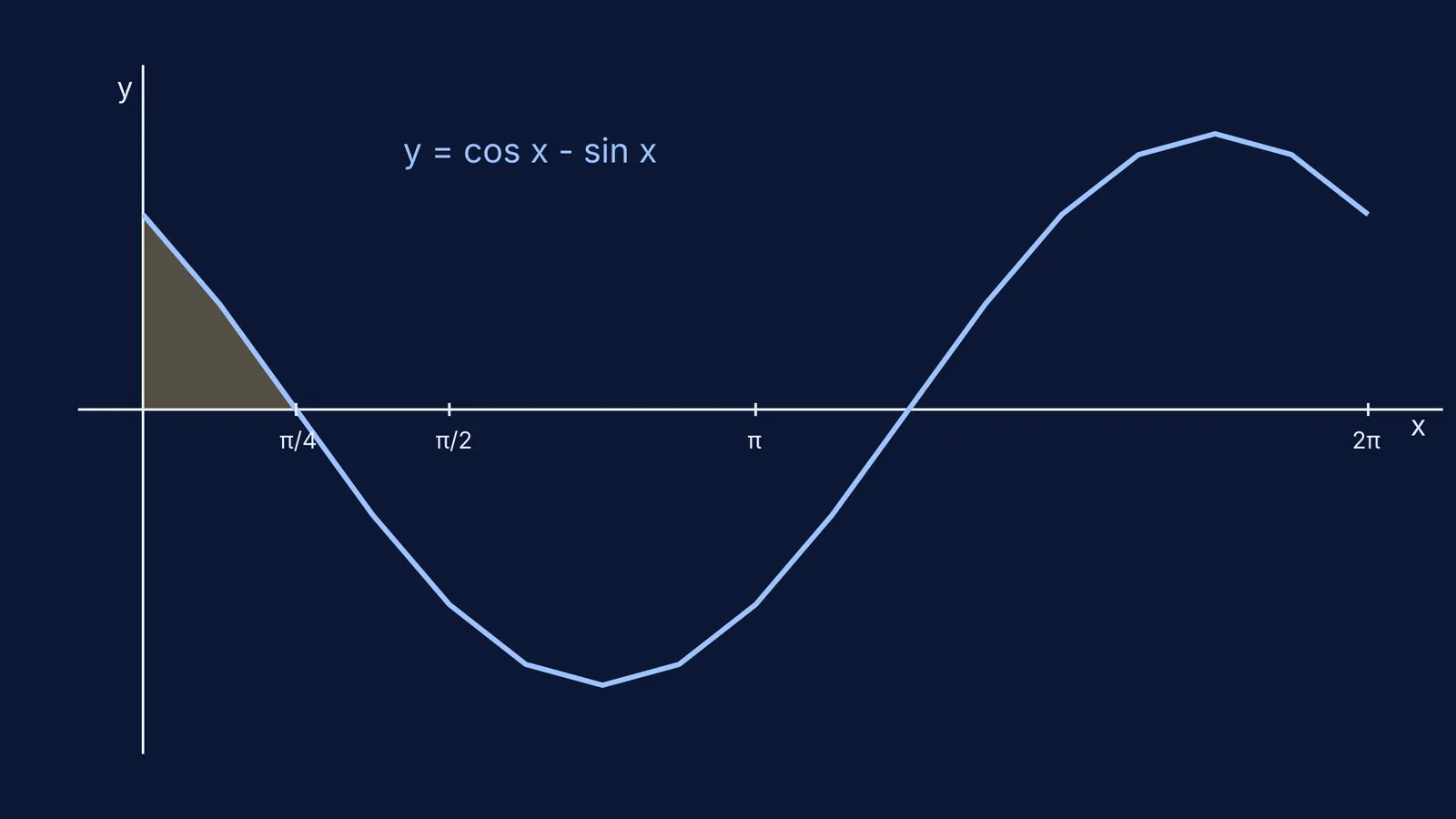
∫ (cos x − sin x)(cos x + sin x) / (cos x + sin x) dx = ∫ (cos x − sin x) dx
Now it is a standard integral. The integral of cos x is sin x, and the integral of −sin x is cos x:
= sin x + cos x + C
If you are struggling to spot these algebraic steps, the Fermi Problem Library has worked problems with a step-by-step solver that explains the reasoning rather than printing an answer, helping you see the pattern before you try to integrate.
How do you integrate the square root of 1 + sin 2x?
Roots are notoriously difficult to integrate directly. The goal is to make the expression inside the square root a perfect square so the root disappears.
For the integral ∫ √(1 + sin 2x) dx, we can use two key identities:
sin 2x = 2 sin x cos x
1 = cos²x + sin²x
Substitute these into the root to get: √(cos²x + sin²x + 2 sin x cos x)
This matches the algebraic expansion of (a + b)² = a² + b² + 2ab. So, we can rewrite the expression as a perfect square: = √((cos x + sin x)²) = cos x + sin x
The integral is now trivial: ∫ (cos x + sin x) dx = sin x − cos x + C
How do you integrate (1 − cos 2x) / (1 + cos 2x)?
Fractions with 1 ± cos 2x are extremely common in calculus and physics problems. The trick is to use the half-angle formulas to eliminate the 1s completely.
1 − cos 2x = 2 sin²x 1 + cos 2x = 2 cos²x
Substitute these into the integral: ∫ (2 sin²x) / (2 cos²x) dx = ∫ tan²x dx
We still cannot integrate tan²x directly. However, another identity, sec²x − tan²x = 1, gives us a direct path: tan²x = sec²x − 1
Since the integral of sec²x is a standard result (tan x), we can finish the problem in one step: ∫ (sec²x − 1) dx = tan x − x + C
A checklist for trigonometric integrals
Before you begin integrating, ask yourself:
Are there mixed angles? If you see 2x and x in the same fraction, use double-angle identities to make them match.
Is there a 1 next to a cos 2x? Use half-angle formulas to eliminate the 1.
Is there a 1 + sin 2x under a root? Rewrite 1 as cos²x + sin²x to create a perfect square.
Memorising identities is not enough; you must know when to use them. If you find yourself stuck because you do not know which identity to apply, Fermi's AI tutor can work out what you already know and build a plan for the session, writing on a board and drawing the figures with you.
For more on integration tricks, read our guide on integrals of the form √(a² − x²) or learn when to use the tan(x/2) substitution. If you need a refresher on the basics, you can explore the entire calculus map in the Fermi Concept Library, which covers every concept in physics, chemistry, biology, mathematics and computing.


