

On this page
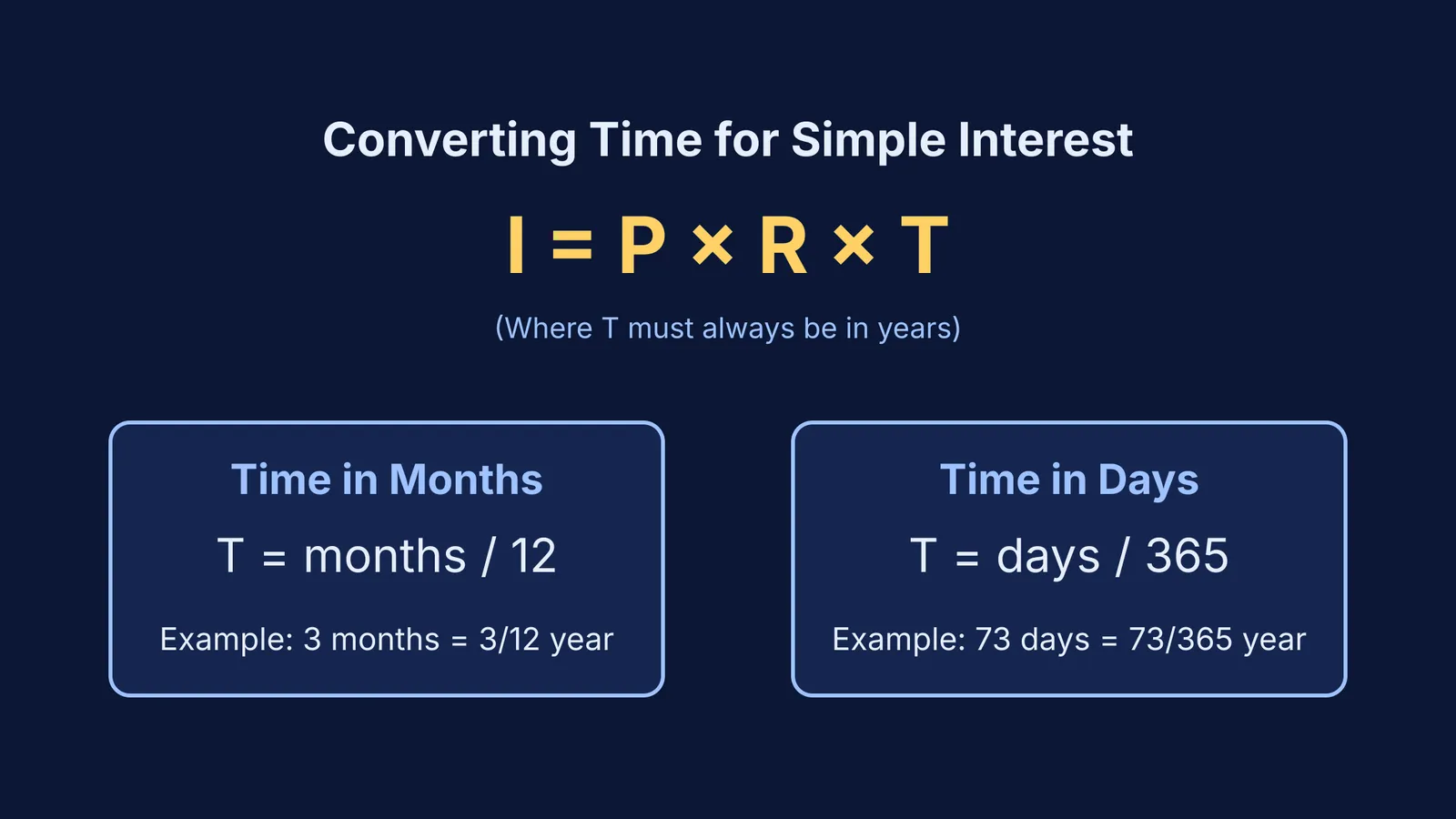
When you solve a simple interest problem, the rate of interest is almost always given as a percentage "per annum" (per year). Because the rate is yearly, the time used in your calculation must also be in years.
If the time is already in years, you simply multiply the principal, rate, and time. But exams often test your attention to detail by giving the time in months or days.
How do you calculate simple interest for months?
When the time period is given in months, you must convert it to a fraction of a year by dividing the number of months by 12. According to standard mathematical definitions, the formula becomes: SI = (P × R × n) / (100 × 12) where n is the number of months (Source).
For example, if you borrow ₹10,000 at an interest rate of 6% per annum for 3 months, the time in years is 3/12, which simplifies to 1/4 of a year. The interest is therefore 10,000 × 6/100 × 1/4 = 150.
Sometimes, the time is given as a mixture of years and months, such as "2 years and 3 months". The easiest approach is to convert the entire period into months first. Two years is 24 months, plus 3 months equals 27 months. You then divide by 12, giving a time period of 27/12 or 9/4 years.
How do you calculate simple interest for days?
If the time is given in days, you must divide the total number of days by 365 to convert it into a fraction of a year. The formula used for this conversion is: SI = (P × R × d) / (100 × 365) where d is the number of days (Source).
For instance, 73 days is exactly 1/5 of a year. If you invest ₹5,000 at 8% per annum for 73 days, the interest is 5,000 × 8/100 × 1/5 = 80. This mathematical pattern appears constantly in the Fermi Problem Library, where worked problems use a step-by-step solver that explains the reasoning rather than printing an answer. Just as you learn standard algebraic setups for choosing three or four numbers in AP or GP, memorising these 73-day multiples will save you crucial minutes during an exam.
Why do textbooks always use 365 days?
In standard educational conventions, you must always assume a 365-day year unless the problem explicitly states that it is a leap year. This ensures a uniform approach for all students attempting the problem (Source).
This 365-day convention is known as "exact interest". You might occasionally hear about "ordinary simple interest", which is a historical banking method that calculates interest using a simplified 360-day year (Source). While ordinary interest is still used in some international commercial systems to slightly increase the daily interest charged to borrowers, it is completely ignored in standard school examinations. Stick to 365 days unless instructed otherwise.
What if the problem explicitly mentions a leap year? If a leap year is specified (for example, 2024 or 2028), and the time period includes the extra day of February 29th, you must divide the number of days by 366 instead of 365. However, if the time period in a leap year does not cross February 29th, you still divide by 365.
How do you count days between two dates?
Often, a problem will not give you the total number of days upfront. Instead, it will give you two dates, such as "from 4th April to 16th June". The standard rule for counting these days is to exclude the first day (the day the money is deposited or borrowed) but include the last day (the day it is withdrawn or repaid). Let us practice with a full example: finding the interest on ₹12,000 at 5% per annum from 10th May to 22nd July in a non-leap year (Source).
May: The month has 31 days total. Subtract the first 10 days, leaving 21 days in May.
June: The entire month has 30 days.
July: The money is taken out on the 22nd, so we count 22 days (including the last day).
Total days = 21 + 30 + 22 = 73 days. Convert this to years by dividing by 365, giving 73/365 = 1/5 year. Now, apply the simple interest formula: 12,000 × 5/100 × 1/5 = 120.
What are the common mistakes to avoid?
Even when students know the correct formulas, small arithmetic and conceptual errors can lead to incorrect answers. Here are the most frequent mistakes to watch out for (Source):
Forgetting to convert at all: The single most common error is plugging the raw number of months or days directly into the P × R × T formula. Multiplying by 3 instead of 3/12 will give you an answer that is twelve times too large.
Miscounting the days in a month: It is easy to forget whether a month has 30 or 31 days. Remember the traditional knuckle mnemonic or the "Thirty days hath September, April, June, and November" rhyme to ensure your day counts are accurate.
Double-counting the first and last day: As mentioned earlier, the rule is to exclude the date of deposit but include the date of withdrawal. If you include both, your day count will be off by one, which often ruins the clean "73-day" fractions set up by the examiner.
By keeping these basic conversion rules in mind, you can avoid the most common trap in quadratic word problems in Class 10 and financial arithmetic: forgetting to match the units of time with the units of the interest rate. Always convert to years first, and the rest of the calculation will fall naturally into place.


