

On this page
The simple interest formula, SI = (P × R × T) / 100, is one of the earliest junctions where everyday arithmetic meets formal algebra. The variables represent four interconnected financial quantities: Principal (P, the initial borrowed or invested sum), Rate (R, the annual percentage rate per annum), Time (T, duration in years), and Simple Interest (SI, the fixed cost of borrowing). While evaluating simple interest from three given values is straightforward, many students hesitate when an exam question presents the interest and asks them to work backward to determine the principal, rate, or time.
Connecting this topic to ratios and proportional reasoning, the formula represents a balance where interest scales linearly with capital and time. Foundational research by Carolyn Kieran demonstrated that early algebra students predominantly perceive the equals sign as an operational command to compute an answer rather than a relational symbol of balance between two expressions (Kieran, 1981). Treating the formula as a balanced scale eliminates the guesswork of determining which value multiplies or divides.
How do you rearrange the simple interest formula for each unknown?
Every rearrangement of the formula relies on inverse operations. Beginning with the base definition:
SI = (P × R × T) / 100
First, multiply both sides of the equation by 100 to clear the fraction:
100 × SI = P × R × T
Now isolate the target unknown by dividing both sides by the product of the other two known terms:
To find Principal (P): P = (100 × SI) / (R × T)
To find Rate (R): R = (100 × SI) / (P × T)
To find Time (T): T = (100 × SI) / (P × R)
When a problem provides the total Amount (A = P + SI) rather than the interest, express interest as SI = A − P. Substituting gives A = P × (1 + R × T / 100), which rearranges to P = (100 × A) / (100 + R × T).
Consider a practical worked example: An investment grows to an amount of ₹13,200 at an annual interest rate of 8% per annum over 4 years. What was the initial principal borrowed?
Identify the known values: A = ₹13,200, R = 8, T = 4 years.
Apply the rearranged amount formula: P = (100 × 13,200) / (100 + 8 × 4).
Simplify the denominator: 100 + 32 = 132.
Calculate: P = 1,320,000 / 132 = ₹10,000.
The original principal was ₹10,000, which accrued ₹3,200 in simple interest over the 4-year period.
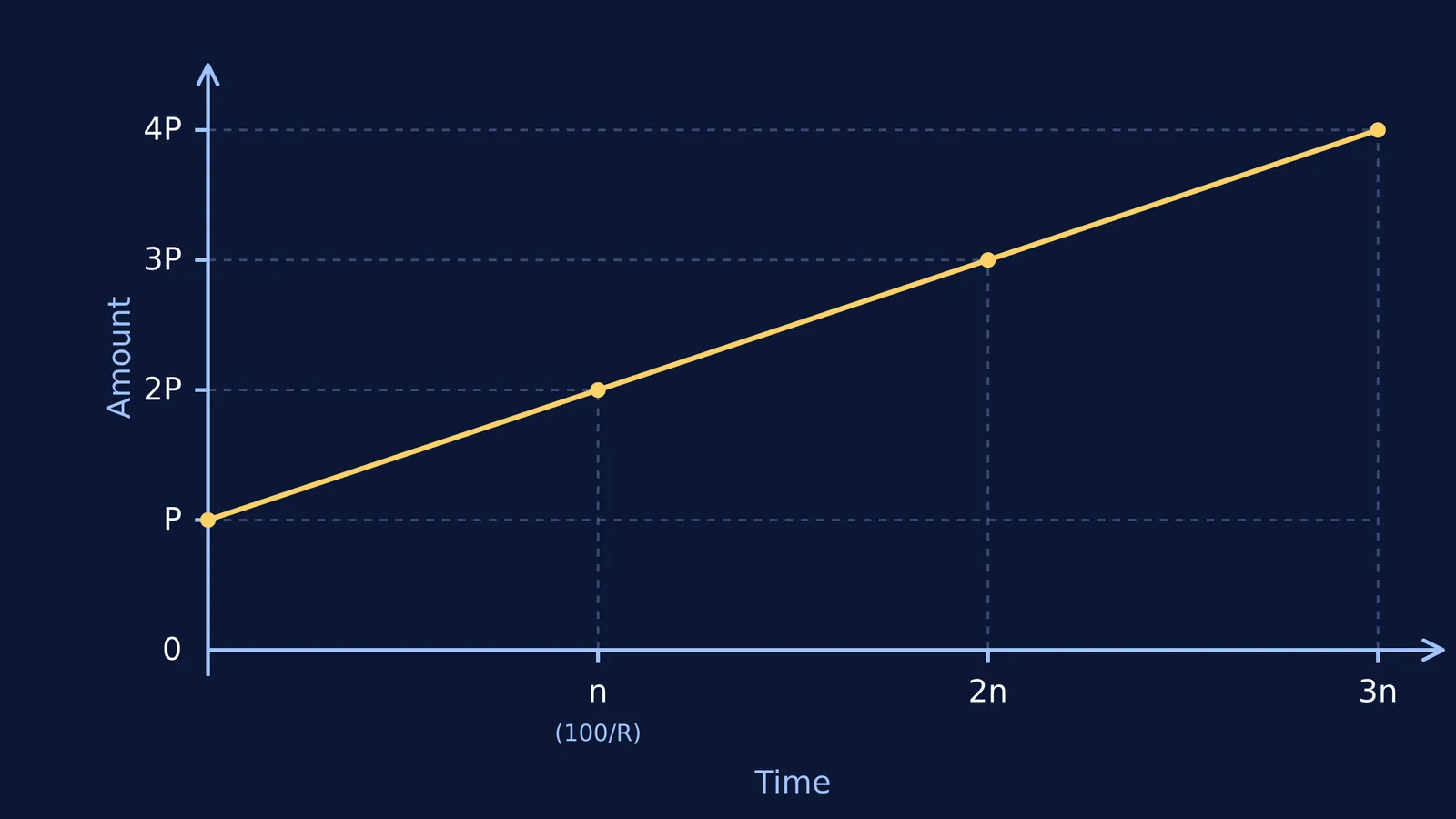
How do you solve 'amount doubles in n years' questions?
A classic quantitative aptitude and school examination question asks: "A sum of money doubles itself in n years at simple interest. What is the rate of interest?"
Students often assume the problem cannot be solved because no monetary principal is stated. However, the initial sum is algebraically irrelevant. When any principal P doubles, the final Amount becomes A = 2P, so the earned simple interest is the difference:
SI = A − P = 2P − P = P
Substitute SI = P directly into the rearranged rate formula:
R = (100 × SI) / (P × T) R = (100 × P) / (P × n)
Because P is present in both numerator and denominator, it cancels out completely:
R = 100 / n % per annum
Similarly, if the annual rate R is given and you must calculate the doubling time, the formula rearranges to T = 100 / R years.
This principle clarifies the related question: in how many years will the sum triple? Under simple interest, only the original principal earns interest each year; past interest never compounds. Gaining an interest of P takes n years. To triple, the investment must reach an Amount of 3P, meaning the total interest earned is 3P − P = 2P. Because earning 2P in interest requires twice the time, the sum triples in exactly 2n years. If a sum doubles in 5 years, it will triple in 10 years, not 15 or 25.
What common pitfalls cause errors in simple interest calculations?
In a landmark classroom study involving 134 algebra students across 9 classrooms in 3 high schools, researchers Julie L. Booth and colleagues found that analyzing worked examples with targeted errors significantly improved students' conceptual understanding and algebraic feature encoding compared to unguided problem solving (Booth et al., 2013). In simple interest calculations, three recurring procedural errors account for most lost marks:
Time unit mismatch: The rate R is defined per annum (yearly), so time T must always be converted into years. If a question specifies 9 months, write T = 9 / 12 = 3 / 4 years. For 146 days, write T = 146 / 365 = 2 / 5 years.
Conflating Amount with Interest: Mistakenly placing the final Amount into the SI position inflates the result. Check whether the problem states "earned an interest of" or "amounted to".
Double division by 100: The formula SI = (P × R × T) / 100 already incorporates percentage division. Entering an 8% rate as 0.08 while retaining the 100 in the denominator divides by 10,000.
An empirical study evaluating simple interest computation among 103 students demonstrated that using a mobile augmented reality tool significantly improved students' achievement and motivation (Hernández Moreno et al., 2021).
The Fermi Problem Library provides worked problems with a step-by-step solver that explains the reasoning rather than printing an answer. When you encounter word problems with multi-step constraints, Fermi's AI tutor works out what you already know and notices where you are stuck, deciding whether to explain, ask, or show each step on an interactive board. Reviewing translating word problems into equations and comparing quantities and commercial calculations in Class 8 further clarifies how linear formulas underpin secondary school mathematics.


