

On this page
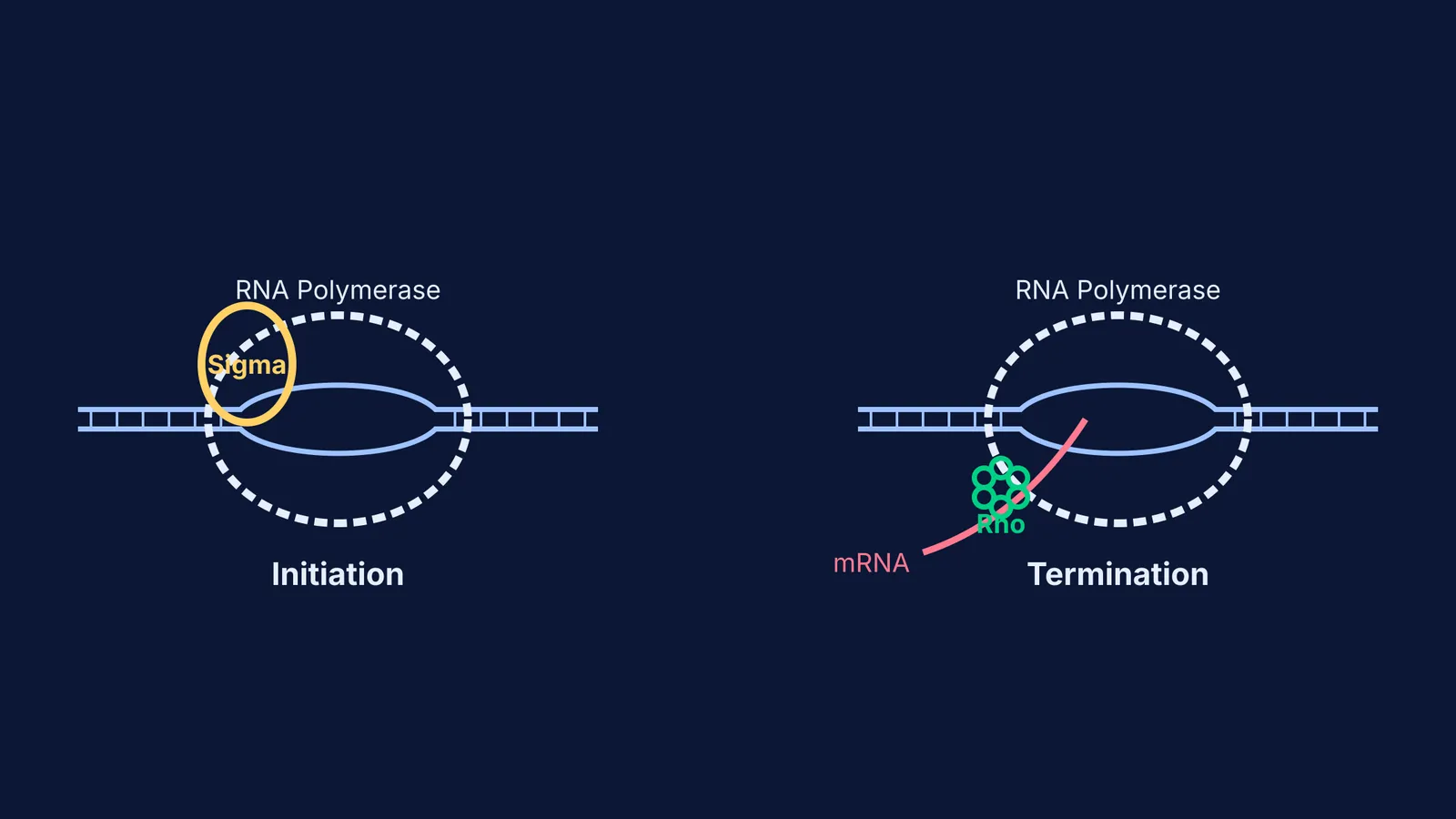
Bacterial cells need a way to read their genes and build RNA, but they cannot do it randomly. The main enzyme that writes RNA, RNA polymerase, needs clear signals to know exactly where to start and when to stop. This precision comes from two helper proteins: the sigma (σ) factor for initiation, and the rho (ρ) factor for termination.
For students preparing for NEET and board exams, understanding the exact roles of these factors is a common sticking point. They are the keys to bacterial transcription, ensuring genes are only read when the cell needs them.
What is the role of sigma factor in transcription?
The bacterial RNA polymerase core enzyme consists of five subunits (Wikipedia)). On its own, this core enzyme can synthesise RNA but cannot find the right place to start reading DNA. To initiate transcription properly, it must bind to a sigma factor to form the RNA polymerase holoenzyme.
The sigma factor's primary role is to recognise and bind to specific sequences on the DNA called promoters, specifically at the −10 and −35 elements before the gene starts. Every molecule of RNA polymerase holoenzyme contains exactly one sigma factor subunit (Wikipedia). Different sigma factors respond to different conditions. For instance, *E. coli* has seven distinct sigma factors, allowing the cell to switch which genes it transcribes depending on whether it is under heat shock, nitrogen starvation, or normal growth conditions (Wikipedia).
Once the holoenzyme binds to the promoter, it unwinds a short stretch of DNA to form an open complex. Traditionally, biologists thought the sigma factor fell off immediately after transcription started. However, recent evidence suggests it sometimes stays attached for longer, cycling between a strongly bound state during initiation and a weakly bound state as the RNA chain elongates.
If you struggle to picture how these complexes assemble, the Concept Library covers every concept in biology. Instead of just giving you an answer, Fermi's AI tutor works out what you already know, builds a plan for the session, and teaches through it—drawing the figure and checking your understanding as it goes.
What is the role of rho factor in transcription termination?
When RNA polymerase reaches the end of a gene, it must detach from the DNA and release the newly synthesised mRNA. Bacteria have two main ways to do this, one of which relies on the rho factor.
The rho factor is a large, hexameric protein that acts as an ATP-dependent helicase (Wikipedia). It binds to a specific sequence on the newly formed RNA called the *rut* (rho utilization) site. The *rut* site is an extended single-stranded region of about 72 to 100 nucleotides (Wikipedia).
Once bound, the rho factor uses energy from ATP hydrolysis to move along the RNA transcript toward the RNA polymerase. During transcription, RNA polymerase typically moves about 40 nucleotides per second faster than the rho factor (Wikipedia). Because of this speed gap, the polymerase must pause at a specific site on the DNA, which allows the rho factor to catch up. When rho reaches the point where RNA is still paired with the DNA template, its helicase activity unwinds the RNA-DNA duplex, freeing the mRNA and terminating transcription.
Eukaryotes use completely different rules, which you can read about in our guides to Three RNA polymerases in eukaryotes: what each one makes and RNA processing in eukaryotes: capping, tailing and splicing.
What should you remember for exams?
When answering questions about the sigma factor and rho factor, keep these points clear:
Core vs Holoenzyme: Core enzyme (synthesises RNA) + Sigma factor = Holoenzyme (initiates at the promoter).
Sigma's job: Promoter recognition and initiation. It does not synthesise RNA itself.
Rho's job: Termination. It acts as a helicase to unwind the RNA-DNA hybrid.
Energy: Rho termination requires ATP.
Binding targets: Sigma binds to the DNA template (the promoter); Rho binds to the naked mRNA transcript (the *rut* site).
For other common genetic problems, try our guide on Chargaff's rule numericals: strand-by-strand DNA base sums.


