

On this page
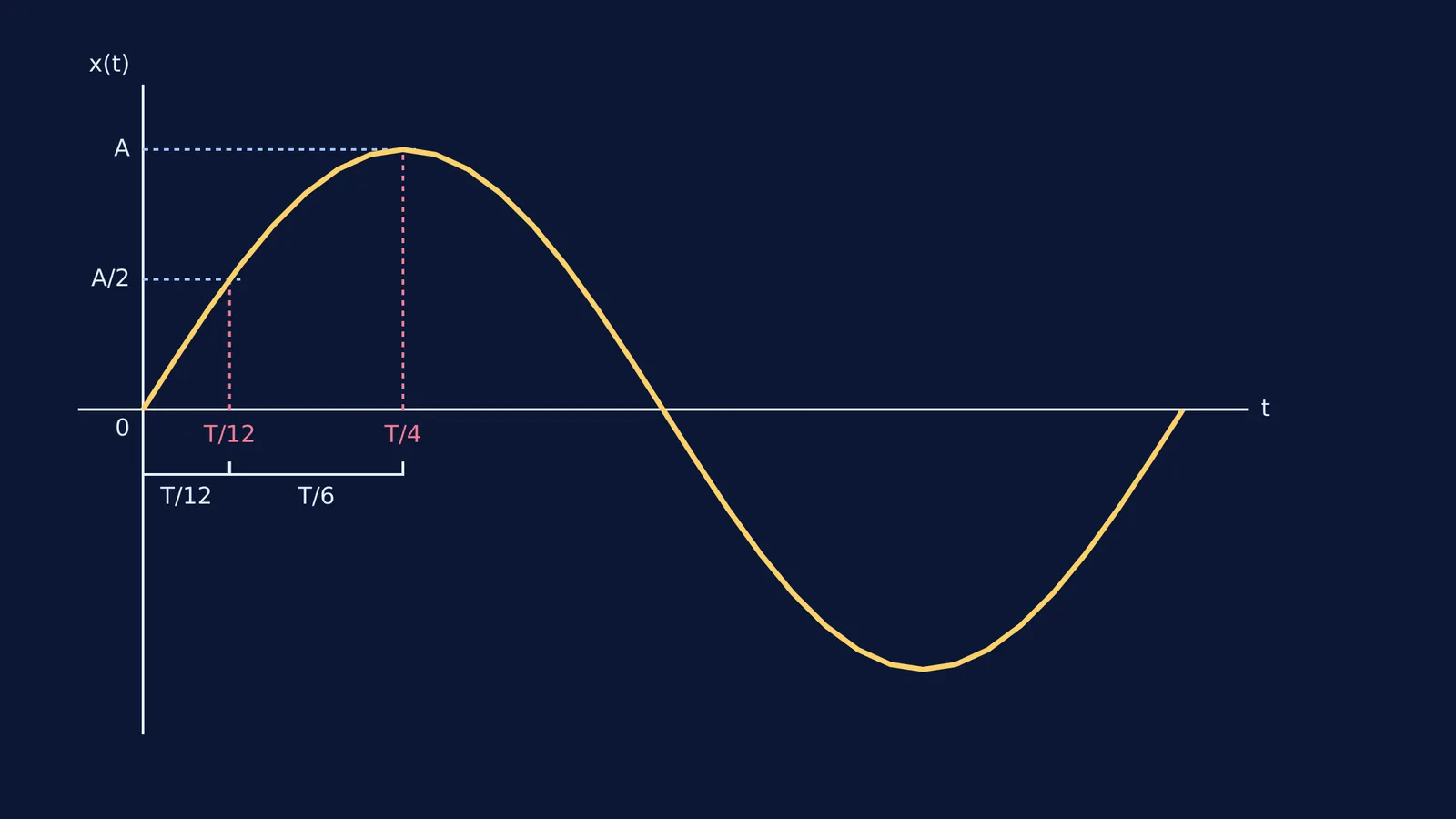
In simple harmonic motion (SHM), the distance from the mean position to half the amplitude is exactly the same as the distance from half the amplitude to the extreme position. However, the time taken to cover these two halves is not equal. A particle takes T/12 to reach half its amplitude and T/6 to cover the rest of the distance.
How do you calculate the time from mean to half amplitude?
We can prove this result using the standard displacement equation for a particle starting its oscillation from the mean position. The position x at any time t is given by x = A sin(ωt), where A is the maximum amplitude and ω is the angular frequency/Book%3A_University_Physics_I_-_Mechanics_Sound_Oscillations_and_Waves_(OpenStax)/15%3A_Oscillations/15.02%3A_Simple_Harmonic_Motion). The angular frequency is related to the time period T by the formula ω = 2π/T.
To find the time taken to reach half the amplitude, we substitute x = A/2 into our displacement equation:
A/2 = A sin(ωt)
Dividing both sides by A gives:
1/2 = sin(ωt)
The smallest positive angle whose sine is 1/2 is 30°, which is π/6 in radians. Therefore, we can write:
ωt = π/6
Substituting ω = 2π/T into this equation yields:
(2π/T) × t = π/6
Solving for t, the π terms cancel out, leaving us with:
t = T/12
This shows that the particle takes exactly one-twelfth of its total time period to travel from the mean position (x = 0) to half its amplitude (x = A/2).
What is the time taken from half amplitude to the extreme position?
To find the time spent in the second half of the journey, we first calculate the total time taken to reach the extreme position, where x = A. Setting x = A in our displacement equation gives:
A = A sin(ωt)
1 = sin(ωt)
The smallest positive angle whose sine is 1 is 90°, or π/2 radians.
(2π/T) × t = π/2
t = T/4
The total time from the mean to the extreme position is a quarter of the time period, or T/4. To find the time taken to travel from x = A/2 to x = A, we simply subtract the time taken for the first half from this total time:
Time = T/4 - T/12
Time = 3T/12 - T/12
Time = 2T/12 = T/6
The particle takes T/6 to cover the second half of the distance. This is exactly twice as long as the T/12 it took to cover the first half.
How long does a mass on a spring take to travel?
Let's apply this rule to a real problem. Suppose a block is attached to a horizontal spring and set into simple harmonic motion. The total time period of oscillation is 12 seconds, and the block oscillates with an amplitude of 10 cm.
How long does it take for the block to travel from a displacement of 5 cm to the extreme position at 10 cm?
Identify the given values. The time period T is 12 s. The amplitude A is 10 cm. The starting position is x = 5 cm, which is exactly half the amplitude (A/2). The final position is x = 10 cm, which is the extreme position (A).
Use the standard fractions. We know that the time taken to travel from the mean position (0 cm) to half the amplitude (5 cm) is T/12. We also know that the time taken to travel the remaining distance from 5 cm to 10 cm is T/6.
Calculate the final time. Time = T/6 = 12 / 6 = 2 seconds.
Even though the block covers 5 cm in the first half of its journey and 5 cm in the second half, the time splits unevenly. It takes just 1 second (T/12) to cover the first 5 cm, but 2 seconds (T/6) to cover the next 5 cm.
Why does the velocity change so much?
To truly understand why the time splits into T/12 and T/6, we have to look at the velocity of the particle. In simple harmonic motion, the restoring force is directly proportional to the displacement. When the particle is at the mean position (x = 0), the restoring force is zero, but the kinetic energy is at its absolute maximum. The particle shoots past the mean position at its highest speed.
As it moves outward towards x = A/2, the restoring force begins to pull it back, slowing it down. However, it is still travelling relatively fast throughout this first segment, which is why it covers the distance in just T/12.
Once it crosses x = A/2, the restoring force becomes much stronger because it is stretched further from the equilibrium. The particle continues to slow down dramatically until its velocity hits zero at the extreme position (x = A). Because the average speed in this outer segment is much lower, it takes exactly twice as long—a full T/6—to cover the same physical distance.
How can you remember phase differences quickly?
When solving exam questions under time pressure, deriving these values from scratch can slow you down. If you need a faster way to picture this phase difference, the Fermi Concept Library explains the reference circle method, which connects the oscillating particle to a point moving in a uniform circle.
In the reference circle, the position x = A/2 corresponds to an angle of 30° (or π/6), and x = A corresponds to 90° (or π/2). Since uniform circular motion sweeps out equal angles in equal times, the 30° slice takes exactly 1/3 of the 90° quarter-circle time. The remaining 60° takes 2/3 of that time. This instantly shows why the first half takes T/12 (which is one-third of T/4) and the second half takes T/6.
Understanding these milestones helps you avoid common traps where you might assume equal distances take equal times. If you get stuck applying these fractions to a complex oscillation problem, the step-by-step solver in the Fermi Problem Library explains the reasoning rather than just printing an answer.
You can also read more about related ideas in our guides on how to prove SHM and find the period and finding phase and time quickly with the reference circle.


