

On this page
In kinematics, you usually find velocity by differentiating displacement, and acceleration by differentiating velocity. But in simple harmonic motion (SHM), the peak values of these three quantities are locked together by a single multiplier: the angular frequency (ω).
If an exam question gives you the maximum speed and maximum acceleration of an oscillating body, you do not need to set up any differential equations or integrate from scratch. The ratio of peak acceleration to peak speed in SHM gives the angular frequency directly.
Here is how the shortcut works, why it is true mathematically, and how to use it to find the amplitude and time period.
What is the ratio of peak acceleration to peak speed in SHM?
According to the OpenStax University Physics Volume 1 textbook, the maximum velocity (v_max) and maximum acceleration (a_max) of a particle executing simple harmonic motion depend only on its amplitude (A) and its angular frequency (ω).
The formulas are:
v_max = Aω
a_max = Aω²
If you divide the peak acceleration by the peak speed, the amplitude (A) cancels out completely: a_max / v_max = (Aω²) / (Aω) = ω
This single division gives you ω in radians per second. From there, finding the time period (T) of the oscillation is straightforward because T = 2π / ω. The frequency in hertz (f) is just 1 / T.
How do you find the amplitude from maximum speed?
Once you know the angular frequency, finding the amplitude takes just one more step. Because you know that v_max = Aω, you can rearrange the formula to make amplitude the subject: A = v_max / ω
Alternatively, if you prefer to memorise a single expression for the amplitude in terms of the given quantities, you can substitute ω = a_max / v_max into the equation. This yields: A = v_max² / a_max
How does this look in a worked example?
Suppose a block on a spring is oscillating horizontally on a frictionless table. You are told it has a maximum speed of 3 m/s and a maximum acceleration of 12 m/s². What are its time period and amplitude?
Find the angular frequency (ω): ω = a_max / v_max = 12 / 3 = 4 rad/s.
Find the time period (T): T = 2π / ω = 2π / 4 = π / 2 ≈ 1.57 s.
Find the amplitude (A): A = v_max / ω = 3 / 4 = 0.75 m.
If you find yourself stuck on simple harmonic motion problems like this one, the Fermi Problem Library can help you find your way. Rather than just printing the final answer, Fermi's AI tutor works with you step by step, asking questions to check your understanding and building a plan for the session so you sit down to a clear next step.
How are velocity and acceleration related in SHM?
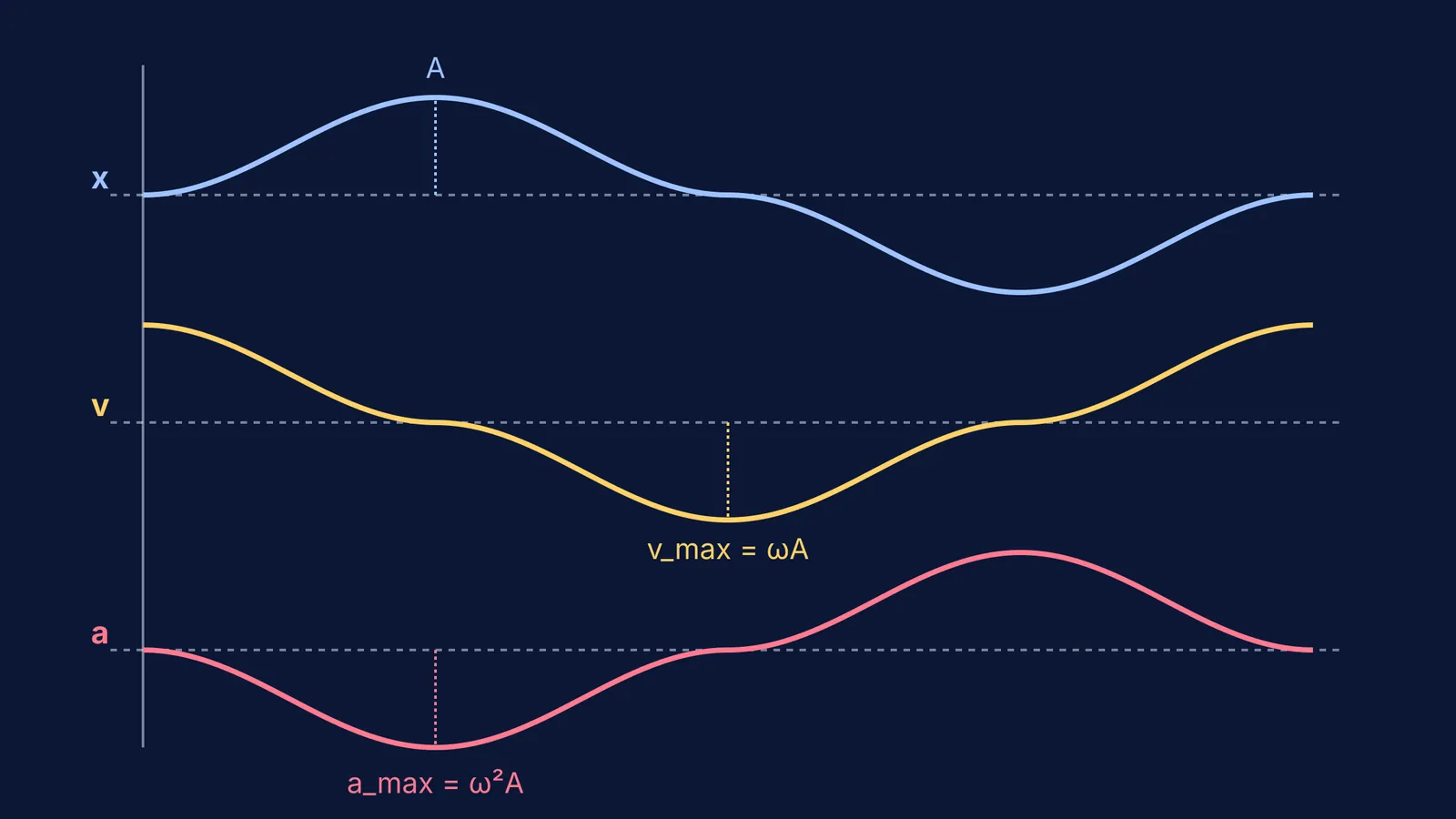
To understand why this shortcut always works, it helps to look at the underlying equations of motion. If a particle starts its motion from the mean position, its displacement x at any time t is: x(t) = A sin(ωt)
Differentiating this displacement with respect to time gives the velocity: v(t) = Aω cos(ωt)
Differentiating the velocity once again gives the acceleration: a(t) = -Aω² sin(ωt)
The sine and cosine functions always oscillate smoothly between +1 and -1. The constants multiplying them out in front—Aω and Aω²—determine the maximum values (the peaks) of the curves. This is why SHM energy graphs and kinematic graphs share the same underlying frequency, even though they reach their maximum values at different times in the cycle.
The negative sign in the acceleration equation shows that the restoring force is always directed opposite to the displacement. When the particle is at its maximum positive displacement, it experiences maximum negative acceleration, pulling it back towards the centre.
You can visualise these relationships and read more about the mathematical foundations using the Fermi Concept Library, which covers the derivations for SHM kinematics and connects them to SHM and the reference circle.
How do you apply this to exam questions?
When you spot a physics question asking for amplitude, frequency or time period in SHM, stop and check what values you are given. If you have any two of the three main kinematic peaks—maximum displacement (x_max), maximum velocity (v_max) and maximum acceleration (a_max)—you can bypass the differential equations entirely.
Keep these three algebraic shortcuts in mind:
Given v_max and x_max (which is A): Divide them to find the angular frequency: ω = v_max / A.
Given a_max and x_max: Divide them and take the square root to find the angular frequency: ω = √(a_max / A).
Given a_max and v_max: Divide them directly to find the angular frequency: ω = a_max / v_max.
Using these ratios is fast, relies purely on basic algebra, and leaves you with less room for arithmetic errors under strict exam time limits.


