

On this page
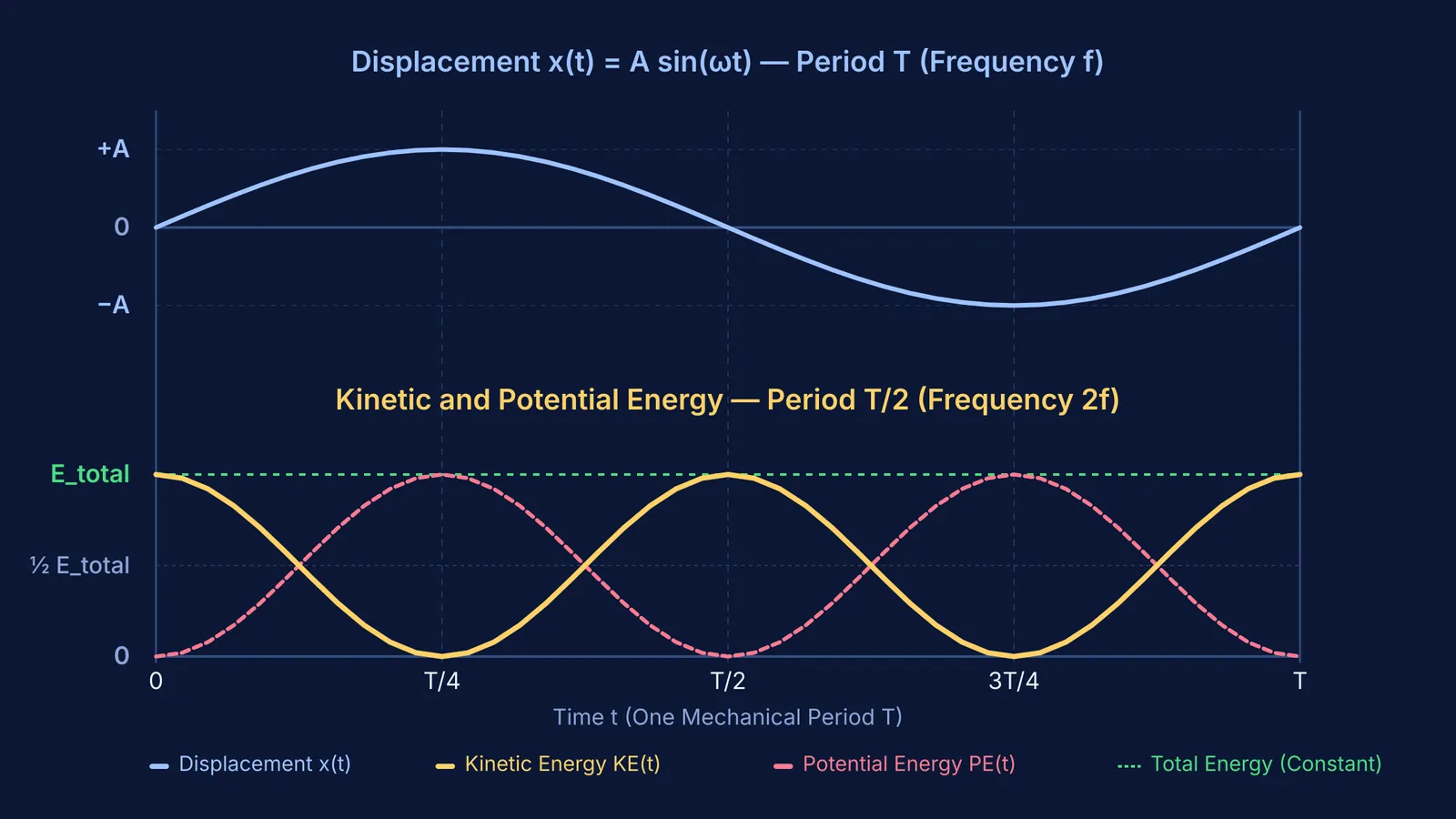
When a mass bounces on a spring or a pendulum swings, it takes a full period T to complete one mechanical cycle: moving from +A through equilibrium (x = 0) to −A, and returning to +A.
During this motion, the particle crosses equilibrium twice. According to OpenStax University Physics Volume 1, kinetic energy peaks at equilibrium, where speed reaches maximum (v = ±v_max). Because kinetic energy is proportional to velocity squared (KE = ½mv²), direction does not affect its sign. At both +v_max and −v_max, kinetic energy reaches the exact same positive peak of ½m(v_max)².
Consequently, while the particle takes time T to complete one positional cycle, kinetic energy completes a full rise-and-fall cycle in T/2, doubling its cyclic frequency from f to 2f. For ideas easier to see than read, the Fermi Simulation Lab provides interactive simulations where you can observe displacement, velocity, and energy oscillating side by side.
What is the mathematical proof for the doubled frequency?
Consider a mass m executing SHM with amplitude A and angular frequency ω, defined by displacement:
x(t) = A sin(ωt)
Instantaneous velocity is:
v(t) = dx/dt = Aω cos(ωt)
Substituting velocity into kinetic energy yields:
KE(t) = ½ m [v(t)]² = ½ m A² ω² cos²(ωt)
With total energy E_total = ½ k A² and k = mω², we apply the identity cos²(θ) = [1 + cos(2θ)] / 2:
KE(t) = ¼ k A² [1 + cos(2ωt)] = ½ E_total [1 + cos(2ωt)]
As demonstrated in OpenStax University Physics Volume 1, the term cos(2ωt) oscillates at angular frequency 2ω. Because cyclic frequency relates to angular frequency by f = ω / (2π), the frequency of kinetic energy is f_KE = 2ω / (2π) = 2f, with period T_KE = T/2.
How does potential energy balance kinetic energy over time?
Potential energy also depends on displacement squared:
PE(t) = ½ k [x(t)]² = ½ k A² sin²(ωt)
Using sin²(θ) = [1 − cos(2θ)] / 2 gives:
PE(t) = ¼ k A² [1 − cos(2ωt)] = ½ E_total [1 − cos(2ωt)]
Potential energy also oscillates at angular frequency 2ω with period T/2. As highlighted in The Feynman Lectures on Physics, kinetic and potential energies operate in exact anti-phase at this double frequency. When displacement reaches extremes (x = ±A), potential energy equals E_total and kinetic energy is zero. At equilibrium (x = 0), potential energy drops to zero and kinetic energy equals E_total.
Summing both expressions confirms mechanical energy conservation:
E = KE(t) + PE(t) = ¼ k A² [1 + cos(2ωt) + 1 − cos(2ωt)] = ½ k A²
The harmonic terms cancel, leaving constant total energy with an oscillation frequency of 0 Hz. Over one full cycle, time-averaged kinetic and potential energy each equal ¼ k A². Explore spatial mappings in our guide on SHM energy graphs with displacement.
How do you calculate mechanical frequency from kinetic energy data?
Oscillator problems frequently appear in competitive exams based on the principles catalogued in OpenStax University Physics Volume 1, testing whether students correctly relate energy frequency to motion frequency.
Problem: A 0.20 kg block on a horizontal spring oscillates on a frictionless surface. Its kinetic energy oscillates at 40 Hz with a maximum of 0.80 J. Determine mechanical frequency, period, spring constant, and amplitude.
Mechanical frequency:
Because kinetic energy oscillates at twice the frequency of displacement (f_KE = 2f), mechanical frequency is f = 40 Hz / 2 = 20 Hz.
Mechanical period:
The period of one oscillation is T = 1 / f = 1 / 20 Hz = 0.050 s (50 ms), while kinetic energy repeats every T/2 = 0.025 s (25 ms).
Spring constant:
Angular frequency is ω = 2πf = 40π rad/s ≈ 125.7 rad/s. Using k = mω²: k = 0.20 kg × (40π rad/s)² = 0.20 × 1600π² N/m ≈ 3158 N/m.
Amplitude:
From E_total = ½ k A² = 0.80 J: A = √(2 × 0.80 J / 3158 N/m) ≈ 0.0225 m = 2.25 cm.
When solving multi-step oscillation problems with shifting phase constants or mixed energy conditions, the Fermi Problem Library provides worked problems with a step-by-step solver that explains the reasoning rather than printing an answer.
How do SHM kinematic and energy variables compare?
According to the framework in OpenStax University Physics Volume 1, distinguishing kinematic quantities from energy quantities prevents common calculation errors in speed, phase, and period.
Displacement x(t): oscillates at frequency f with period T, ranging between −A and +A.
Velocity v(t): oscillates at frequency f with period T, lagging displacement by π/2 rad (90°), ranging between −Aω and +Aω.
Acceleration a(t): oscillates at frequency f with period T, opposite in phase to displacement by π rad (180°), ranging between −Aω² and +Aω².
Kinetic energy KE(t): oscillates at frequency 2f with period T/2, non-negative, ranging between 0 and ½kA².
Potential energy PE(t): oscillates at frequency 2f with period T/2, non-negative, ranging between 0 and ½kA².
Total mechanical energy E: constant over time with a frequency of 0 Hz, maintaining the invariant value ½kA².
For visual geometric derivations, check our walkthrough on the reference circle method for SHM or our guide to proving SHM and calculating period. To understand how linear restoring forces link across domains, the Fermi Concept Library organizes every concept in physics, chemistry, biology, mathematics and computing, each with its own lesson and its place in the map.


