

On this page
When you rest your hand on a thick book and push the top cover sideways, the pages slide over one another. The book changes from a rectangle into a parallelogram. This type of deformation—where parallel layers of a material slide past each other—is called shear.
Understanding how materials behave under shear forces is a core part of mechanical properties in physics. It tells us why steel is rigid, why rubber is flexible, and how structures will stand up to wind or earthquakes.
What is shearing stress and sideways shift?
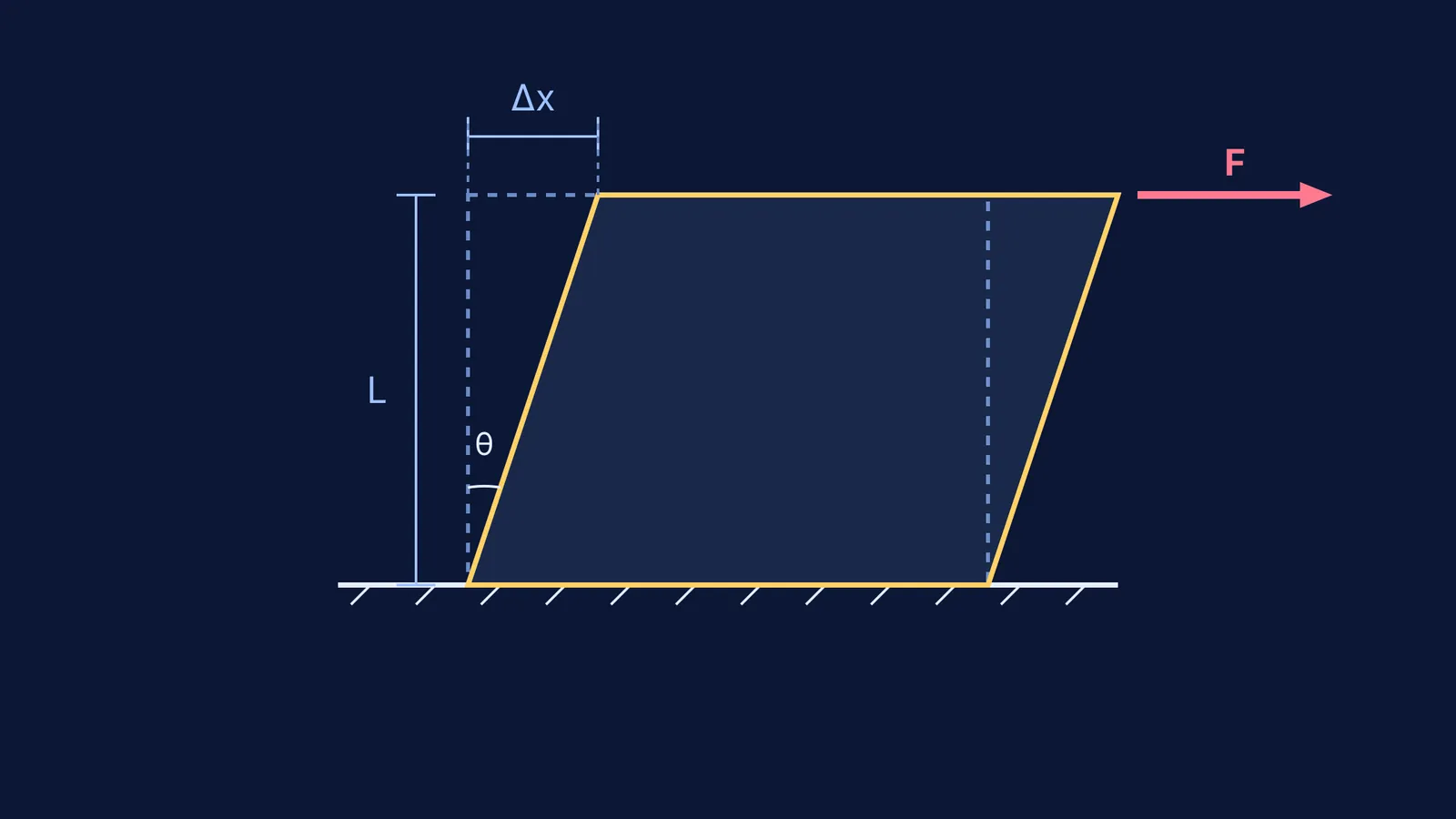
If you have a solid block fixed to a table, and you apply a tangential force (F) across its top face (which has an area A), you are applying a shearing stress.
Shearing stress is defined as the force applied parallel to the surface divided by the area of that surface: Shearing stress = F / A.
Because the bottom of the block is fixed, the top face moves laterally by a small distance. This relative lateral displacement is called the sideways shift (often written as Δx).
How do you calculate the angle of shear?
The angle of shear (θ) is the angle by which a face that was originally perpendicular to the fixed base is tilted.
If the block has a height L and the top face shifts sideways by Δx, you can see a right-angled triangle forms. The tangent of the tilt angle is the opposite side over the adjacent side: tan θ = Δx / L
Because solids only deform by very small amounts before they break or permanently yield, θ is tiny. For small angles in radians, tan θ ≈ θ. Therefore, the angle of shear is simply: θ = Δx / L
This ratio (Δx / L) is also the definition of shearing strain. So, the angle of shear and the shearing strain are the exact same value.
What is the formula for shear modulus?
To find out how rigid a material is, we compare the stress we apply to the strain it produces. The shear modulus (denoted by G or sometimes η), also known as the modulus of rigidity, is the ratio of shearing stress to shearing strain.
G = Shearing stress / Shearing strain
Substituting our terms from above: G = (F / A) / θ G = (F × L) / (A × Δx)
The SI unit for shear modulus is the pascal (Pa), or N/m². Rigid materials like steel have a very high shear modulus (for example, 82.7 GPa in the NCERT tables), while softer materials like rubber have a much lower one, and ideal liquids have a shear modulus of zero because they cannot resist sideways forces.
Mastering these formulas takes practice. A 2011 study published in Science showed that physics students taught through active problem-solving scored 74% on a test of the material, compared to 41% for those listening to traditional lectures. If you are stuck on textbook questions, the Fermi Problem Library has a step-by-step solver that explains the reasoning rather than just printing an answer.
A worked example: shifting a metal block
Suppose you have a metal cube with a side length of 10 cm (L = 0.1 m), and its bottom face is glued to a floor. You apply a sideways force of 5000 N to the top face. The shear modulus G of the metal is 25 × 10⁹ Pa.
Find the area:
A = 0.1 m × 0.1 m = 0.01 m²
Find the shearing stress:
Stress = 5000 N / 0.01 m² = 500,000 Pa.
Find the angle of shear (shearing strain):
Since G = Stress / θ, we rearrange to get θ = Stress / G. θ = 500,000 / (25 × 10⁹) = 0.00002 radians.
Find the sideways shift:
Since θ = Δx / L, then Δx = θ × L. Δx = 0.00002 × 0.1 = 0.000002 m, or 0.002 mm.
The math shows why solid metals feel completely rigid to the human hand—a force of 5000 N only shifts the top by 0.002 mm.
For more on how materials stretch and compress under different forces, you can read our guides on elasticity, stress, strain and Young's modulus problems or how to calculate the elastic potential energy in a stretched wire.


