

On this page
In the Class 9 chemistry curriculum, separating a mixture of common salt, sand and camphor is a classic experiment. It demonstrates how you can isolate substances from a complex mixture by taking advantage of their unique physical properties. Whether you are preparing for a practical exam or just trying to understand the principles of matter, mastering this technique is an important milestone. The secret to getting a clean separation lies not just in the methods you use, but in the exact order you perform the steps.
Why do we remove camphor first?
Camphor is unique because it undergoes sublimation, which means it transitions directly from a solid state to a gaseous state without ever becoming a liquid Wikipedia. It sublimates slowly even at room temperature and much faster when heated gently, reaching a vapour pressure of 4 mmHg at 70 °C Wikipedia.
If you were to add water first, the entire separation process would become messy and inefficient. Camphor has a very low solubility in water, dissolving at a rate of only about 1.2 grams per litre Wikipedia. The wet camphor and sand would clump together into a sludge, making sublimation nearly impossible to perform cleanly later on.
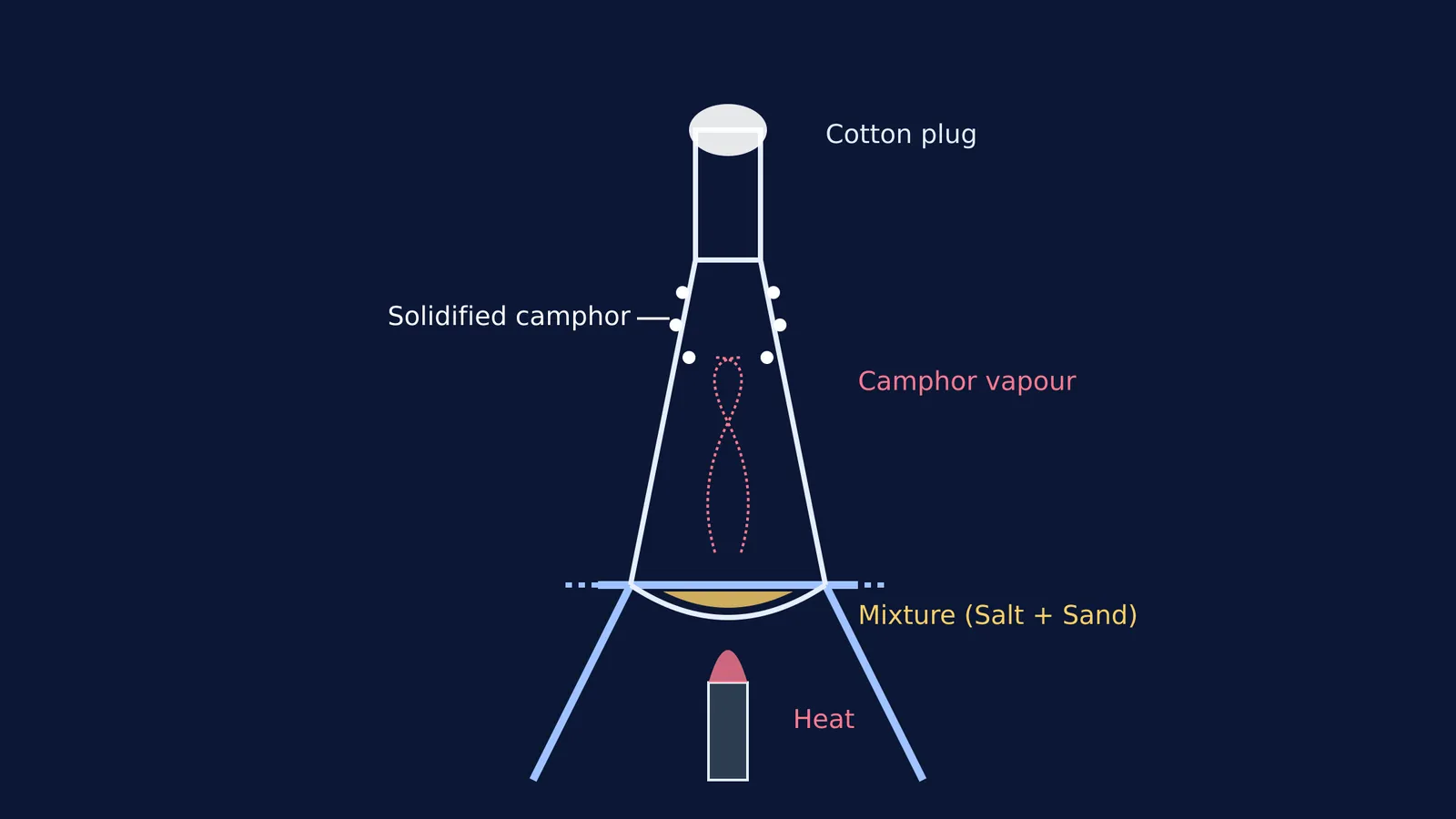
Instead, you start by heating the dry mixture in a china dish covered with an inverted glass funnel. The narrow stem of the funnel is plugged with a piece of cotton. As the mixture heats up, the camphor turns into a thick, white vapour. This vapour rises and hits the cooler inner walls of the funnel, where it condenses back into pure solid camphor crystals. The salt and sand, which do not sublime, are left completely dry in the dish.
How do we separate salt from sand?
Once the camphor has been safely removed and collected, you are left with a dry mixture of sodium chloride (common salt) and silicon dioxide (sand). While they may look remarkably similar as dry, granular powders, they react completely differently to water.
Sodium chloride is highly soluble, easily dissolving at a rate of 360 grams per litre in water at 25 °C Wikipedia. Sand, on the other hand, is a network solid and is completely insoluble in water.
By transferring the remaining mixture into a beaker and stirring in an adequate volume of distilled water, the salt dissolves to form a clear brine solution. The sand remains unaffected and simply settles at the bottom of the beaker.
How do you filter and evaporate the salt?
To physically separate the dissolved salt from the solid sand, you pour the wet mixture through a piece of filter paper set in a standard funnel—a technique known as filtration. The filter paper acts as a microscopic sieve Wikipedia. The dissolved salt and water pass straight through the paper's pores as the filtrate. The large, bulky grains of sand are too large to pass through and remain trapped on the paper as the residue.
Finally, you must recover the solid salt from the clear brine. Because water is a volatile liquid (it boils at 100 °C) and salt is highly non-volatile, you can boil or evaporate the filtrate Wikipedia. As the water turns to steam and escapes into the air, pure sodium chloride crystals are left behind in the evaporating dish.
A practical checklist for the lab
To successfully execute this separation without losing your sample, follow this practical checklist:
Keep the heat gentle: Sublimation does not require a roaring blue flame. Use a low, gentle flame to prevent the salt from spitting out of the dish or the sand from overheating.
Seal the funnel properly: Ensure the cotton plug at the top of the inverted funnel is snug. If it is too loose, the camphor vapour will escape into the room; if it is too tight, air pressure could build up dangerously.
Wait before dissolving: After the sublimation step is complete, allow the china dish to cool completely. Adding cold water to a hot ceramic dish can cause the dish to crack or shatter.
Stir thoroughly: When dissolving the salt, stir the water continuously for at least two minutes. Sodium chloride is highly soluble Wikipedia, but it takes time and mechanical agitation for the solid crystals to fully integrate into the solvent.
Rinse the residue: Once you have filtered out the sand, pour a small splash of distilled water over the sand trapped in the filter paper. This washes any remaining salt solution down into the filtrate, ensuring your final salt yield is accurate.
Practicing separation techniques
When you perform this experiment in the lab—much like when you investigate micelles and hard water or trace a ray through a glass slab—understanding the distinct physical properties of each component is key to knowing what to do next.
If you are reviewing separation methods for your exams, the Fermi Concept Library has a lesson for every concept in chemistry. Fermi teaches rather than answers, holding a line of reasoning across a session to ensure you understand the "why" behind the physical properties.


