

On this page
A differential equation is called "separable" if it can be written as the product of a function of x and a function of y. At first glance, the term e^(x+y) in the equation dy/dx = e^(x+y) looks like a single function.
However, one of the fundamental rules of exponents is that adding exponents is the same as multiplying terms with the same base. By rewriting e^(x+y) as eˣeʸ, the equation becomes: dy/dx = eˣeʸ
This matches the separable form dy/dx = f(x)g(y), where f(x) = eˣ and g(y) = eʸ.
How do you separate the variables?
According to the problem-solving strategy in Calculus Volume 2 by OpenStax, the goal is to group all y terms with dy on one side of the equation and all x terms with dx on the other.
Starting with: dy/dx = eˣeʸ
Divide both sides by eʸ to move the y terms to the left. Since 1/eʸ is the same as e⁻ʸ, you can write this as: e⁻ʸ dy/dx = eˣ
Next, multiply by dx to finish the separation: e⁻ʸ dy = eˣ dx
Now the equation is fully separated and ready to integrate.
What is the general solution?
Once the variables are separated, integrate both sides: ∫ e⁻ʸ dy = ∫ eˣ dx
The integral of e⁻ʸ with respect to y is −e⁻ʸ, and the integral of eˣ is simply eˣ. Do not forget to add the constant of integration, C, on one side: −e⁻ʸ = eˣ + C
This is an implicit solution. To solve for y explicitly, isolate the e⁻ʸ term by multiplying both sides by −1: e⁻ʸ = −eˣ − C
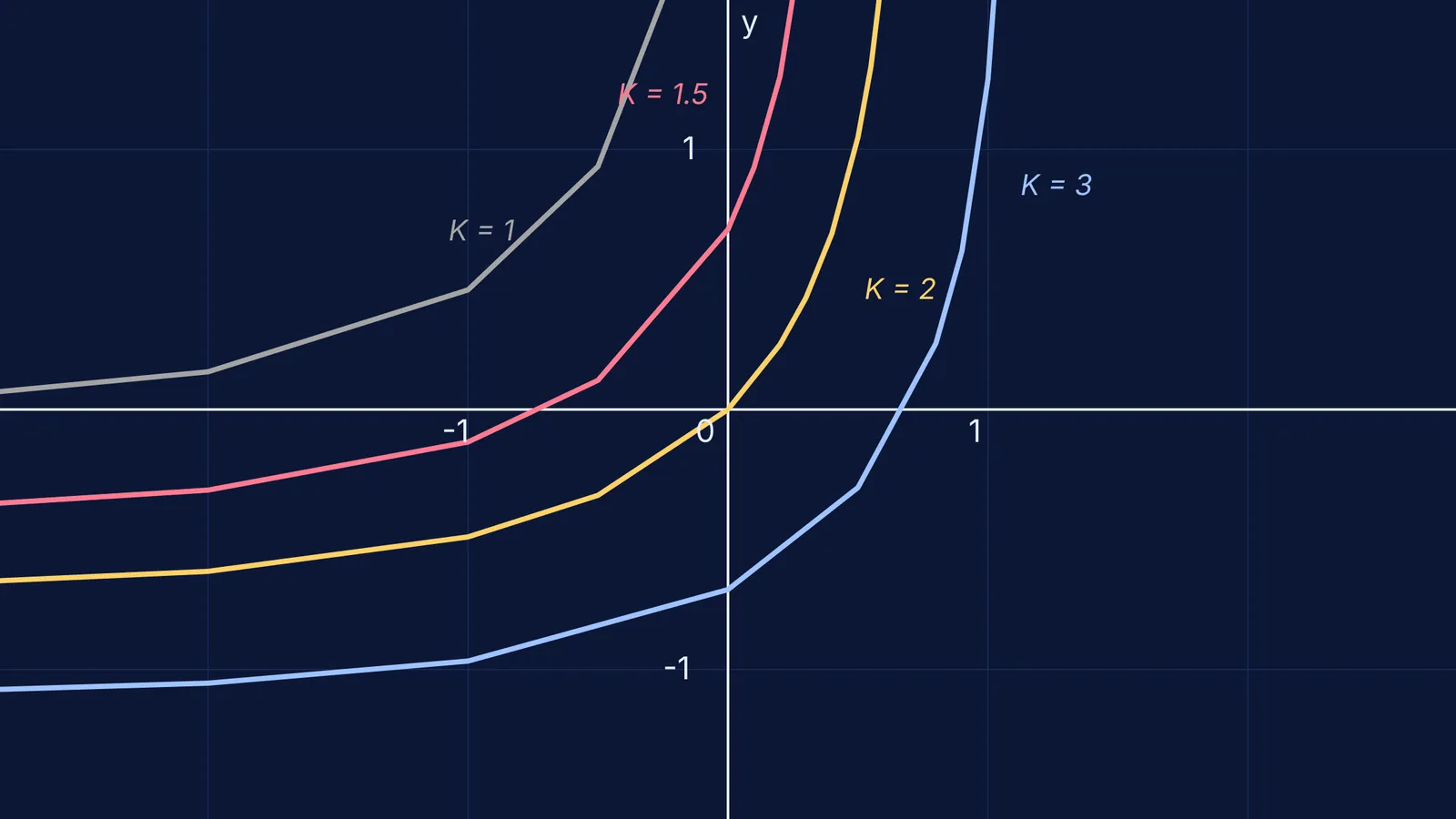
Since C is an arbitrary constant, −C is also an arbitrary constant. It is standard practice to rename −C as a new constant; let's call it K. e⁻ʸ = K − eˣ
Now, take the natural logarithm (ln) of both sides to extract −y: −y = ln(K − eˣ)
Finally, multiply by −1: y = −ln(K − eˣ)
This is the general solution. Notice that the solution is only defined when the expression inside the logarithm is positive (K − eˣ > 0), which restricts the domain based on the value of K.
How do you find a specific solution?
If you are given an initial condition, you can substitute it into the general solution to find the exact value of K.
Let's find the specific solution for the initial condition y(0) = 0. Substitute x = 0 and y = 0 into the general solution: 0 = −ln(K − e⁰)
Since e⁰ = 1, this simplifies to: 0 = −ln(K − 1)
For the natural logarithm to equal zero, the argument must be 1: K − 1 = 1 K = 2
Substitute K = 2 back into the general solution to get the final answer: y = −ln(2 − eˣ)
Recognizing when to use exponent rules to separate variables takes practice. If you find yourself staring at an unfamiliar equation and not knowing where to start, the Fermi Problem Library has worked problems with a step-by-step solver that explains the reasoning rather than printing an answer.
For related techniques, reviewing how to handle homogeneous differential equations or differentiating one expression with respect to another can build your intuition for calculus substitutions.


