

On this page
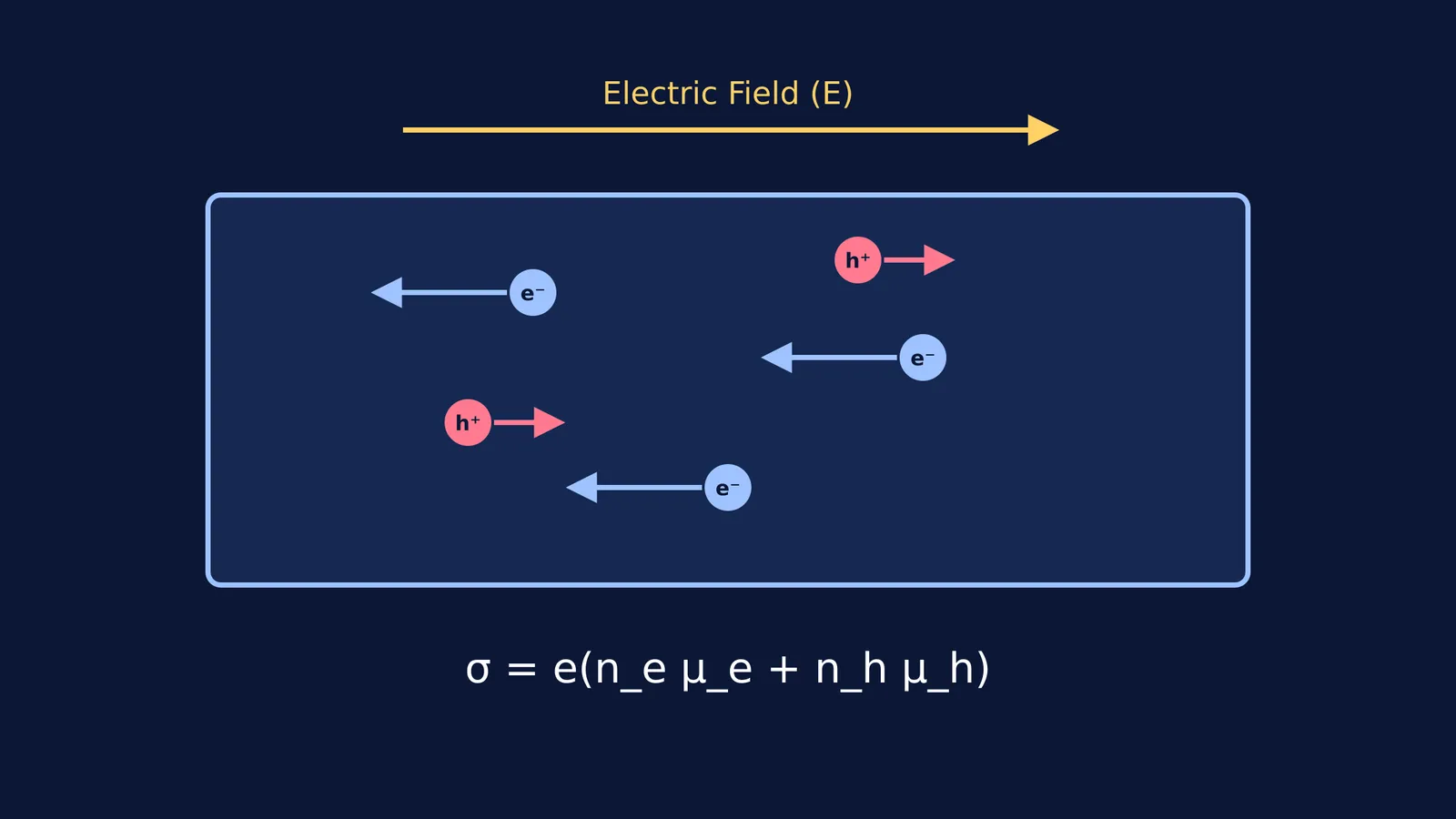
In a semiconductor, current is carried not just by negative electrons, but also by positive holes. To find how well the material conducts electricity, you have to account for both.
What is the conductivity of semiconductor formula?
The total conductivity σ (sigma) of a semiconductor is the sum of the conductivity from both of its charge carriers. The formula is:
σ = e(n_e μ_e + n_h μ_h)
Here is what each term means:
σ is the total conductivity, measured in S/m (Siemens per metre) or Ω⁻¹m⁻¹.
e is the elementary charge (1.6 × 10⁻¹⁹ C).
n_e and n_h are the concentrations of free electrons and holes (number per cubic metre).
μ_e and μ_h are the mobilities of the electrons and holes.
According to the NCERT Class 12 Physics syllabus, pure (intrinsic) silicon at room temperature has an intrinsic carrier concentration (n_i) of 1.5 × 10¹⁶ m⁻³ (Source). In this pure state, electrons and holes exist in exactly equal numbers (n_e = n_h = n_i). The resulting intrinsic conductivity is extremely low—only around 4.4 × 10⁻⁴ S/m—which is why pure silicon is not a practical conductor for everyday electronics. To make silicon useful, we must intentionally introduce impurities, a process known as doping, to dramatically increase either the electron or hole concentration.
What is electron and hole mobility?
Mobility (μ) measures how quickly a charge carrier drifts through a material when an electric field is applied. It depends on how easily the carrier can move without scattering off atoms in the crystal lattice.
In silicon, electrons are substantially more mobile than holes. The standard NCERT values at 300 K are (Source):
Electron mobility (μ_e): 0.135 m² V⁻¹ s⁻¹
Hole mobility (μ_h): 0.048 m² V⁻¹ s⁻¹
Because electrons move freely through the conduction band while holes move by hopping between bonds in the valence band (as explained in our guide to Energy bands: conductors, semiconductors and insulators compared), the electron mobility is nearly three times higher. This physical difference explains why n-type semiconductors, which rely on electrons, are often preferred over p-type semiconductors in high-speed electronic devices. The faster the carriers can drift, the more rapidly the device can switch on and off.
How do you calculate conductivity in doped silicon?
When you dope silicon to make it an extrinsic semiconductor, one carrier type vastly outnumbers the other. (See n-type and p-type semiconductors: carrier concentration problems for more on finding these exact numbers). Let us look at a worked example for an n-type semiconductor where the electron term dominates.
As per NCERT examples (Source), suppose you dope a silicon crystal with phosphorus to a donor concentration of 10²² atoms per cubic metre. Phosphorus is a pentavalent impurity, meaning each phosphorus atom donates one free electron to the crystal lattice.
Find the majority carriers: At room temperature, the thermal energy is enough to ionise almost all the donor atoms. The electron concentration n_e is roughly equal to the donor concentration, so n_e ≈ 10²² m⁻³.
Find the minority carriers: Using the mass action law (n_e n_h = n_i²), we can find the hole concentration. The holes drop to just 2.25 × 10¹⁰ m⁻³.
Apply the formula:
σ = 1.6 × 10⁻¹⁹ (10²² × 0.135 + 2.25 × 10¹⁰ × 0.048)
Notice that the hole term in the brackets (2.25 × 10¹⁰ × 0.048 ≈ 1.08 × 10⁹) is entirely dwarfed by the electron term (1.35 × 10²¹). The difference is so vast—a factor of a trillion—that we can safely ignore the holes. For all practical calculations, we drop the minority carrier term entirely:
σ ≈ e n_e μ_e σ = (1.6 × 10⁻¹⁹) × (10²²) × 0.135 σ = 216 S/m
This simple approximation is often the fastest route to solving numericals on tests like JEE Main or NEET-UG. You only need to know the concentration and mobility of the majority carrier. Understanding this baseline formula is the first step towards analyzing more complex circuits, such as those covered in Semiconductors, diodes and logic gates: a board and NEET guide.
If you are stuck on similar physics problems, the Fermi Concept Library can help you break down the principles of semiconductors, while Fermi's AI tutor walks you through the step-by-step logic of identifying the dominant carriers in doped materials.


